Students are building in Waterloo with ambition and energy
Waterloo Tech Week and Hack the North shine a light on the local tech ecosystem boosting Canada’s competitive edge
University of Waterloo students put the city on the map last week with two stand-out events, Waterloo Tech Week and Hack the North. Both showcased the dynamic Waterloo tech ecosystem and its entrepreneurial energy, bringing together business founders, talent spotters, students, startups, venture capitalists and hackers from around the world.
Now in its 13th year, Hack the North, Canada’s largest student-led hackathon, welcomed more than 1,000 hackers who spent 36 straight hours building, collaborating and connecting with peers and industry. Building on the success and spirit of Hack the North, the student organizing team launched Waterloo Tech Week in 2025, creating an event that is open to anyone interested in connecting with the startup community in the Waterloo Region.
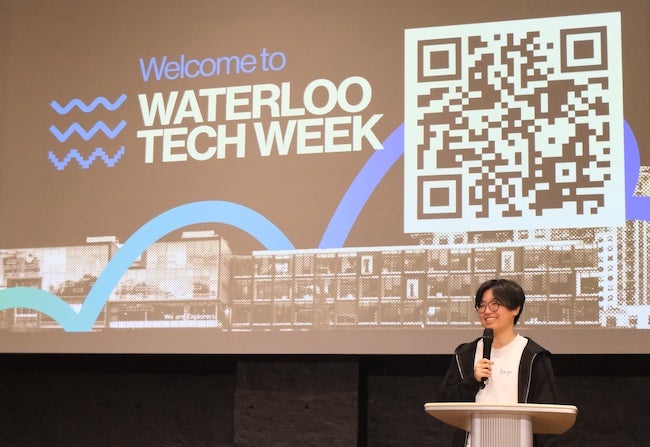
"The two events share the same mission to help people dream big and build even bigger," says Maggie Lu, Waterloo Tech Week team lead and Computing and Financial Management student.
"We see great connections being made at both Hack the North and Waterloo Tech Week and we hope people stay in touch, keep sharing ideas and go on to build things together. That's the spirit that makes Waterloo the place to be in Canada for founders, startups and tech talent."
Pitchbook’s recent 2026 University Rankings support Lu’s assertion, recognizing Waterloo as the top institution in Canada — and the seventh in the world — for producing undergraduate entrepreneurs.
Stay and build in Canada
Building on the momentum of the two events, the Faculty of Engineering hosted a panel discussion with alumni Michael Litt (BASc ’10), co-founder of Vidyard and Garage Capital, and Jocelyne Murphy (BASc ’25), co-founder of Wygo, with Chris Albinson, Managing Partner of True North Fund, in conversation with Professor Chris Holt of the Conrad School of Entrepreneurship and Business. The message from all three panellists was the same — Waterloo's density of talent and its founder network are assets that are hard to replicate anywhere else, including Silicon Valley.

Chris Albinson, True North Fund; Chris Holt, Conrad School of Entrepreneurship and Business; Michael Litt, Vidyard & Garage Capital; Jocelyne Murphy, Wygo.
Albinson spent two decades in Silicon Valley before returning to Canada to run Communitech and later co-found True North Fund in Waterloo. About the University he says, “This is the most diverse campus doing the most interesting things on the planet with the most ambition. If you can bring the smartest people in the world into one place and build, it's amazing. It is so powerful, and there's not another place anywhere you can do that right now.”
Litt, a Systems Design Engineering graduate, started Vidyard, an AI-powered video messaging and hosting platform, as a fourth-year capstone design project. The company went through Y Combinator in 2011 and was well on its way to become another Silicon Valley startup. But, at a time when conventional wisdom held that building outside Silicon Valley meant losing, Litt decided to bring the business home.
“Waterloo has this really sticky foundation of awesome people and the student pipeline,” Litt says. “You get access to real-world problems on a consistent basis through co-op and get to work with people you can potentially found and build companies with.”
Murphy built Wygo — a platform that helps community organizers build sustainable businesses and nonprofits — during her undergraduate degree in Systems Design Engineering.
She and her co-founder Chris Oka (BASc '25) have since gone on to raise over $1.5 million from an all-Canadian team of investors including Garage Capital and Shopify CEO Tobi Lutke. Murphy credits the University’s Conrad School of Entrepreneurship and Business’ Enterprise Co-op (E Co-op) program, the Pearl Sullivan Scholarship for Community Leadership and Waterloo’s Accelerator Centre with giving her team the financial freedom to establish Wygo's foundations before raising venture capital. Wygo was the official platform powering this year’s Waterloo Tech Week.
“Ahead of fundraising I urge you to build community, meet everybody and give more than you’re asking for,” Murphy says. “I think the people in Canada really want to see other Canadians win, and they'll reach down and pull you up.”
The power of play and connection
On the back of the successes of Hack the North and Waterloo Tech Week, the student organizing team is proud of how both events are bringing together people who want to learn from their peers and founders, build something useful, experiment with wonderfully weird ideas and have fun doing it.
Highlights from this year’s Hack the North include keynote speaker Erik Bernhardsson, co-founder and CEO of Modal; the custom-built electronic hacker badges for easy networking and access to panels and food; and 353 projects spanning software, robotics, health care, economics and more — from a face-punching simulator to a multiplayer game built with the hacker badge. Just two years in, Waterloo Tech Week has made a name for itself, and the team plans to build on that energy to welcome and connect more people at future events and create more opportunities for the community.
"Waterloo gathers such a large concentration of people who are really excited to build something,” says Megan Chun, co-director of Hack the North and Computer Engineering student. “As a student, you’re surrounded by action and it feels like you’re on the cutting edge of innovation... it's the general excitement to make things happen that makes this such a great place to be."