Researchers have created a 3D-printed electrode that could help make it easier and safer to store large amounts of renewable energy generated by wind and solar farms.
Led by University of Waterloo professor Dr. Maxime van der Heijden, the research team drew inspiration from natural structures to redesign a key component of redox flow batteries (RFBs), a technology that can store electricity for later use. The new design helps battery liquid move more efficiently, allowing the chemical reactions that store and release energy to occur more effectively.
Redox flow batteries work differently from the lithium-ion batteries commonly found in phones, electric vehicles and many energy-storage systems.
These batteries use water-based electrolytes rather than the flammable materials found in lithium-ion batteries, making them a potentially safer alternative for large-scale energy storage.
Redox flow batteries are a complementary technology to lithium-ion batteries for large -scale energy storage applications. Their water-based electrolytes make them a safer option for storing renewable energy at the scale needed to supply, for example, communities and the electrical grid with continuous renewable energy.
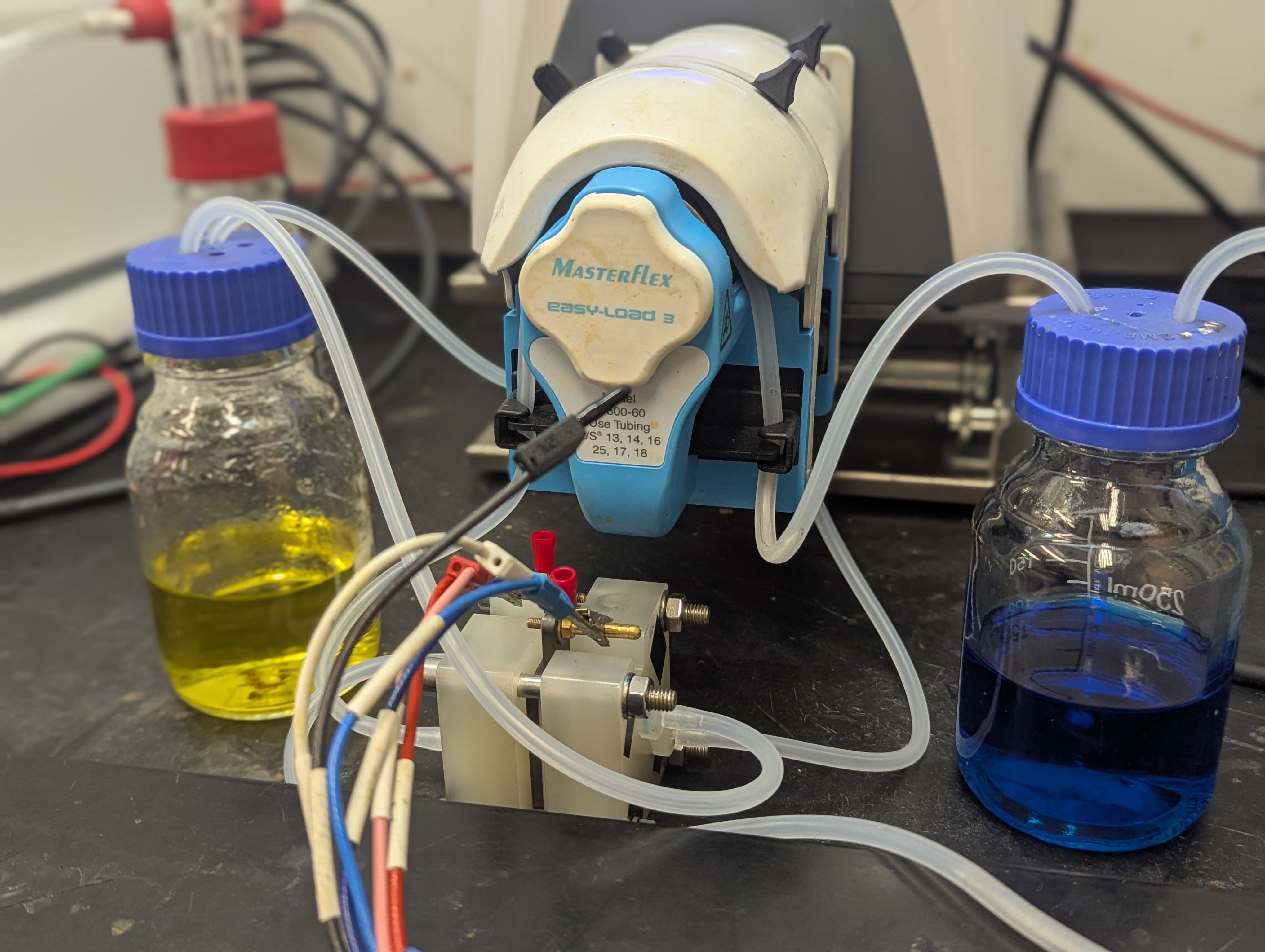
The redox flow battery setup consists of a reactor connected to two beakers that serve as electrolyte tanks, with tubing running through a pump to circulate the liquid electrolytes through the battery. The redox flow battery is connected to a potentiostat, which collects and records the energy generated by the battery (University of Waterloo).
“Instead of storing energy in solid materials, they store energy in liquid electrolytes held in external tanks,” said van der Heijden, a chemical engineering professor at Waterloo. “The amount of stored energy can be increased simply by using larger tanks, making them well-suited for large-scale renewable energy storage and grid applications.”
That flexibility could become increasingly important as more electricity comes from renewable sources. Wind and solar power are intermittent, as they do not always produce electricity when it is needed, creating a need for technologies that can store excess energy and return it to the grid later.
Researchers used 3D printing to create porous RFB electrodes, enabling precise control over their structure and fluid flow.
“With 3D printing, we can design the internal structure of an electrode in ways that are difficult to achieve using conventional manufacturing,” said van der Heijden. “That gives us much greater control over how the liquid moves through the battery and reaches the surfaces where the energy-storing reactions take place.”
A key innovation was the use of triply periodic minimal surface (TPMS) geometries, complex, repeating three-dimensional shapes that can resemble structures found in nature.
The researchers tested several TPMS designs and found that one known as the “diamond” geometry worked best, increasing performance by 52 per cent.
They then used a digital light-processing 3D printer to produce the porous structures, which were heat-treated to form conductive carbon electrodes capable of carrying electricity.
The team successfully tested the electrodes in laboratory flow cell experiments and in a working vanadium redox flow battery, demonstrating that the 3D-printed designs can function in an operating battery. The proof of concept could help pave the way for more efficient redox flow batteries designed for large-scale energy storage.
Future research will focus on increasing the electrodes’ surface area, improving manufacturing methods and exploring advanced design tools to create even more effective electrode structures.
The study, Enhancing Mass Transport in Redox Flow Batteries with 3D-Printed Triply Periodic Minimal Surface Electrode Structures, appears in the Journal of Energy Storage.