Quantum-Nano Revolution

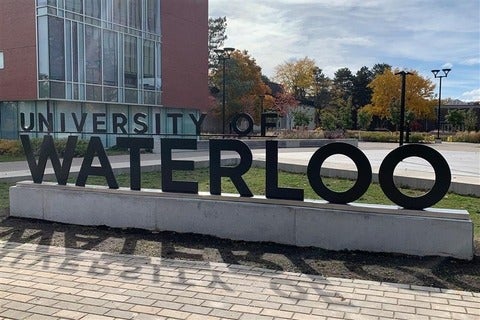
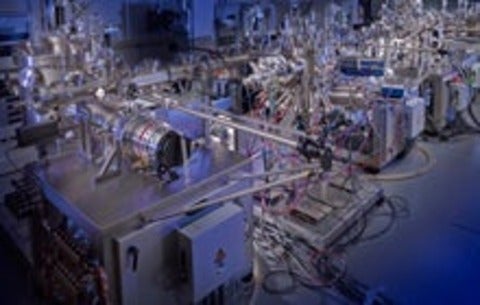
Opened in 2012, the Mike and Ophelia Lazaridis Quantum-Nano Centre offers some of the world’s most sophisticated laboratories for quantum science and nanotechnology research. Quantum research at Waterloo has the potential to change the way we share and secure information, and nanotechnology discoveries will influence everything from human health to alternative energy. These innovations include advances in cryptography that will keep our digital information safer and nano-materials than can help clean water.

Tuesday, March 18, 2014

Waterloo, Technion partner to advance research, commercialization

by Staff, Marketing and Strategic Communications

Two of the world’s top innovation universities hope to accelerate breakthroughs in research and commercialization with a new agreement signed during a joint conference in Israel on March 18.

The agreement between the University of Waterloo and Technion-Israel Institute of Technology brings together some of the top minds in quantum information science, nanotechnology and water for pure and applied research. Research in these important areas has the potential to:

·       improve human health

Tuesday, February 18, 2014

Physics prof awarded prestigious Sloan Research Fellowship

by Katharine Tuerke, Faculty of Science

A Waterloo physicist whose theoretical research has resulted in a better understanding of the thinnest - yet one of the strongest materials known to man - has been awarded a prestigious fellowship from the Alfred P. Sloan Foundation.

Dmitry Abanin is the recipient of a Sloan Research Fellowship – an award given annually to promising scientists, mathematicians and economists from Canada and the United States who are at an early stage in their careers.

Monday, February 17, 2014

Leading the quantum revolution

by Staff, Marketing and Strategic Communications

Once considered a technology of tomorrow, quantum devices are transforming fields including communication, research and geological exploration in the here and now.

New technologies that operate according to the laws of quantum mechanics, are rapidly moving from the laboratory to the marketplace. The real-world application of quantum devices was the subject of a University of Waterloo-led symposium on Sunday at an international meeting of scientists, policymakers and science media in Chicago, IL.

Friday, February 14, 2014

Institute for Quantum Computing continues rapid growth

by Media Relations

The University of Waterloo’s Institute for Quantum Computing (IQC) has added renowned physicist Raffi Budakian, Michal Bajcsy and Kyung Soo Choi to grow its faculty complement to 21.

The Institute for Quantum Computing, which was recently allotted an additional $15 million funding by the Government of Canada, continues to grow towards its target of 33 faculty, 55 postdoctoral fellows and 165 graduate students.

Wednesday, February 12, 2014

When should innovation take an ethical pause?

by Suzanne Bowness, Marketing and Strategic Communications

Is a biologist experimenting with potentially deadly pathogens responsible for thinking about where those viruses might end up? Should a computer programmer worry about her code being hijacked and used maliciously by hackers?

Heather Douglas
At what point, if any, should scientists enlist experts from the social sciences to help grapple with these moral dilemmas?

Tuesday, February 11, 2014

Federal budget supports quantum research at Waterloo

by Media Relations

The University of Waterloo thanks the Government of Canada for renewing its support for the Institute for Quantum Computing (IQC).

Economic Action Plan 2014 announced today allots a further $15 million to IQC over three years.

"With this federal support, IQC and the University of Waterloo can help Canada lead the world in quantum research and in developing the new companies that will build the quantum information science industry," said Feridun Hamdullahpur, president and vice-chancellor of Waterloo.

Thursday, December 12, 2013

Researchers will grow quantum materials in new Waterloo lab

by Tobi Day-Hamilton, Institute for Quantum Computing

Researchers will create quantum materials that could lead to the development of the first quantum computer in a new laboratory at the University of Waterloo’s Institute for Quantum Computing (IQC.)

The lab houses a unique deposition tool to grow materials that could form the building blocks of quantum technologies. Deposition systems ‘deposit’ layers of materials, a nanometer to several micrometers thick, to create materials for use in a wide range of technologies.

Quantum materials are building blocks