
Friday, December 19, 2014
Quantum physics breakthrough: Scientists solve 100-year-old puzzle

Opened in 2012, the Mike and Ophelia Lazaridis Quantum-Nano Centre offers some of the world’s most sophisticated laboratories for quantum science and nanotechnology research. Quantum research at Waterloo has the potential to change the way we share and secure information, and nanotechnology discoveries will influence everything from human health to alternative energy. These innovations include advances in cryptography that will keep our digital information safer and nano-materials than can help clean water.
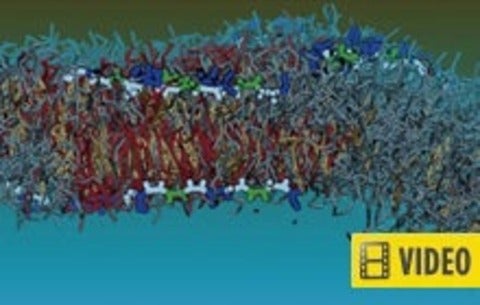
Researchers based at the University of Waterloo have won two of five prestigious Polanyi Prizes given to leading researchers in Ontario this year.
Drew Bennett, a post-doctoral researcher in the Department of Chemistry, is being honoured for groundbreaking research that may improve treatment for serious diseases like cancer and Parkinson’s. He uses computer simulations to study biological problems.
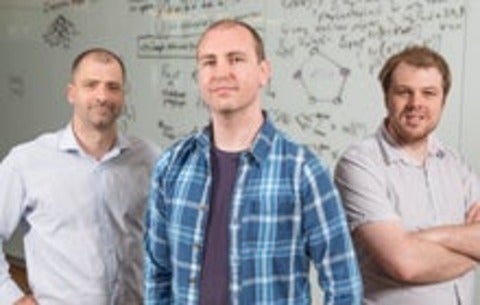
A form of quantum “weirdness” has been found, by researchers at Waterloo’s Institute for Quantum Computing (IQC), to be a key ingredient for building a quantum computer.
In a paper published in the journal Nature, IQC researchers have shown that quantum contextuality is a necessary resource to achieve the “magic” required for universal quantum computation.
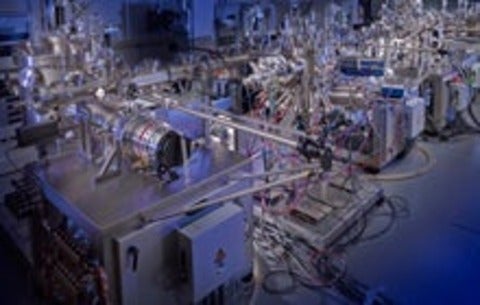
A state-of-the-art lab that will support research programs ranging from photonics to quantum computing to nanoelectronics will open at the University of Waterloo today.
The Molecular Beam Epitaxy (MBE) facility is a high-end research and development lab with production capabilities. It will produce compound semiconductor materials. MBE is now a fundamentally important tool for the fabrication of semiconductor devices for cell phones, solar cells and light-emitting diodes (LED).
Date: Wednesday, June 4, 2014
The Province of Ontario renewed its investment in world leading quantum technology research today allotting $25 million to the Institute for Quantum Computing at the University of Waterloo over five years.
“We are extremely grateful that the Province of Ontario continues to create the conditions for Ontario, and Canada, to lead the world in quantum information research," said Feridun Hamdullahpur, president and vice-chancellor of Waterloo.

A University of Waterloo delegation, led by the president and vice-chancellor of the University, is in China this week to strengthen relationships with leading Chinese universities. Feridun Hamdullahpur will meet with representatives from five of China’s top universities:
Hamdullahpur will also learn more about China’s education policy through meetings with representatives of the Ministry of Education.

On April 14 and 15, the University of Waterloo will be at the centre of a global innovation conversation during the Waterloo Innovation Summit held on campus.
Watch the summit online and join the conversation April 14 at 1:00 p.m. and April 15, at 9:00 a.m..
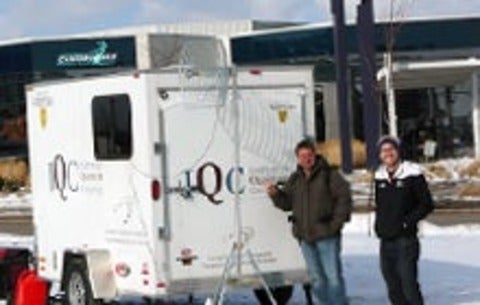
In the world of quantum communications, researchers use names like Alice, Bob and Charlie to help them communicate their complex theories. Alice and Bob have been communicating for years. Charlie joined the conversation a few years ago.
Physicists are one step closer to developing the world’s first room-temperature superconductor thanks to a new theory from the University of Waterloo, Harvard University and the Perimeter Institute.
The theory explains the transition phase - known as the pseudogap phase - to superconductivity. It’s one of the last obstacles to developing the next generation of superconductors and one of the major unsolved problems of theoretical condensed matter physics.