Uniting science and art through STEAM education
While it is often believed that art and science fall on opposite sides of the left- and right-brain divide, history sho
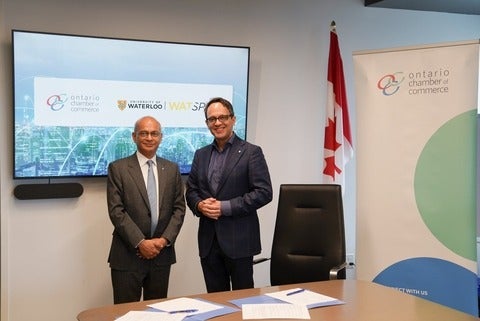
The Ontario Chamber of Commerce (OCC) launched its new AI Hub on Wednesday with the University of Waterloo’s WatSPEED professional and executive education unit selected as an anchor partner to help strengthen the province’s role as a leader in AI adoption.
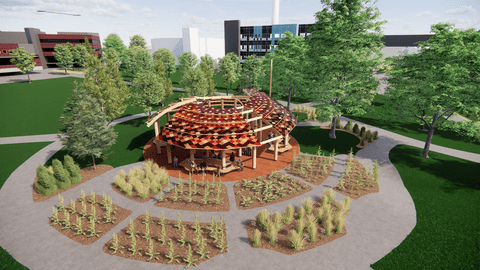
This fall, students, faculty and staff at the main campus of the University of Waterloo will have a new outdoor space for teaching, celebrating and bringing awareness about Indigenous peoples and cultural practices.
The University recently broke ground on the gathering space, which will be used for First Nations, Métis and Inuit-led events, celebrations and gatherings. The space will also be available as an outdoor classroom to anyone educating on First Nations, Métis and Inuit content.
For people who have been taking multiple medications for years, or those taking medication which can cause withdrawal or rebound symptoms, the notion of deprescribing can be scary, even if it may improve their health and well-being.
For Frank Cairo (BES ’05), investing in new approaches to planning and building cities isn’t a choice — it’s a necessity.
“We're facing complex challenges. From the rising cost of housing to aging infrastructure and environmental impact. We need new thinking, across a variety of disciplines to tackle these problems through innovation and the scientific method.”
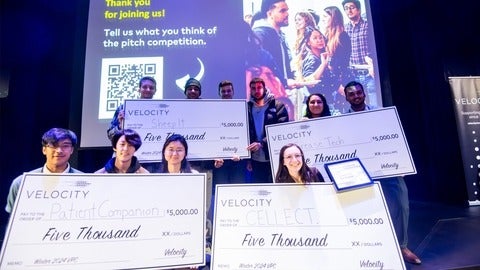
The Winter 2024 Velocity Pitch Competition saw a big turnout, attracting more than 100 student applications from campus. Narrowing down from a competitive initial pool, 26 teams emerged to compete in the semi-finals, leading to the final showdown of eight standout finalists.
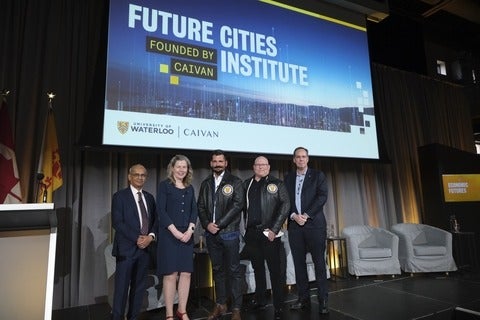
Thanks to a transformational $10 million donation from Caivan Group (Caivan), one of Canada’s leading real estate developers, co-founded by Waterloo alumni Frank Cairo (BES ’05) and Troy van Haastrecht (BASc ’93), the University has embarked on a bold new mission to create healthier, more prosperous cities with the launch of the Future Cities Institute founded by CAIVAN (FCI).
On April 8, 2024, sky gazers and astronomy enthusiasts in southern Ontario will be treated to a spectacular once-in-a-lifetime event — a total solar eclipse. This rare marvel occurs when the Moon completely covers the Sun, sweeping a shadow over us to reveal a mesmerizing solar corona.
We recently asked Dr. Roan Haggar, a postdoctoral fellow and the outreach co-ordinator for the Waterloo Centre for Astrophysics (WCA) at the University of Waterloo, to share the science behind the solar eclipse so we can better understand this phenomenon as it passes over us.
The University of Waterloo and Ontario land development and homebuilding company The Caivan Group (Caivan) are launching the Future Cities Institute (FCI) thanks to a transformational $10-million commitment from Caivan. The Institute will bring together some of the top minds in the country and provide the resources they need to tackle the greatest challenges facing urban spaces now, and in the future.
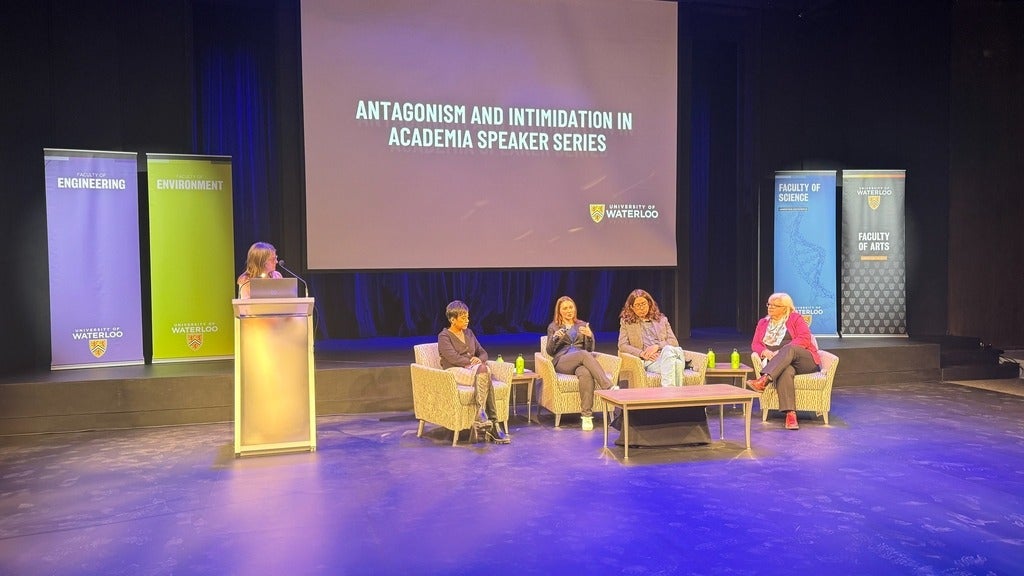
Climate change is real and human activity contributes to the problem. For most, this statement is undisputed. With an increase in forest fires, unusual weather patterns and drought, it’s hard to not acknowledge the changes around us. For environmental researchers, it’s a passion, a question, a problem to better understand, and something we can help mitigate. Yet, climate science researchers experience hostility, aggression and opposition.