Reshaping health care with AI innovations
On June 12, WatSPEED convened senior health care leaders and executives to explore the transformational potential of artificial intelligence (AI) in enhancing Canadian health care services.
Waterloo researchers, students and alumni approach challenges differently. They unlock barriers by working together to develop creative approaches across disciplines. The futures they are transforming are not independent islands but an interconnected landscape of opportunities representing a path for Waterloo to foster lasting, impactful global change.
Researchers at two Ontario universities have developed a pain-free, wearable sensor that can continuously monitor levels of blood sugar, lactates and other critical health indicators for weeks at a time, sending results to a smartphone or other device.
The Wearable Aptalyzer, created by a team featuring researchers from McMaster University and the University of Waterloo, uses an array of tiny hydrogel needles that penetrate just deeply enough to reach the interstitial fluid beneath the skin, but not far enough to reach the blood vessels or nerves.

Spring 2024 Convocation ceremonies saw family, friends, staff and faculty come together to recognize students for their hard work and perseverance during some of the world’s most challenging circumstances.
For five consecutive days, across 14 ceremonies, Waterloo’s campus was full of beaming pride and jubilation. The 128th convocation was made even more special with the University officially ushering its 250,000th graduate across the stage. This major milestone was achieved during the Faculty of Arts ceremony on Thursday, June 13.
When Raven Sim receives her degree this June, it will mean the fulfilment of a long-held ambition. "I’ve known I wanted to be at Waterloo for computer engineering since Grade 4" Sim says. Her interest in the subject was ignited during an engineering summer camp and was later cemented when she learned about Waterloo’s co-op program.
Paralympic athlete and Canadian icon Rick Hansen offers an inspiring lecture, sharing the highs and lows of his incredible journey in accessibility.
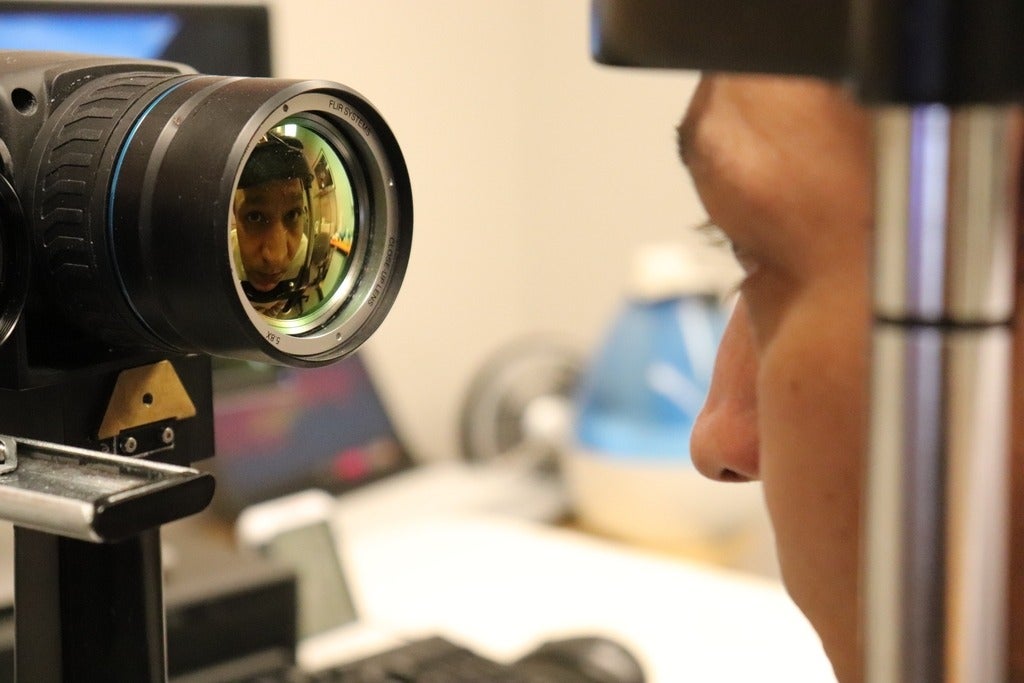
Taking your temperature can often help a healthcare practitioner figure out if you’re sick. A new University of Waterloo spinoff company aims to do something similar with your eyes.
ThermOcular AI, a company started by Waterloo vision science and engineering researchers, aims to bring a patented thermal imaging system to market that can measure in detail the temperature of the cornea, the transparent part of the eye that domes over the iris and pupil. The novel device could be used to screen for dry eye and potentially other ocular diseases.
Sukhu plans to pursue a career as a police officer with the Waterloo Regional Police Service following graduation.
The University of Waterloo has broken ground on the Waterloo Eye Institute (WEI), the School of Optometry and Vision Science’s new centre of excellence in vision research, optometric education and patient care.
The journey to completing a PhD is not always smooth nor linear. Beyond the intellectual rigour of coursework and research papers, pursuing a PhD requires unconventional and, at times, interdisciplinary thinking.
Through the years of pursuing a doctoral degree, candidates’ critical research helps to unlock conventional barriers by developing new and creative approaches to tackling complex problems.
Waterloo PhD graduates undertake ground-breaking research projects that can often have global impact and lead to a healthier, more sustainable future.