Health Futures

Thursday, November 9, 2023

A better way to heal damaged muscle

by Media Relations

People who have experienced significant muscle damage have new hope thanks to Evolved.Bio, a startup that has developed innovative technology that can regenerate muscle tissue in a highly effective way.  

Other biotech companies use natural or synthetic materials along with cells to create in vitro-grown tissue replacements, building blocks that can be implanted into the human body. But a patient’s body might register these as foreign objects, leading to medical complications or interference with the body’s natural healing process. 

Monday, November 6, 2023

Helping refugees and newcomers see

by Karen Kawawada, School of Optometry & Vision Science

There was the young woman who’d suffered an eye injury in an attack and was left with only one functioning eye. The man who had low vision due to blunt force trauma and was desperate to find ways of coping so he could work. The teenager who’d been using a pair of glasses several years old despite her sight having worsened significantly since the last time she’d been able to get an eye exam.

Friday, November 3, 2023

Leveraging technology to improve tuberculosis health care

by Angelica Marie Sanchez, University Relations

Every year, around 10 million people contract tuberculosis (TB) — a treatable disease where bacteria attack a patient’s lungs. Globally, only about half of those who contract TB yearly are diagnosed. Many other people with TB are undiagnosed and untreated, partly due to a lack of access to quality health-care systems, particularly in resource-limited settings and among marginalized groups.  
Wednesday, November 1, 2023

Prize-winning research aims to better treat eye diseases

by Karen Kawawada, School of Optometry and Vision Science

An interdisciplinary, multi-institutional team with a University of Waterloo professor as a core member, has been named the winner of the prestigious Brockhouse Canada Prize for Interdisciplinary Research in Science and Engineering on November 1st. 

Tuesday, October 31, 2023

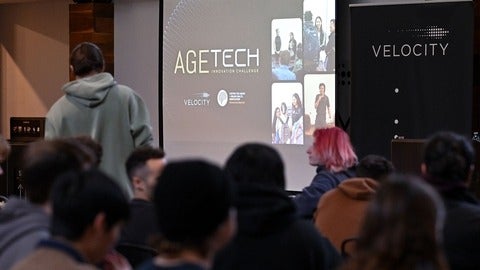
Shaping tomorrow's aging solutions

by Jordan Flemming, University Relations

According to the World Health Organization, by 2050, those aged 60 years and older will number approximately 2 billion, a significant rise from 900 million in 2015. In response to the aging global population, health-care systems confront the immense challenge of catering to the requirements of older adults, presenting challenges for individuals, health-care providers, caregivers and the institutions serving them.

Friday, October 27, 2023

A model for northern eye care

by Karen Kawawada, School of Optometry and Vision Science

It’s cold outside but the view of Hudson’s Bay is beautiful from the Churchill Health Centre (CHC), where dozens of patients got their eyes examined this week, some for the first time in years, thanks to state-of-the art equipment donated through the University of Waterloo School of Optometry & Vision Science.  

The eye clinic, which took place from October 23 to 25 in the northern Manitoba town of about 900 people, was the first to pilot an initiative co-led by the School, the Manitoba Association of Optometrists (MAO) and the CHC. 

Wednesday, October 25, 2023

Setting standards and unlocking the potential of synthetic data in health research

by Jordan Flemming, University Relations

At the intersection of data privacy, open science and public health, the University of Waterloo has initiated a collaborative effort with several Canadian government agencies to explore the use of synthetic data for research and analysis.

Dr. Helen Chen, a professor in the Faculty of Health and director of the Professional Practice Centre in Health Systems is leading the initiative.

Monday, October 23, 2023

Plant-based isn't just about burgers anymore

by Media Relations

A team of University of Waterloo researchers has created smart, advanced materials that will be the building blocks for a future generation of soft medical microrobots.

These tiny robots have the potential to conduct medical procedures, such as biopsy, and cell and tissue transport, in a minimally invasive fashion. They can move through confined and flooded environments, like the human body, and deliver delicate and light cargo, such as cells or tissues, to a target position.

An international team of interdisciplinary researchers has successfully created a method for better 3D modelling of complex cancers.

The University of Waterloo-based team combined cutting-edge bioprinting techniques with synthetic structures or microfluidic chips. The method will help lab researchers more accurately understand heterogeneous tumours: tumours with more than one kind of cancer cell, often dispersed in unpredictable patterns.