Health Futures

Wednesday, May 17, 2023

Students design solutions for the local health-care system

by Angelica Marie Sanchez, University Relations

On May 16, Velocity kicked-off a partnership with the Grand River Hospital Foundation (GRHF) as part of their Care Never Stops campaign by presenting the Health Innovation Challenge.  The student hack-a-thon with a twist provides an opportunity for University of Waterloo students to take part in designing solutions to health care challenges being experienced within our local c

Monday, April 17, 2023

Q and A with the experts: World Hemophilia Day

by Media Relations

Today is World Hemophilia Day under the theme ‘Access for all: prevention of bleeds as the global standard of care’. Dr. Andrea Edginton, Hallman Director at the University of Waterloo School of Pharmacy, uses her research to help pharmacists, doctors and nurses manage treatment for hemophilia patients that has, in turn, helped these patients lead a better quality of life.

What is hemophilia?

Monday, April 17, 2023

Keep Your Head Up

by Angelica Marie Sanchez (BA ’21), Waterloo Magazine

Athletes are often at risk of experiencing sports-related concussions — a type of traumatic brain injury (TBI) that can result in temporary or persistent symptoms and can have a lasting impact beyond physical symptoms.

In 2011, Felicia Corrado (BPH ’19) sustained a concussion during a ringette game. She had persistent symptoms: chronic headaches, nausea, light sensitivity and ringing in her ears. Corrado had difficulty going through the recovery journey on her own, where her symptoms resulted in multiple stressors in her life.

Tuesday, March 28, 2023

Inspiring the next generation of pharmacists

by Milana Madzarac, School of Pharmacy

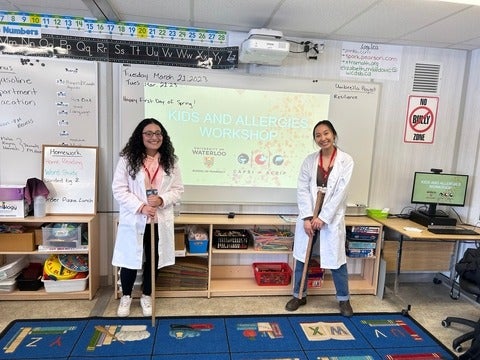
Every March since 2016, students from Waterloo’s School of Pharmacy have been volunteering and visiting Region of Waterloo schools to educate the younger generation on what pharmacists do during Pharmacy Appreciation Month (PAM).

This year during PAM, 30 pharmacy students volunteered and presented to more than 400 elementary students across nine schools in the region.

Tuesday, March 28, 2023

AI in health care challenges us to define what better, people-centred care looks like

by Catherine Burns, Health Initiatives, Office of Research

From faster and more accurate disease diagnosis to models of using health care resources more efficiently, AI promises a new frontier of effective and efficient health care. If it’s done right, AI may allow for more people-centred care and for clinicians to spend more time with people, doing the work they enjoy most. But to achieve these aspirations, foundational work must occur in how we operate today and in defining what health care looks like in the future.

Tuesday, March 28, 2023

The importance of knowledge translation in health care

by Milana Madzarac, School of Pharmacy

In an age of misinformation, knowledge translation (KT) is an increasingly important way to communicate research to the audiences who need it.

Knowledge translation links the creation of knowledge from research areas to real-world situations. With increased specialization and the level of disciplinary-specific training required to engage with research findings, KT is a purposeful approach to bridging communication gaps between disciplines and with public audiences.

Thursday, March 23, 2023

New in-home AI tool monitors the health of elderly residents

by Media Relations

Engineers are harnessing artificial intelligence (AI) and wireless technology to unobtrusively monitor elderly people in their living spaces and provide early detection of emerging health problems.

The new system, built by researchers at the University of Waterloo, follows an individual’s activities accurately and continuously as it gathers vital information without the need for a wearable device and alerts medical experts to the need to step in and provide help.

Monday, March 13, 2023

Velocity company Vessl Prosthetics sees inclusion as key to product design

by Jon Parsons, University Relations

A Velocity health-technology startup is designing a new kind of self-adjusting socket for prosthetics.

The company, Vessl Prosthetics, identified a common concern for many amputees who use prostheses – poor socket fit. As Vessl’s CEO and co-founder Sydney Robinson explains, the limb inside the prosthetic can shrink throughout the day. For many amputees, that can mean a poor fit and discomfort.