Awards, Honours and Rankings
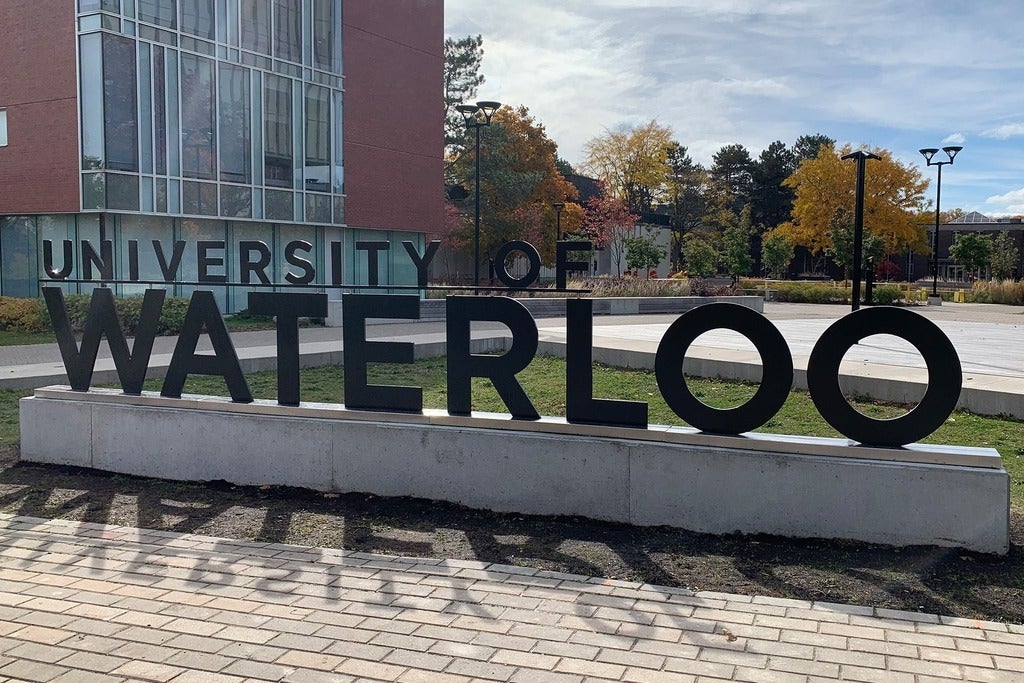
Seven subjects at the University of Waterloo rank among the top 100 universities in the world, according to results published today.
The rankings, published today by UK firm Quacquarelli Symonds (QS), put Waterloo 24th in the world for its work in Computer Science and in Mathematics – second amongst Canadian universities in both subjects. It’s the fourth consecutive year that Computer Science has risen in the international classification and the third year that Mathematics has risen.
As the world turns its eyes on Sochi, Richard Robinson is fixing his on the form and motion of Canadian Olympians.
Robinson’s skill in chiropractic medicine, primed by his kinesiology degree from the University of Waterloo (BSc. 1993), has earned him a spot on the support team for Canada’s athletes in the Russian city.
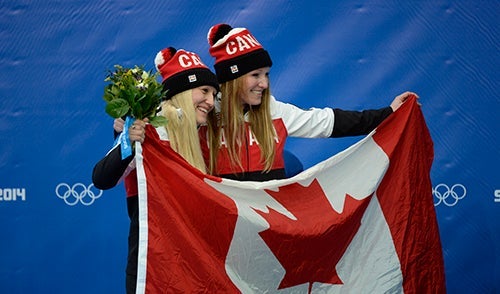
Heather Moyse and her longtime sled partner Kaillie Humphries made Olympic history in Sochi this week. The pair became the first women to win gold medals in consecutive Olympics for the two-man bobsled event. The pair triumphed over their close competitors on the U.S. team in the final heats on Wednesday.
Photo credit: Canadian Olympic Committee
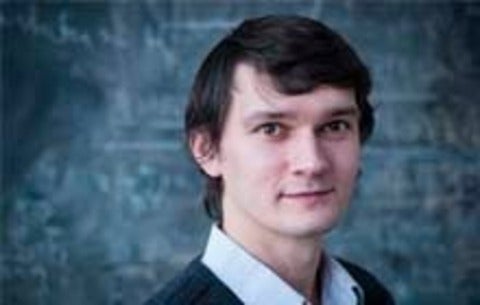
The Alfred P. Sloan Foundation has recognized Waterloo professor, Dmitry Abanin, for his groundbreaking theoretical research in condensed matter physics of Dirac materials, such as graphene.
Thirty-two-year-old Abanin’s work has resulted in a number of significant theories related to graphene and other, so called, Dirac materials that exhibit potentially game-changing properties as conductors. He was named as a recipient of a Sloan Research Fellowship today.
A Waterloo physicist whose theoretical research has resulted in a better understanding of the thinnest - yet one of the strongest materials known to man - has been awarded a prestigious fellowship from the Alfred P. Sloan Foundation.
Dmitry Abanin is the recipient of a Sloan Research Fellowship – an award given annually to promising scientists, mathematicians and economists from Canada and the United States who are at an early stage in their careers.
When 2010 Olympic gold medalist Heather Moyse arrived at Canada’s national bobsleigh training facility for testing in August, expectations were low.
Less than a year before, the Waterloo kinesiology graduate had undergone surgery to repair a torn labrum in her right hip. The surgery left her unable to train for weeks, and jeopardized her ability to return to the sport at an elite level.
But with a 5.50 second-start that day, Moyse proved to herself and her coaches that not only was she back— but she was faster and stronger than before.
Salmon can spot their true love across a crowded stream.
On a commercial salmon farm in Canada, researchers allowed female salmon to follow their heart and mate with the male of their choice rather than selecting their mates for them.
The result? Healthier babies.
Unconventional breeding strategies
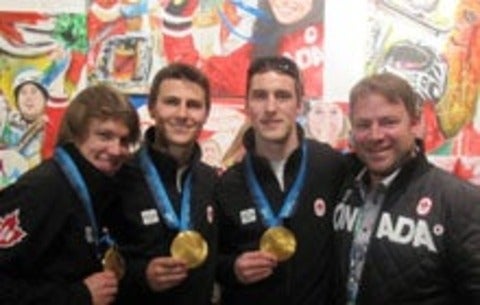
University of Waterloo students and alumni are proving they're among the best in the world as they prepare to battle for gold at the 2014 Sochi Olympic Games.
“On behalf of the University of Waterloo, I want to wish the best of luck to all of our Olympians,” says Feridun Hamdullahpur, president and vice-chancellor of the University of Waterloo. “These exceptional alumni and students head to Sochi representing the bold and dynamic spirit of their alma mater, and we are incredibly proud of them.”
When Andrew Poje and Kaitlyn Weaver first put on their Team Canada jackets, the reality of what they were about to do sunk in.
“That was the aha moment,” said Poje's father, Bill. “That was a tear jerking moment.”
The University of Waterloo students — Poje is an undergraduate student in the Faculty of Science and Weaver is working towards an undergraduate degree in the Faculty of Arts — recently earned a spot on the Olympic ice dancing team after placing second at Canada's 2014 Canadian Tire Skating Championship.
The University of Waterloo, Maplesoft, and Toyota Motor Manufacturing Canada are the recipients of a Natural Sciences and Engineering Research Council of Canada (NSERC) Synergy Award for Innovation, which recognizes their success in collaborating on the model-based design and control of automotive systems that improve vehicle safety and comfort while reducing fuel consumption and emissions.