Friday, April 3, 2020
Q and A with the Experts: Modelling COVID-19
What is a disease model/projection and how are they created?
What is a disease model/projection and how are they created?
In this extraordinary time, it is my fervent hope that you and your loved ones are well.
On behalf of the Faculty, I want you to know that your Faculty is doing what we do best — working on the difficult problems facing society.

Never before has there been such a need as there is now for rigorously trained and innovative Waterloo engineers who can pivot quickly.


The world has moved online, seemingly overnight. Are we using social media more, and what does that mean?

“We know that startups have a great capacity to identify opportunities, innovate quickly, and develop market-ready technologies,” said Adrien Côté, executive director of Waterloo's Velocity incubator. “Velocity can help by working with founders to quickly evolve their strategies and product development to rally to this cause.
"We are already working with a number of companies building COVID-19 solutions, and we are ready to work with more.”
Professor Philip Boyle, an expert in public safety and urban governance at the University of Waterloo, discusses the Emergencies Act and stopping the spread of COVID-19.
What is the Emergencies Act and what powers does it give the federal government?
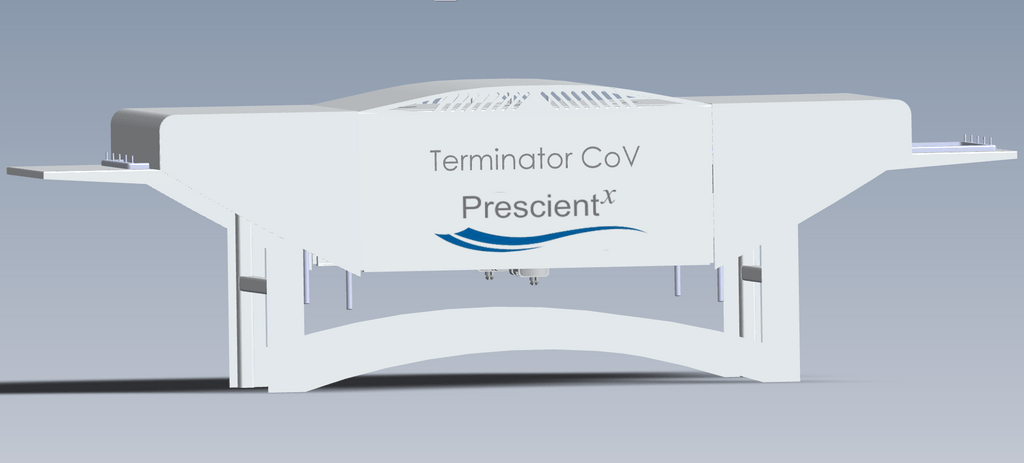
A professor at the University of Waterloo is drawing on two decades of research into disinfection using ultraviolet (UV) light to help solve a shortage of masks for front-line healthcare workers in the COVID-19 crisis.
Bill Anderson, a professor of chemical engineering, has consulted with officials at several hospitals in southern Ontario as they explore ways to reuse N95 respirators instead of throwing them out after each use.
“At this point, in Canada at least, people are looking at it as a Plan B in case they run out of masks,” he said.
3D printers in the Multi-Scale Additive Manufacturing (MSAM) Laboratory and in the Print and Retail Solutions Department at the University are being used to build certified pieces of the protective equipment from a special material currently in short supply throughout the local medical community.
The University’s efforts build on the significant work of local entrepreneurs like InkSmith CEO Jeremy Hedges, whose company was recently certified by Health Canada to mass-produce protective shields for healthcare workers.
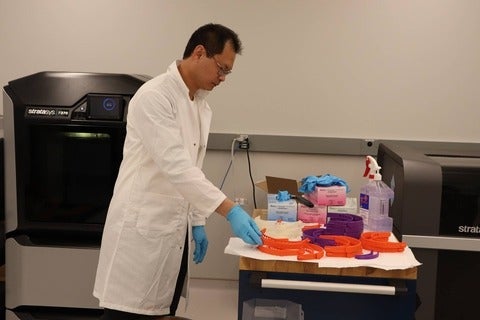
University of Waterloo facilities have shifted their production focus to 3D-printed parts for face shields used by health-care workers battling COVID-19.