Research

Tuesday, December 17, 2019

Screening tool uses AI to weed out fake news

by Brian Caldwell, Faculty of Engineering

Researchers at Waterloo Engineering have developed a new artificial intelligence (AI) tool that could help social media networks and news organizations weed out false stories.

Motivated by the proliferation of disinformation online, the system uses deep-learning AI algorithms to determine if claims made in posts or stories are supported by other posts and stories on the same subject.
Friday, December 13, 2019

Making the grade

by Victoria Higgins (BSc ’14), Alumnus

One moment you’re studying and test-taking with a goal of getting that A. The next moment you’re responding to physicians and trouble-shooting spurious lab results with a goal of providing quality patient care.

How do you adjust to these new responsibilities? How do you prepare for this new role?

I completed my Bachelor of Science at Waterloo. Academically, this time was filled with attending lectures and labs, reading textbooks and regurgitating information on exams. My goal was to learn the material, meet deadlines and get those As!

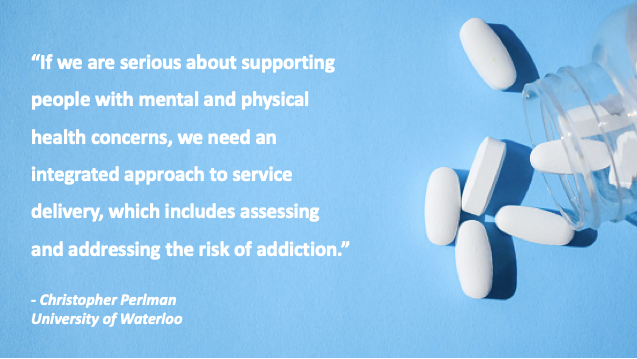
The study found that 7.5 per cent of 165,434 patients admitted to psychiatric hospitals in Ontario between 2006 and 2017 had used opioids in the year prior to admission, which compares to estimates that 2 per cent of the general population used opioids in 2015. Among patients who said they experience daily pain, the percentage who reported opiate use jumped to 22 per cent.

Quote by Christopher Periman

Transformative Quantum Technologies (TQT), a research initiative led by the University of Waterloo, today announced the launch of its Quantum Alliance (QA) program, which brings together a collaborative community of researchers, world-class infrastructure and TQT’s unique Quantum Innovation Cycle for the advancement of impactful quantum technologies. 

Rates of deforestation in war zones increase dramatically once peace is declared, according to a study from the University of Waterloo.

The study, by Simron Singh, a researcher in Waterloo’s Faculty of Environment and Nelson Grima from the University of Vermont, looked at data on conflict zones around the world, with a specific focus on Nepal, Sri Lanka, Ivory Coast and Peru. 

Wednesday, November 27, 2019

3D scanner could increase accuracy of surgery

by Media Relations

Researchers have created a new scanner that can improve everything from surgical procedures to our understanding of landslides.

The new scanning technology, created by engineering researchers at the University of Waterloo, is able to capture full-field 3D surface-shape data in real time by enabling 3D capabilities at every camera pixel.
 

The high-resolution technology uses novel algorithms to compute surface shape at the same frame rate as video with a measurement accuracy of approximately 0.1 mm and can capture images of moving or static objects.