Research

Tuesday, February 11, 2014

Waterloo alum is biomechanics expert for Olympic team

by Staff, Marketing and Strategic Communications

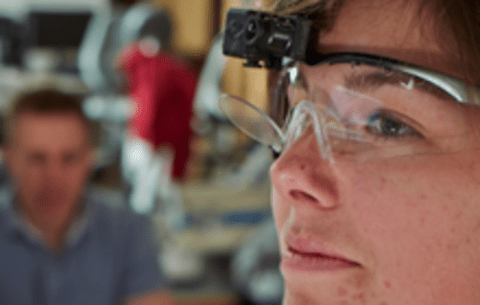
Canadian luge athletes speed down icy tracks in open sleds at upwards of 130 kilometres an hour. It’s thrilling to watch, but for Pro Stergiou, a Waterloo alum, the most interesting part is the start.

Stergiou, a biomechanics expert, uses high-speed video and accelerometers to help him analyze those early moments in the race when Olympic luge athletes pull off the starting handles.

“We know that their start is very vital to the race,” says Stergiou, who has been working with luge Olympic athletes for almost ten years.

Tuesday, February 11, 2014

Research at the University of Waterloo supported in federal budget

by Media Relations

The Government of Canada announced significant funding for transformational research at the University of Waterloo with the federal budget tabled today.

"I am so pleased that the University of Waterloo stands to benefit from such important investments contained in the budget," said Feridun Hamdullahpur, president and vice-chancellor of Waterloo. "They will strengthen our economy and increase our innovative capacity."

Tuesday, February 11, 2014

Federal budget supports quantum research at Waterloo

by Media Relations

The University of Waterloo thanks the Government of Canada for renewing its support for the Institute for Quantum Computing (IQC).

Economic Action Plan 2014 announced today allots a further $15 million to IQC over three years.

"With this federal support, IQC and the University of Waterloo can help Canada lead the world in quantum research and in developing the new companies that will build the quantum information science industry," said Feridun Hamdullahpur, president and vice-chancellor of Waterloo.

Monday, February 10, 2014

Meeting global challenges

by Staff, Marketing and Strategic Communications

Some of the world’s most pressing challenges will be discussed in Chicago this week at a meeting that brings together top scientists and researchers from around the globe.

University of Waterloo researchers will be there, sharing their insights into what the virtual world can reveal about human health, how quantum information will shape our future, and the ethical implications of innovation.

World’s largest scientific society

Tuesday, February 4, 2014

Finding your way after a stroke

by Christine Bezruki, Faculty of Applied Health Sciences

Tucked in the corner of a lab in B.C. Matthews Hall is a piece of equipment set to change the way patients recover from stroke.

While it may not look like much to the untrained eye, the exercise bike and connected video screen is the prototype for an innovative rehabilitation technology that uses Google Earth to improve stroke patients’ cognitive skills.

Good for the heart; good for the brain

Monday, February 3, 2014

University of Waterloo partnership receives innovation award

by Yvonne Hunter, Faculty of Engineering

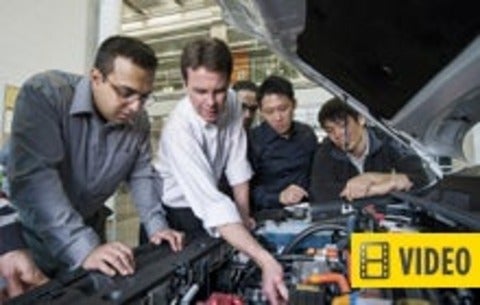
The University of Waterloo, Maplesoft, and Toyota Motor Manufacturing Canada are the recipients of a Natural Sciences and Engineering Research Council of Canada (NSERC) Synergy Award for Innovation, which recognizes their success in collaborating on the model-based design and control of automotive systems that improve vehicle safety and comfort while reducing fuel consumption and emissions.

The University of Waterloo, Maplesoft, and Toyota Motor Manufacturing Canada are the recipients of a Natural Sciences and Engineering Research Council of Canada (NSERC) Synergy Award for Innovation, which recognizes their success in collaborating on the model-based design and control of automotive systems that improve vehicle safety and comfort while reducing fuel consumption and emissions.

Sunday, February 2, 2014

Climate change puts Arctic winters on thin ice

by Staff, Marketing and Strategic Communications

Arctic lakes have been freezing up later in the year and thawing earlier, creating an ice season about 24 days shorter than it was in 1950, a University of Waterloo study has found.

The research, sponsored by the European Space Agency (ESA), also reveals that climate change has dramatically affected the thickness of lake ice at the coldest point in the season: In 2011, Arctic lake ice was up to 38 centimetres thinner than it was in 1950.