Research

Wednesday, February 19, 2014

Waterloo physicist awarded prestigious Sloan Fellowship

by Media Relations

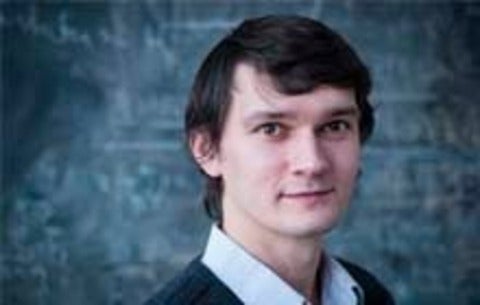
The Alfred P. Sloan Foundation has recognized Waterloo professor, Dmitry Abanin, for his groundbreaking theoretical research in condensed matter physics of Dirac materials, such as graphene. 

Thirty-two-year-old Abanin’s work has resulted in a number of significant theories related to graphene and other, so called, Dirac materials that exhibit potentially game-changing properties as conductors. He was named as a recipient of a Sloan Research Fellowship today.

Tuesday, February 18, 2014

Physics prof awarded prestigious Sloan Research Fellowship

by Katharine Tuerke, Faculty of Science

A Waterloo physicist whose theoretical research has resulted in a better understanding of the thinnest - yet one of the strongest materials known to man - has been awarded a prestigious fellowship from the Alfred P. Sloan Foundation.

Dmitry Abanin is the recipient of a Sloan Research Fellowship – an award given annually to promising scientists, mathematicians and economists from Canada and the United States who are at an early stage in their careers.

Monday, February 17, 2014

Leading the quantum revolution

by Staff, Marketing and Strategic Communications

Once considered a technology of tomorrow, quantum devices are transforming fields including communication, research and geological exploration in the here and now.

New technologies that operate according to the laws of quantum mechanics, are rapidly moving from the laboratory to the marketplace. The real-world application of quantum devices was the subject of a University of Waterloo-led symposium on Sunday at an international meeting of scientists, policymakers and science media in Chicago, IL.

Friday, February 14, 2014

Will Waterloo’s virtual brain replace lab rats?

by Mark Witten, Marketing and Strategic Communications

Testing the effects of different drugs on Spaun, a simulated brain developed by Waterloo researchers, could lead to breakthrough treatments for neurological disorders such as Parkinson’s, Huntington’s and Alzheimer’s disease.

“Our hope is that you could try out different possible treatments quickly to see how the brain reacts and how each one changes behaviour before testing them in people,” says Terrence Stewart, a post-doctoral researcher with the Centre for Theoretical Neuroscience at Waterloo and project manager for Spaun.  

Our response to societal pressures about vaccination has a direct effect on the spread of pediatric infectious diseases in areas where inoculation is not mandatory, says new research published this week in Proceedings of the Royal Society B.

By incorporating social norms into predictive mathematical modelling, a research team from the University of Guelph and the University of Waterloo found that they can foresee the observed patterns of population behaviour and disease spread during vaccine scares—times when anti-vaccine sentiment is strong.

Friday, February 14, 2014

Institute for Quantum Computing continues rapid growth

by Media Relations

The University of Waterloo’s Institute for Quantum Computing (IQC) has added renowned physicist Raffi Budakian, Michal Bajcsy and Kyung Soo Choi to grow its faculty complement to 21.

The Institute for Quantum Computing, which was recently allotted an additional $15 million funding by the Government of Canada, continues to grow towards its target of 33 faculty, 55 postdoctoral fellows and 165 graduate students.

Friday, February 14, 2014

Can a virtual brain replace lab rats?

by Media Relations

Testing the effects of drugs on a simulated brain could lead to breakthrough treatments for neurological disorders such as Parkinson’s, Huntington’s and Alzheimer’s disease.

Researchers from the University of Waterloo in Canada hope Spaun, the world’s largest functioning model of the brain, will be used to test new drugs that lead to medical breakthroughs for brain disorders.

Thursday, February 13, 2014

True love makes pacific salmon healthier

by Media Relations

Salmon can spot their true love across a crowded stream, according to research from a university-industry partnership involving the University of Waterloo. Allowing female salmon to follow their heart and mate with the male of their choice produces healthier babies than those who have their mates selected for them.

Heart-shaped salmon crudités

Heart-shaped salmon crudités (©iStock.com/beyhanyazar)

Wednesday, February 12, 2014

When should innovation take an ethical pause?

by Suzanne Bowness, Marketing and Strategic Communications

Is a biologist experimenting with potentially deadly pathogens responsible for thinking about where those viruses might end up? Should a computer programmer worry about her code being hijacked and used maliciously by hackers?

Heather Douglas
At what point, if any, should scientists enlist experts from the social sciences to help grapple with these moral dilemmas?