Researchers with the potential to change lives
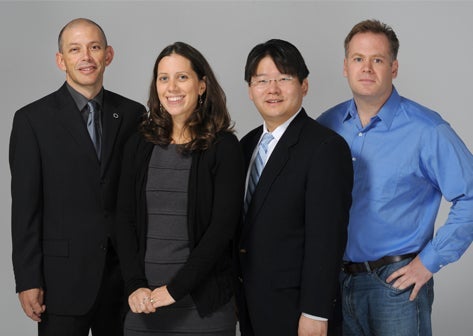
Left to right: Jack Callaghan, Abigail Scholer, Frank Gu, Ken Stark.

Left to right: Jack Callaghan, Abigail Scholer, Frank Gu, Ken Stark.
WATERLOO, Ont. (Tuesday, Oct. 9, 2012) – A group exercise program that operates out of the Faculty of Applied Health Sciences at the University of Waterloo is marking 10 years of helping approximately 900 people with cancer cope with treatment.

WATERLOO, Ont. (Wednesday, Oct 3, 2012) – For the first time, researchers have determined where the energetic jets of matter and radiation that some black holes emit originate and how their existence relies on the speed at which the black holes spin. The jets are powerful enough to inhibit the growth of galaxies, so these findings may help scientists further understand how galaxies formed and grew.
WATERLOO, Ont. (Tuesday, Oct. 2, 2012) – An international team of scientists, including University of Waterloo researcher Brian Kendall, has uncovered evidence for extensive ocean oxygenation about 635 million years ago. In the most recent issue of the journal Nature, the research team led by the University of Nevada Las Vegas makes a link between one of the most dramatic glaciations in the Earth’s history, the subsequent oxygenation of surface environments, and the appearance of the earliest animals.

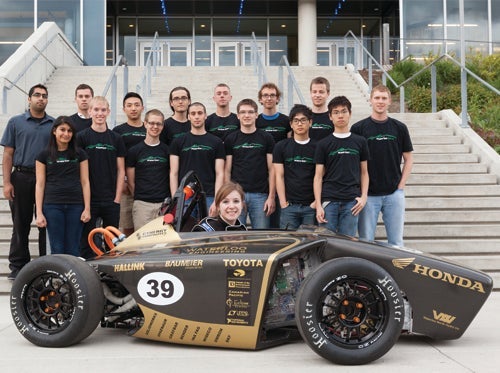
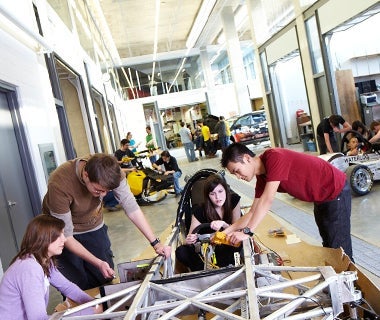
A mass of wires, hoses clamps and two motors — one electric, one gas — Waterloo Hybrid’s competition vehicle looks like a buggy bound for a distant planet.
But its purpose lies much closer to home: Push a few technological boundaries and challenge the students who put it together.


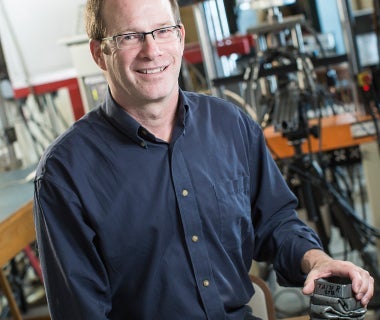
A professor and Canada Research Chair in the University of Waterloo’s Department of Mechanical and Mechatronics Engineering, Worswick leads a research team that punishes metal and other materials en route to a lighter, safer automobile.

No gritted teeth or finger-flipping. No dented fenders, bruised egos or missed exits. Certainly fewer lives lost.
The key, he says, is intelligence, and not just the kind that rests in the human mind.
WATERLOO, Ont. (Tuesday, Sept. 25, 2012) – A University of Waterloo professor leads a team of researchers that has developed a new method of detecting Alzheimer's disease by looking into the eye. The discovery may lead to earlier, better and less expensive treatment for patients, and it was recognized with a significant government grant announced today.