Research

Friday, October 27, 2023

Can we create a sustainable future for aeronautics?

by University Relations

“If you actually want to do something, you have to change who you are,” said Chris Hadfield, the first Canadian Commander of the International Space Station.

Hadfield was speaking about the personal growth and work he put into becoming a decorated astronaut, but he was also referring to the change and innovation we need to preserve the future of our planet.

Wednesday, October 25, 2023

Setting standards and unlocking the potential of synthetic data in health research

by Jordan Flemming, University Relations

At the intersection of data privacy, open science and public health, the University of Waterloo has initiated a collaborative effort with several Canadian government agencies to explore the use of synthetic data for research and analysis.

Dr. Helen Chen, a professor in the Faculty of Health and director of the Professional Practice Centre in Health Systems is leading the initiative.

Tuesday, October 24, 2023

Using mathematical modelling to save coral reefs

by Media Relations

A team of researchers at the University of Waterloo is using mathematical models to help determine the best strategies for saving coral reefs from climate change.

As havens of biodiversity, coral reefs are some of the world's most important ecosystems – and some of the most vulnerable to the impacts of climate change. While the world's reefs face numerous intersecting threats, the Waterloo team focused on predicting outbreaks of crown-of-thorns (CoT) starfish.

Tuesday, October 24, 2023

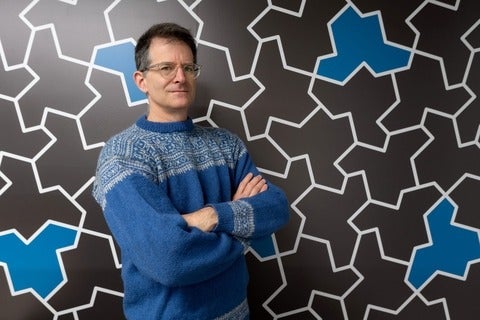
New shape makes TIME’s Best Inventions of 2023 list

by Joe Petrik, Cheriton School of Computer Science

Earlier this year, Cheriton School of Computer Science Professor Craig S. Kaplan and his international colleagues David Smith, Joseph Myers and Chaim Goodman-Strauss discovered a single shape that tiles the plane — an infinite, two-dimensional surface — in a pattern that can never be made to repeat.

Now, that shape has been chosen by TIME magazine as one of the best inventions of 2023.

Monday, October 23, 2023

Plant-based isn't just about burgers anymore

by Media Relations

A team of University of Waterloo researchers has created smart, advanced materials that will be the building blocks for a future generation of soft medical microrobots.

These tiny robots have the potential to conduct medical procedures, such as biopsy, and cell and tissue transport, in a minimally invasive fashion. They can move through confined and flooded environments, like the human body, and deliver delicate and light cargo, such as cells or tissues, to a target position.