Talent

Monday, June 17, 2024

Waterloo welcomes 250,000th graduate to its alumni club

by University Relations

Spring 2024 Convocation ceremonies saw family, friends, staff and faculty come together to recognize students for their hard work and perseverance during some of the world’s most challenging circumstances. 

For five consecutive days, across 14 ceremonies, Waterloo’s campus was full of beaming pride and jubilation. The 128th convocation was made even more special with the University officially ushering its 250,000th graduate across the stage. This major milestone was achieved during the Faculty of Arts ceremony on Thursday, June 13.  
Monday, June 17, 2024

Waterloo researchers awarded more than $10 million

by University Relations

The University of Waterloo is a leading global research-intensive university and home to transformational research and inspired learning. Waterloo researchers recently received more than $10 million as part of $693.8 million in funding awarded on June 14 to support discovery and applied research.

Wednesday, June 12, 2024

Creating human-centred AI

by Melodie Roschman, Faculty of Mathematics

“In the tech industry, it’s so easy to lose track of the fact that we are humans designing things for other humans,” says Areena Akhter, who graduates with a bachelor’s degree in Computer Science this month. “Whether we’re thinking about ethics or interfacing with diverse social systems, people need to be at the core of everything we do.”

Monday, June 10, 2024

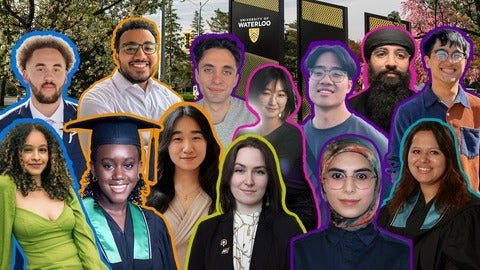
Celebrating Waterloo’s Class of 2024 valedictorians

by Angelica Marie Sanchez, University Relations

Convocation is a time of immense pride and celebration across campus. This year, 13 outstanding students have been chosen to represent the graduating Class of 2024. 

Below they share parts of their academic journey filled with innovation, growth and resilience.  

Why did you choose to study at the University of Waterloo?   

Natasha J. Chen portrait image

Natasha J. Chen

Friday, June 7, 2024

Tackling complex problems for a better future

by University Relations

The journey to completing a PhD is not always smooth nor linear. Beyond the intellectual rigour of coursework and research papers, pursuing a PhD requires unconventional and, at times, interdisciplinary thinking.  

Through the years of pursuing a doctoral degree, candidates’ critical research helps to unlock conventional barriers by developing new and creative approaches to tackling complex problems.  

Waterloo PhD graduates undertake ground-breaking research projects that can often have global impact and lead to a healthier, more sustainable future.  

Wednesday, June 5, 2024

Waterloo graduates earn distinguished Governor General Gold Medal

by University Relations

The University of Waterloo is pleased to award three graduate students with the prestigious Governor General Gold Medal at Spring 2024 Convocation.  

The Governor General’s Gold Medal is awarded to graduate students with outstanding academic performances and tremendous records of scholarship. Awardees represent our exceptionally gifted community of scholars who are creating knowledge and generating transformative research to the betterment of society. 

The University of Waterloo is proud to award a new group of honorary doctorates, the highest honour conferred by the University, at this year’s spring convocation ceremony.

Honorary doctorates are presented to inspiring individuals who provide exceptional service or leadership and those who have made outstanding contributions to their discipline. This year’s recipients have made significant global and societal impact through their personal experiences and fields in computing, mathematics, science and environmental studies.

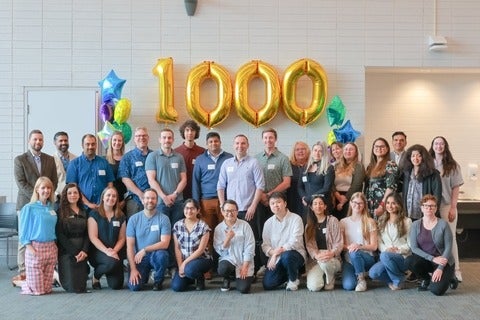
This spring marks a significant milestone for WatSPEED, the University of Waterloo’s professional, executive and corporate education arm, as the team celebrates 1,000 days in operation.  

WatSPEED's journey over the past 1,000 days includes the launch of flagship courses in generative AI, data science and machine learning, as well as enhanced partnerships and impactful events that support the unit's commitment to equipping Canadians with essential skills to navigate the evolving workforce.  

To build artificial intelligence you need droves of data. But if your data isn’t clean, the intelligence it produces won’t be either. AI systems learn from the data they are trained on, so any errors or inconsistencies in the data can lead to incorrect or unreliable outcomes. According to IBM, data scientists spend around 80 per cent of their time cleaning and organizing data, highlighting the importance of clean data in AI development.