
Owner of one of Canada’s largest optometric practices says relationships, mentorship, innovation, psychology and tracking key performance indicators are keys to success
Dr. Kerry Salsberg (OD’94) has known since Grade One what he wanted to be: a friend to thousands. That’s the core of who he is today, though he realized along the way that to be most effective at helping people, he also needed to be an innovative and analytical businessperson.
Salsberg’s father, Dr. Stan Salsberg (OD ’70), was an optometrist. He was always coming home with stories about all the interesting patients he’d met. To young Kerry, optometry sounded like an endless series of meet-up with friends – not just for fun but also for helping them and building lifelong relationships with them.
Growing up, Salsberg spent a lot of time at his dad’s Toronto practice as it grew from a one-optometrist office in a closet-sized space to the early days of Eyes on Sheppard, now one of Canada’s largest optometry practices, with 10,000 square feet of space and some 130,000 patient files in its system.
At the University of Waterloo, Salsberg studied hard to meet his goals of getting into clinical practice as quickly as possible and helping patients as well as possible. He still found time to make good friends and is even now in regular contact with about 10 classmates from across Canada.
One experience that might have changed Salsberg’s trajectory was a placement in Memphis, Tennessee. There, he was at a large, famous surgical centre, part of a team of optometrists that worked in areas such as low vision rehabilitation as essential partners to ophthalmologists who performed retinal and cataract surgeries.
“I was captivated by the innovation down there and the medical model that we really didn’t have in Canada when I first graduated,” says Salsberg. “For a while, I really wanted to get my green card and work there, but that didn’t work out, so I came back to Toronto.”
Not only was his dad relieved, it turned out to be for the best for him too, says Salsberg.
“I think if I’d been able to stay in Memphis, I might have stayed there for good – and that would have been a mistake. I spent years practising with my dad and it was just wonderful.”
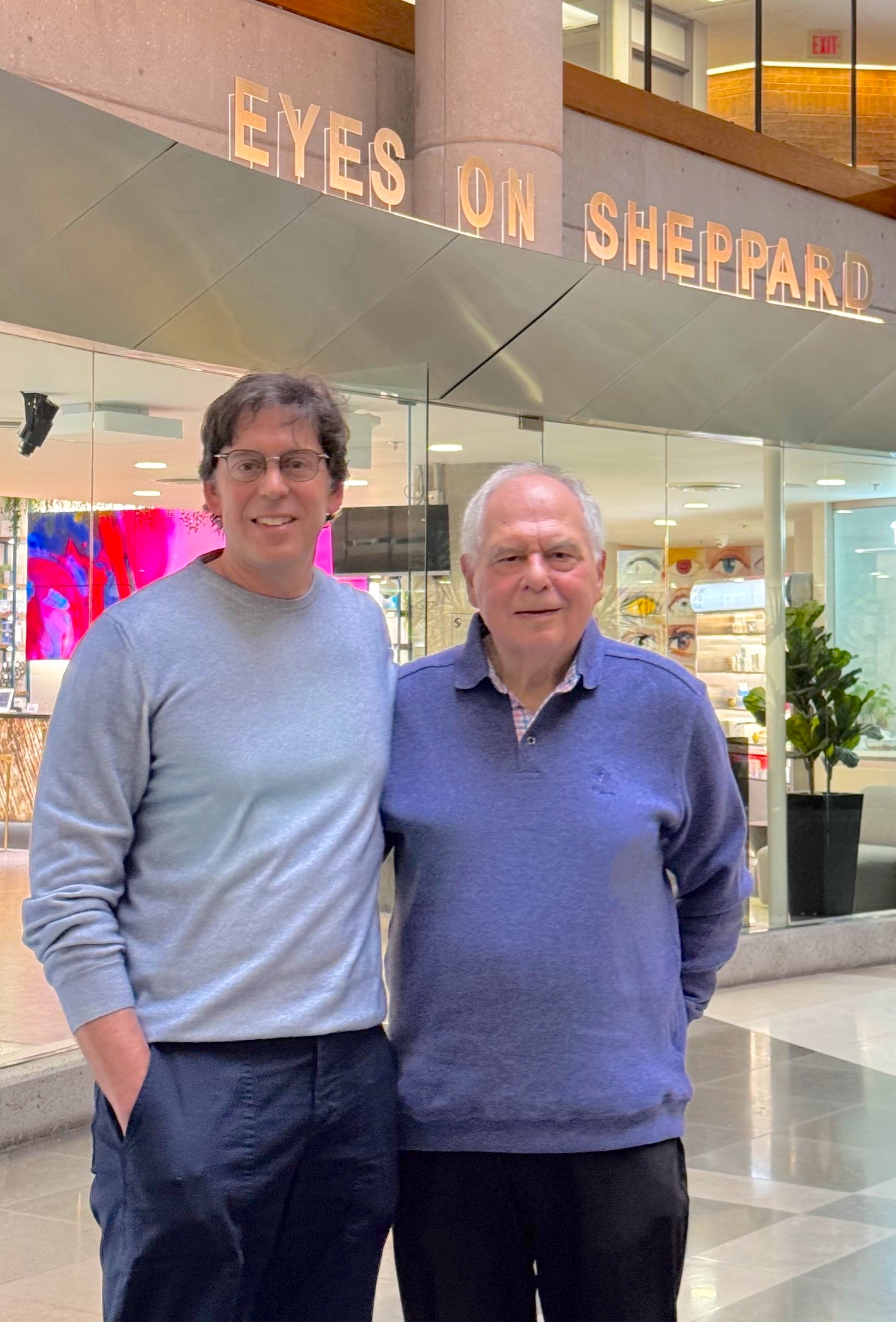
Drs. Stan and Kerry Salsberg stand in front of an Eyes on Sheppard sign.
Learning in the deep end
After he graduated, Salsberg and his father both thought he might ease into practice at a slower pace as he built experience. Then, a few months in, a close family friend and optometrist was hospitalized. Suddenly, he found himself seeing 30 patients a day at a busy downtown practice.
Though Salsberg doesn’t remember making clinical mistakes, he did make business mistakes. It wasn’t easy to balance making patients feel heard and cared for with staying on schedule and optimizing resources. He learned quickly, though – largely by modelling his behaviour on his father’s.
“My dad has an ability to be curious, listen and really be present. It lets him get the most out of people and help them do the best they can while respecting their time,” says Salsberg. “I think learning that opened my eyes to the business of optometry and what it really takes to run a successful practice.”
To learn more, Salsberg delved deeply into business books and attended business management conferences. His biggest learnings?
“You have to track your KPIs,” says Salsberg. “A lot of doctors run their practices looking through the rearview mirror. They look at their year end three months after it’s done and realize whether they’re profitable. We look through the front windshield. We have certain targets we want to meet, not only financially but also in terms of patient satisfaction.”
Salsberg also read a lot about psychology to learn about consumer behaviour and patient motivation.
“I learned to find out what really motivates and is important to the patient,” says Salsberg. “We don’t talk down to a patient. We collaborate with them.”
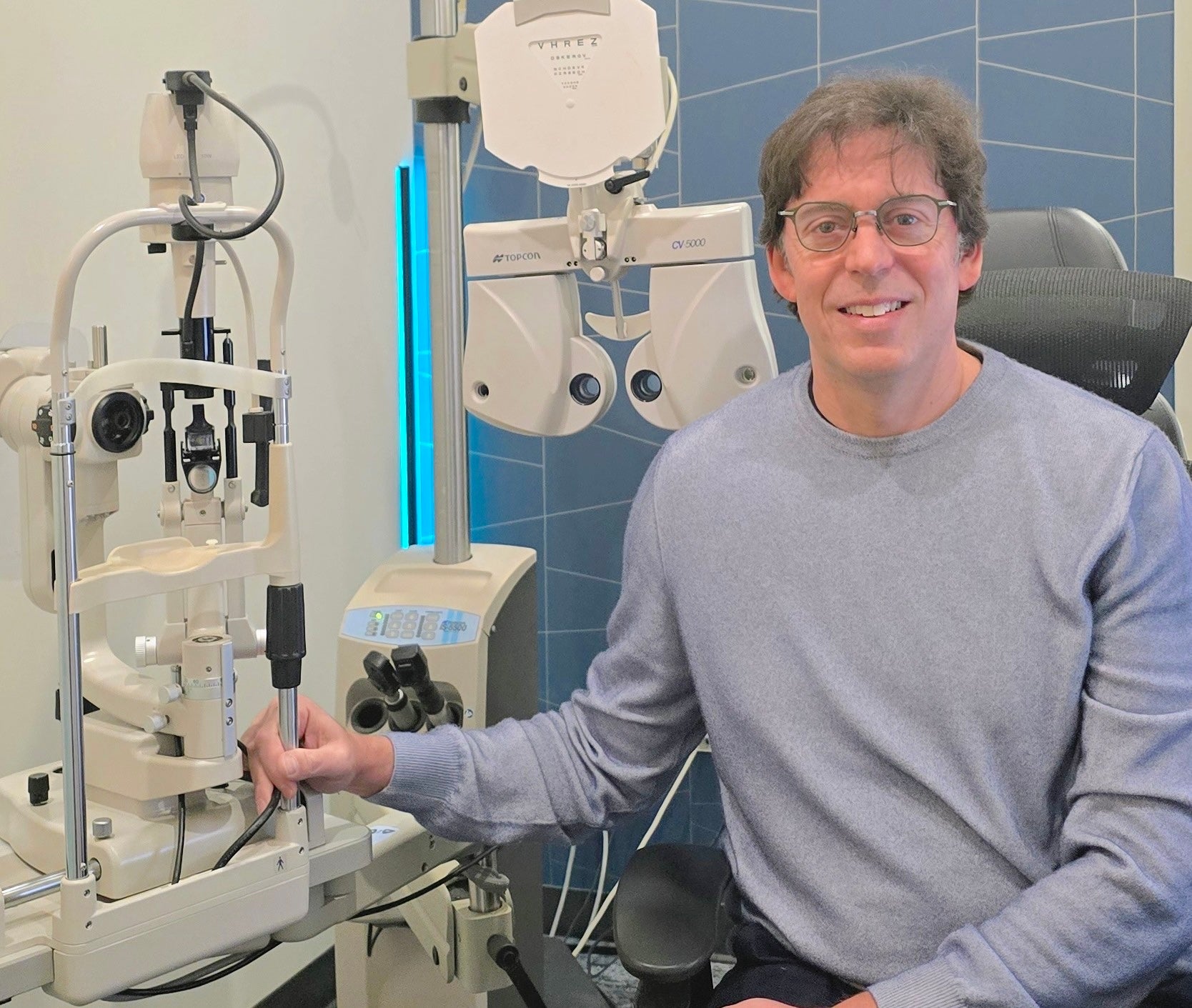
Another key to success been innovation – thinking big, trying, failing and learning. Repeat.
Not only does Salsberg now run Eyes on Sheppard – his father retired in 2018 – he’s also CEO of 3conX, a healthcare software company specializing in digital signage and patient communication tools. He also works closely with his brother, Paul Salsberg, vice-president of 3conX and president of Bright Optical, a leading distributor in Canada of ophthalmic products.
The practice has always been an early adopter of new technologies. It was one of the first to use an automated email and text recall reminder system – about 150 practices now use the system it developed. It has also innovated in ways to make patients feel special, from installing coffee machines to memorable giveaways such as maple syrup.
A family-focused practice

Salsberg has loved working with family – he calls his father his mentor and his brother his best friend. He also considers the other staff part of the family. There are now nine optometrists and 40 support staff at the practice. Of the other eight optometrists, six are School alumni – Drs. Michelle Baron (OD ’13), Amit Bhatia (OD ‘16), David Black (OD ‘04), Adriana Cotovio (OD ‘17), Vanessa Lin (OD ‘23) and Fiona Soong (OD ‘97).
Patients are part of the family too. Some have been at the practice over 50 years and have brought in their children and grandchildren, says Salsberg. Another point of pride is that numerous staff members have gone on to pursue optometry degrees after being exposed to the profession at Eyes on Sheppard.
The practice was honoured in 2021 with the prestigious international MIDO award for retail design and innovation. MIDO is the world's largest international eyewear trade show, held annually in Milan. It was the first time a Canadian practice had been awarded this honour.
Salsberg and his team also recently received Health Canada approval for a red-light device for ocular wellness. The product of six years of work by a team of optometrists, ophthalmologists and photobiomodulation experts, the at-home device is now available through eye care providers in North America, Europe and Australia as well as directly to consumers through arunalight.com.
“It’s the first eye-specific device to have Health Canada approval with an indication for improved ocular blood flow,” says Salsberg. “This has tremendous therapeutic benefits for people suffering from macular degeneration, diabetic retinopathy, dry eye and other retinal diseases.”
Salsberg is now keen to help other optometrists become as successful at business as they are at patient care. He recently spoke at a University of Waterloo Advancement of Independent Optometry Club (UWAOIC) event and is part of a peer-to-peer group where members from across North America share knowledge, problems and solutions.
“A lot of doctors, especially in a competitive market, hold their cards close to their chest, but it’s important to realize that the problems you have are shared amongst other people and the solutions are very much the same,” says Salsberg. “You don’t necessarily need an MBA to run a successful business, but you do need mentorship and collaboration.”