Beauty and the eye
Dr. Alexa Hecht isn’t just another influencer – she’s an optometrist educating beauty product enthusiasts on eye health and safety.
From lash extensions to serums for crow’s feet, beauty influencers and cosmetics are big business. However, eye health and safety are seldom the focus. Dr. Alexa Hecht (OD ’21) is working to change that.
Hecht isn’t against cosmetics – far from it. Having been a dancer growing up in Winnipeg, she wore makeup at competitions and shows from a young age and mastered putting on false eyelashes by the age of 10.
Today, Hecht is a full-time optometrist in Toronto – and an influencer in her own right. With 61,000 followers on TikTok and 36,000 on Instagram, she’s been featured on Good Morning America and has made multiple brand deals. She hosts a podcast with another optometrist friend and has been asked to speak at various events. All less than five years after her graduation.
“I’m still figuring it out, but I don’t necessarily think my career in optometry will be traditional,” says Hecht.
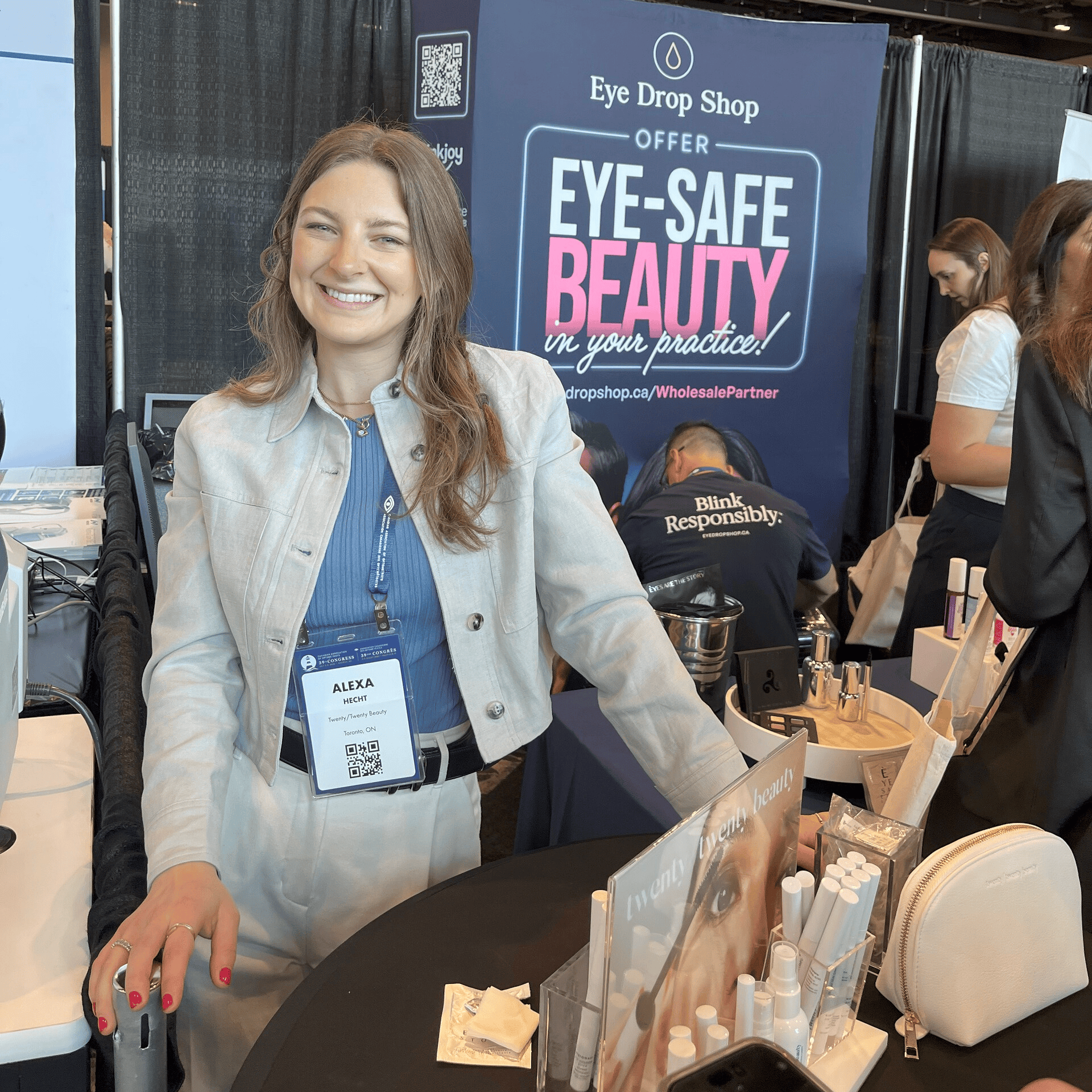
The making of an eye-nfluencer
Hecht started posted on social media during the second year of her optometry studies at the University of Waterloo, initially just to document her life. Then the Covid-19 pandemic hit at the end of her third year. Hecht’s plans for a clerkship in Miami were scuttled. She and her classmates still managed to complete their rotations and write their board exams, but even after their online convocation, things were far from normal.
“I started posting more actively because I didn’t have a ton of patients and I was bored,” says Hecht. “TikTok and Instagram were blowing up and there was a surge of all these things you could do around the eye and enhancements you could make. A light bulb went off and I thought, ‘Who’s talking about how to do this safely, if not us [optometrists]?’”
Hecht started posting some educational content for the public and her following started to grow. Even as she got busier in clinic, she kept on posting. Some of her posts went viral. “Three makeup trends I would never do as an eye doctor” was the one that got the attention of the producers at Good Morning America.
“What interested me was the large reach you could achieve just from one post,” says Hecht. “I have followers from around the world. It’s bigger than what I can achieve interacting with patients one on one. Also, there’s a lot of misinformation online. If I can be a voice that people know is legitimate, because the information is coming from an optometrist, then to me, that feels good.”

A side hustle full of challenges and rewards
Being a content creator isn’t easy. There’s the pressure of keeping up with fast-moving trends and posting regularly. Some posts go unexpectedly viral while others get little traction. Then there are the haters, trolls, scammers and creeps.
“Of course, you’re going to get weird DMs and creepy people commenting, but I’ve learned not to care what people are saying or think of you,” says Hecht. “It’s easier said than done, but you need to stick to your ‘why.’ My why for doing this is to educate people.”
Hecht says being a content creator has helped her improve her communication skills, whether on screen, with patients or public speaking. It’s helped with her business skills, as she’s negotiated brand deals – some in the beauty industry, some in the eye care industry and miscellaneous others. It’s also helped her network – some conference invitations and even a clinical job came about at least partly due to her online presence.
While Hecht remains first and foremost an optometrist in clinical practice, she has made money from posting for brands and representing them at events such as conferences. She has also consulted for brands – gigs that came about as a result of her social media work.
For the past year, she has teamed up with her friend Dr. Amrit Bilkhu to co-host the Future Focus podcast for NextGenOD, part of VuePoint, a marketing and media company for the eye care industry. The podcast started after the two presented at a Canadian Association of Optometry Students event in Waterloo and realized there was much more to say.
“Our goal for the podcast is to have a space for students and new grad optometrists to help bridge the gap between graduation and practicing as an optometrist,” says Hecht. “That’s something I’m passionate about because I felt there was a bit of disconnect between ‘I graduated’ and ‘Now what?’ If we can be a resource in that transition, I think that’s useful.”
Eye-safe beauty tips
Hecht’s top tip for her patients is to think carefully about the beauty products and services they’re using – to read makeup ingredients and examine the reputations of lash artists.
In terms of products, Hecht avoids waterproof mascara – though she made an exception for her wedding last year – because it usually contains PFAS, or ‘forever chemicals.’ She also warns against at-home lash lifts and tints, as well as lash serums that contain prostaglandins or prostaglandin analogues.
“Prostaglandins do rapidly grow your eyelashes, but there are a lot of negative side effects, like darkening of the skin around the eye, periorbital fat atrophy and changing of your actual eye colour in addition to things like redness and dry eye disease,” says Hecht. “If you want a lash serum, look for something that’s peptide-based, that’s nourishing and hydrating. The results might not be as dramatic, but you won’t have all those nasty side effects.”
Hygiene is also very important, says Hecht, citing bacteria and demodex eyelash mites, both of which can multiply beyond a manageable level and spread between people.
“Don’t share your eye makeup and replace your makeup frequently. Something I also stress to people is to clean your makeup brushes. For the past few years, I’ve cleaned mine almost weekly, which I think has changed my skin and my overall hygiene around my eyes. Also, you need to remove your makeup every night. If you’re waking up and you have leftover mascara under your eyes, you didn’t remove it properly.”
Hecht’s message for optometrists and optometry students is to have open conversations with patients about cosmetics.
“Some of my male colleagues especially feel uncomfortable talking about this stuff,” says Hecht, who hopes to one day do a master class about cosmetic safety targeting male optometrists. “I know it can be awkward to start a conversation about something like the uncleanliness of a patient’s eyelash extensions, but who better to do it than us?