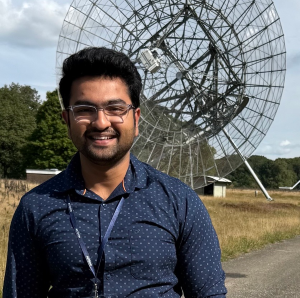
Mayukh is currently a PhD candidate in Astronomy at Queen's University, Canada, working with Prof. Laura Fissel on the Balloon-borne VLBI Experiment (BVEX). His research focuses on developing balloon-borne radio telescopes for Very Long Baseline Interferometry. Beyond instrumentation, his work includes forecasting observations of black hole photon rings with a future submillimeter BVEX. He completed his Bachelor's in Electrical and Electronics Engineering in India (2020) and MSc in Astronomy at Queen's (2023). During his MSc, he analyzed polarimetric dust data from star-forming cores and characterized atmospheric observability for CCAT Prime.

Felix Thiel currently is a PhD student in the Department of Physics at Queen's University in Kingston, Ontario Canada and a member of the Balloon-borne VLBI Experiment (BVEX) collaboration under the supervision of Laura Fissel. He completed his Bachelor degree at McGill University in 2017 under the supervision of Cynthia Chiang working on the Array of Long Baseline Antennas for Taking Radio Observations from the Sub-Antarctic (ALBATROS). In 2023 he completed his Masters degree at Queen's University under the supervision of Laura Fissel on the Fields and Filaments Survey with the TolTEC camera
Title: Observing Black Holes from the Stratosphere
Abstract: In 2019, the Event Horizon Telescope (EHT) published the first ever image of the black hole at the center of the radio galaxy M87. This image was obtained using a technique called Very Long Baseline Interferometry (VLBI), which involves combining simultaneous observations from radio telescopes all across the Earth, giving a resolution that is the equivalent of an Earth-sized telescope. The EHT is limited in resolution in two ways: on the one hand, by the diameter of the Earth; on the other, by atmospheric absorption of sub-millimetre cosmic signals. One remedy for this challenge would be to build a space-based VLBI station that gives access to longer baselines and higher observing frequencies. The other, much cheaper option is to build a balloon-borne VLBI station which operates at an altitude of about 35 km above 99% of the atmosphere, giving access to sub-millimetre observing wavelengths. In this talk, we will be giving a brief overview of the Balloon-borne VLBI Experiment (BVEX), a K-band (22 GHz) balloon-borne radio telescope, which will serve as a proof of concept with the aim to demonstrate VLBI between a balloon-borne and a ground-based telescope. We will then wrap up the talk by discussing the science impact a high-frequency balloon-borne VLBI station (230 GHz and above) could have on event-horizon scale black hole science when paired with the EHT (230GHz) as well as ngEHT(345 GHz and above).