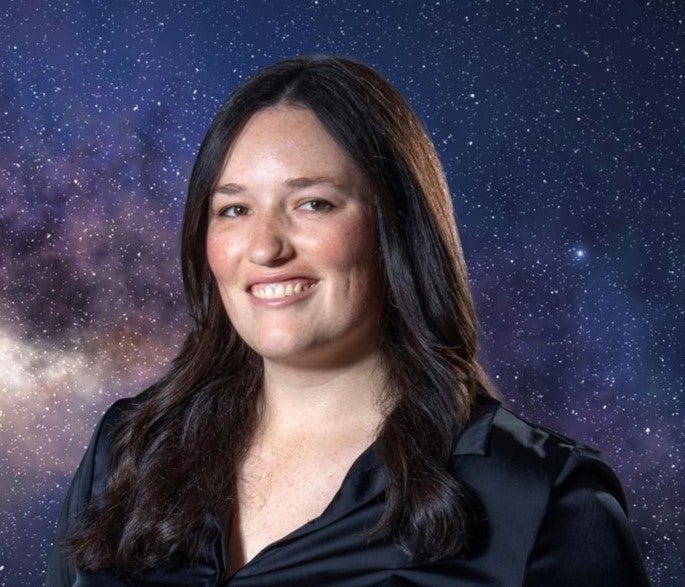
Skylar Grayson is a postdoctoral fellow at the Waterloo Centre for Astrophysics. Her research focuses on understanding how feedback from active galactic nuclei impacts diffuse gas reservoirs around galaxies. She primarily works with cosmological hydrodynamic simulations, exploring different implementations of feedback physics and forward-modelling simulations for comparison against tSZ and X-ray observations of the circumgalactic medium. She is also a Guest Scientist in the XRISM Collaboration and uses high resolution X-ray spectroscopy to test models of the circumgalactic and intracluster medium. Grayson has previously worked in astronomy education research, focusing on learning in online environments. Beyond research, she is currently serving as the Outreach Coordinator for the WCA and does science communication on social media with her “Space According to Skylar” accounts. Grayson earned her PhD from Arizona State University and her undergraduate degree from Whitman College.
Title: Feedback Mechanisms and Diffuse Gas: What Can We Learn from Hydrodynamic Simulations?
Abstract: Feedback from stars and Active Galactic Nuclei (AGN) plays an important role in galaxy formation, impacting star formation and gas conditions across a range of physical and temporal scales. Hydrodynamic cosmological simulations rely on feedback to match observations of global properties of galaxies, but they vary dramatically in their treatment of the underlying physical mechanisms. One promising means of better constraining these AGN feedback models is through the circumgalactic medium (CGM). In this talk, I will begin by exploring how the AGN feedback prescriptions in a range of cosmological simulations shape the CGM. I will assess the observability of these differences by generating mock thermal Sunyaev-Zel’dovich and X-ray observations and comparing them against stacked CGM observations. In the second half of this talk, I will share my work using high resolution X-ray spectroscopy from the XRISM telescope to test AGN feedback models at larger mass scales, exploring the dynamics of the intracluster medium. I will also talk about how XRISM has impacted our understanding of stellar feedback processes, using observations of the starburst galaxy M82 to test longstanding models of supernovae-driven winds.