At this very moment, political leaders from all over the world are gathering in Marrakech, Morocco for the 22nd Session of the Conference of Parties to the United Nations Framework Convention on Climate Change (COP22), which began today and will run until November 18th. Joining them are five student delegates selected by the Interdisciplinary Centre on Climate Change (IC3), as well as two IC3 members and professors, who will be representing the University of Waterloo. The student delegates are acting as ambassadors for UWaterloo and Canadian students as a whole, observing negotiations, attending events and listening to speakers, engaging with other delegates through meetings and conversations, and working with global youth and research groups that provide input throughout the official negotiation process.
Nicknamed the “Action COP,” COP22's focus is to build on the Paris Agreement, which emerged out of last year's conference, and to discuss the details of the implementation of the Agreement. One key outcome of the Paris Agreement was the temperature limit: a long term goal to limit global warming to well below 2 degrees Celsius (ideally 1.5 degrees Celsius) by the end of the century. The Paris Agreement came into force on November 4th, 2016, 30 days after the date on which the threshold of ratification by at least 55 countries accounting for at least 55% of total global greenhouse gas emissions was reached. To date, 102 parties, including Canada, representing about 70% of global greenhouse gas emissions have ratified the Agreement. A live Paris Agreement Tracker is available for the most up-to-date numbers.
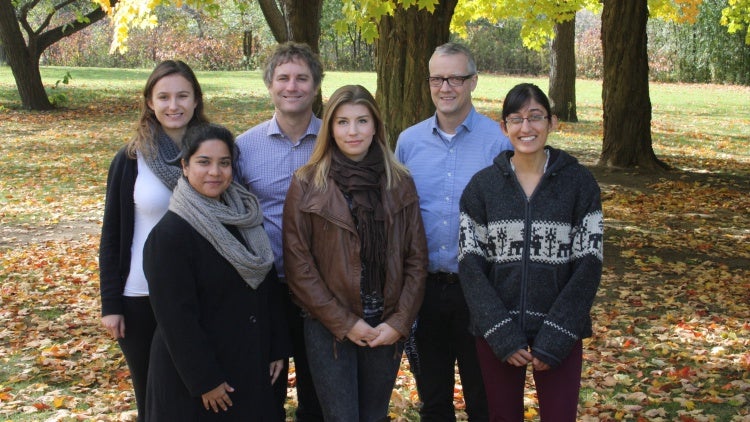
L-R: Kayla Hardie (SCI), Masroora Haque (ARTS), Professor Brendon Larson (ENV), Bailey Jacobs (ENV), Professor Neil Craik (ENV), and Ambika Opal (ENG). Missing: Hadi El-Shayeb (ENV).
University of Waterloo students have been engaged in the annual climate change conference as delegates and advocates since 2013, but this is the first time that the delegation includes students from faculties outside of Environment, including Arts, Engineering, and Science. While the ways in which the students have been educated about climate change may differ, they agree that the need for action is urgent and that people need to come together across disciplines, sectors, and regions to create solutions for this complex problem.
Sarah Brown, IC3's Associate Director, is especially thrilled about the interdisciplinary nature of this year's delegation. She states,
Working closely with this group as they prepare to take part in COP22 has been so energizing. They are proof to me that the combined passion, knowledge, and skills of people from diverse educational and cultural backgrounds is extremely powerful.
Meet the delegation and discover where to find them on social media below:
Week 1
Kayla Hardie (3A Physics, Faculty of Science)
Hadi El-Shayeb (4A Planning, Faculty of Environment)
Neil Craik (Director, School of Environment, Enterprise and Development, Faculty of Environment)
Week 2
Ambika Opal (4A Systems Design Engineering, Faculty of Engineering)
Masroora Haque (Master of Arts in Global Governance, Faculty of Arts)
Bailey Jacobs (4A Environment, Resources and Sustainability, Faculty of Environment)
Brendon Larson (Associate Dean Undergraduate, Faculty of Environment)