WIN Innovation Speaker Series: Dr. Kumar Sadayappan & Dr. James Chen
The Waterloo Institute for Nanotechnology (WIN) is pleased to present an
Innovation Speaker Series talk by Dr. Kumar Sadayappan & Dr. James Chen from
CanmetMATERIALS (CMAT).
The Waterloo Institute for Nanotechnology (WIN) is pleased to present an
Innovation Speaker Series talk by Dr. Kumar Sadayappan & Dr. James Chen from
CanmetMATERIALS (CMAT).
The Waterloo Institute for Nanotechnology (WIN) has launched a new seminar series, Quantum Nano Collision (QNC) Seminar Series, to deepen the engagement of the Waterloo researchers who work at the interface of quantum and nanotechnologies.
Measuring Quebecers' preferences for surface water quality
April 13, 2022 - 12:00 p.m. EST.
Jie He, Professor, Department of Economics, Université de Sherbrooke
Join us for a new webinar series highlighting state-of-the-art water valuation practices in Canada and identifying practitioners’ demand for information about the value of water.
The webinar series targets anyone from academia to non-government agencies and practitioners who are interested in better understanding the value of water in Canada from a broad social science perspective, and how this value is captured, acknowledged and integrated in Canadian water policy and decision-making.
The Waterloo Institute for Nanotechnology (WIN) has launched a new seminar series, Quantum Nano Collision (QNC) Seminar Series, to deepen the engagement of the Waterloo researchers who work at the interface of quantum and nanotechnologies. This seminar series will also provide opportunities for senior graduate students, post-doctoral fellows, and research associates to present their innovative work along with the faculty members to bring together the excitement around these cutting-edge technologies that would shape our future.
The next talk for the QNC Seminar Series will be delivered by Professor Zbig Wasilewski.
Cells interact with biochemical signals and biophysical signals, such as rigidity and topography, in their extracellular matrix microenvironment. An ideal scaffold for tissue engineering application should mimic the microenvironment and present the appropriate biochemical and biophysical cues such as topographies to regulate cellular responses. Our research group is interested in studying the interfacial interactions of cells with the extracellular substrate and how to apply this knowledge to stem cell differentiation and tissue engineering applications. In this presentation, strategies on engineering cell-materials interface, such as incorporating topographies on biomaterials for different application for vascular and corneal repair will be discussed.
Quantum sensors allow us to measure with incredible accuracy, precision and selectivity. Future quantum devices that achieve these ultimate sensing qualities by harnessing the complexities of atoms, photons and semiconductors will play a critical role in improving applications such as medical technology, radar, geological exploration, molecular imaging and more.
We need new experimental techniques to build these devices. In this panel discussion, we’ll hear from three leading experts in the Waterloo region who are pushing boundaries to develop new sensing technologies based on quantum mechanics:
Michael Reimer, Assistant Professor at IQC and the University of Waterloo’s Department of Electrical & Computer Engineering who is developing highly efficient photon detectors
Kostadinka Bizheva, Professor at the University of Waterloo’s Department of Physics & Astronomy who is working on new techniques for optical coherence tomography (OCT)
Troy Borneman, Senior Scientist at High Q Technologies who is building sensitive superconducting resonators for medical sensing applications.
Quantum Perspectives: A Panel Series celebrates 20 years of quantum at IQC. Over the past two decades, IQC’s leading quantum research has powered the development of transformative technologies, from ideas to commercialization, through research in theory, experiment and quantum applications. This year, we’re diving in to all aspects of quantum in celebration of IQC’s 20th anniversary with a panel series exploring all perspectives of quantum, including sensing, materials, communication, simulation and computing.
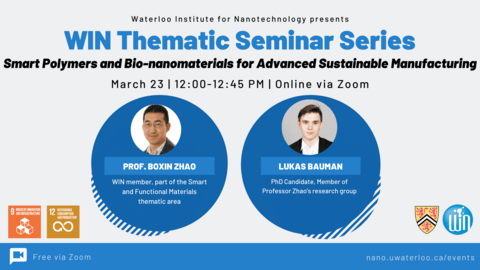
The Waterloo Institute for Nanotechnology (WIN) has four main thematic research areas; Smart and Function Materials, Connected Devices, Next Generation Energy Systems and Therapeutics and Theranostics. To showcase the work going on within these areas, we will be holding monthly WIN Thematic Seminars featuring our members and their research group members.
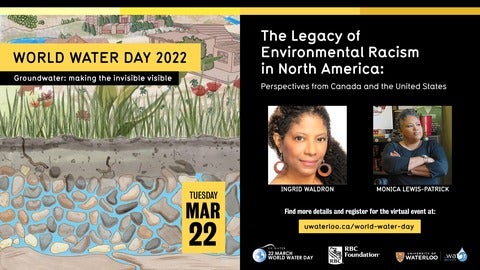
The Legacy of Environmental Racism in North America: Perspectives from Canada and the United States
This event will feature presentations from two high-profile advocates who are leading community-level resistance movements against environmental racism followed by an interactive, student-led discussion.
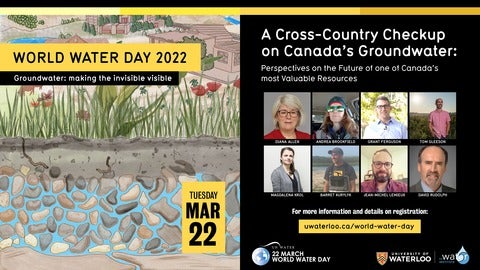
A Cross-Country Checkup on Canada’s Groundwater: Perspectives on the Future of one of Canada’s most Valuable Resources
Scientists of all backgrounds and genders, have made important contributions in science, technology, engineering and mathematics (STEM), but the participation of women remains low in many areas of STEM, including physics. What can we do to build an inclusive STEM community? Shohini Ghose, IQC affiliate and Director of the Laurier Centre for Women in Science (WinS) will discuss data that can shed light on where we stand today and describe a practical framework for increasing access and inclusion in STEM.