We are happy to share our latest work published in JACS: "Cation-Ordering-Driven Design of Superionic Lithium Halospinels." The paper was first authored by group member Yubo Wang.
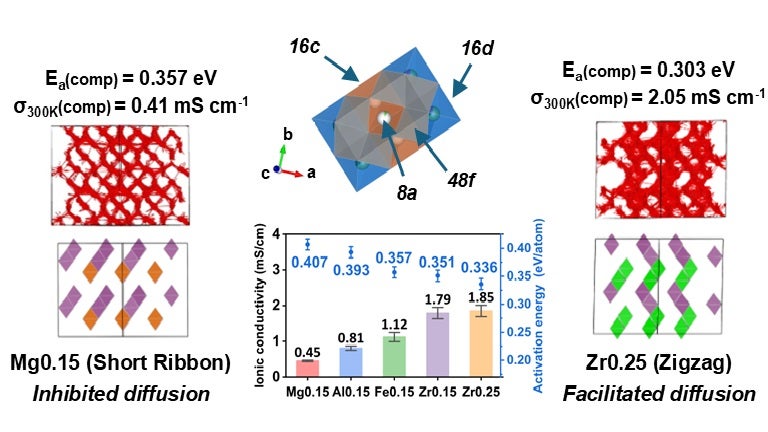
Reducing the materials cost of inorganic solid-state electrolytes is crucial to advancing all-solid-state batteries (ASSBs) for next-generation energy storage applications. We combine M3GNET universal machine learning interatomic potential (UMLIP) and density functional theory (DFT) for efficient screening of lower cost cation substitution into Li2Sc2/3Cl4 halospinel. As a cost-mitigation strategy, predicted Mg2+, Al3+, Fe3+ and Zr4+-substituted spinels with substitution fractions up to 37.5% were experimentally synthesized with only minor impurities, achieving room-temperature ionic conductivities as high as 1.85 mS cm−1. Molecular dynamics simulations (MD) using highly accurate moment tensor potentials (MTPs) indicate that Li+/Sc3+/Mn+ ordering plays a crucial role in determining the conductivity of disordered substituted compositions. ASSBs operating at 3.8 mAh cm−2 capacity with Li1.75Sc0.416Zr0.25Cl4 at a high current density of 2 mA cm−2 exhibited 80% of the capacity of more moderately-loaded ASSBs cycled at a low-rate. This work provides a foundational methodology for predicting the thermodynamic stability and ion transport of disordered lithium solid electrolytes and accelerating the discovery of novel materials for a range of applications.
DOI: 10.1021/jacs.5c15656