We are excited to share our latest work accepted in Chemistry of Materials: "Dissecting Disorder: Defect-Driven Structural Complexity in Layered Li3InCl6 Solid Electrolyte." The paper was co-first authored by group members Lanting Qian and Ivan Kochetkov.
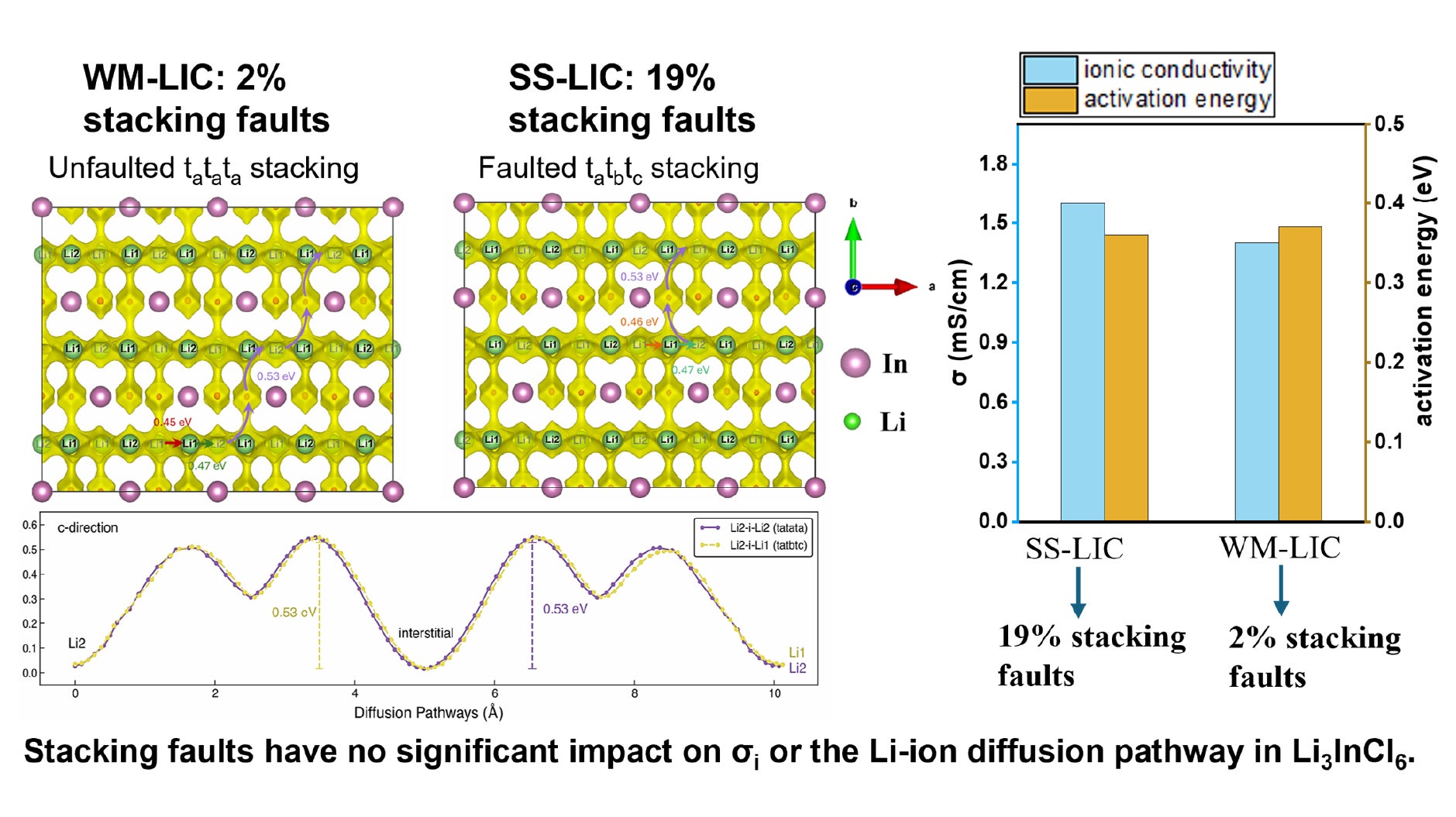
Halide solid electrolytes have emerged as promising candidates for solid-state batteries owing to their high oxidative stability and ionic conductivity. Among them, Li3InCl6 (LIC) has attracted significant attention. However, diffraction patterns of LIC synthesized via different methods exhibit distinct differences ─particularly at low-angle reflections─indicative of underlying structural disorder. These variations are attributed to deviations from ideal crystallographic order, especially stacking faults, whose impact on structure and ion transport remains poorly understood. Here, we identify and quantify stacking faults in LIC samples prepared under different synthetic conditions. Using X-ray diffraction and time-of-flight neutron diffraction, we construct and refine stacking fault models that accurately reproduce the experimental diffraction features. LIC samples with higher degrees of stacking faults exhibit only negligible differences in ionic conductivities and activation energies. This indicates that stacking faults have a limited impact on altering the Li+ diffusion pathway along the c-axis, likely due to the high concentration of vacancies in the In layers, while Li+ diffusion remains nearly unchanged in the ab-plane. Our results account for the observed differences in diffraction patterns across samples and provide a quantitative assessment of faulting probabilities and stacking sequences. The insights gained from this study are expected to be broadly applicable to other layered halide solid electrolytes and contribute to a deeper understanding of the role of structural disorder in ion transport.
DOI: 10.1021/acs.chemmater.5c02259