We are excited to share our latest work in Angewandte Chemie: “Enabling Moisture and Interfacial Stability in Sulfide Solid Electrolytes via a Processable Organic Coating Strategy for High-Voltage All-Solid-State Batteries.” The paper was first authored by group member Lanting Qian.
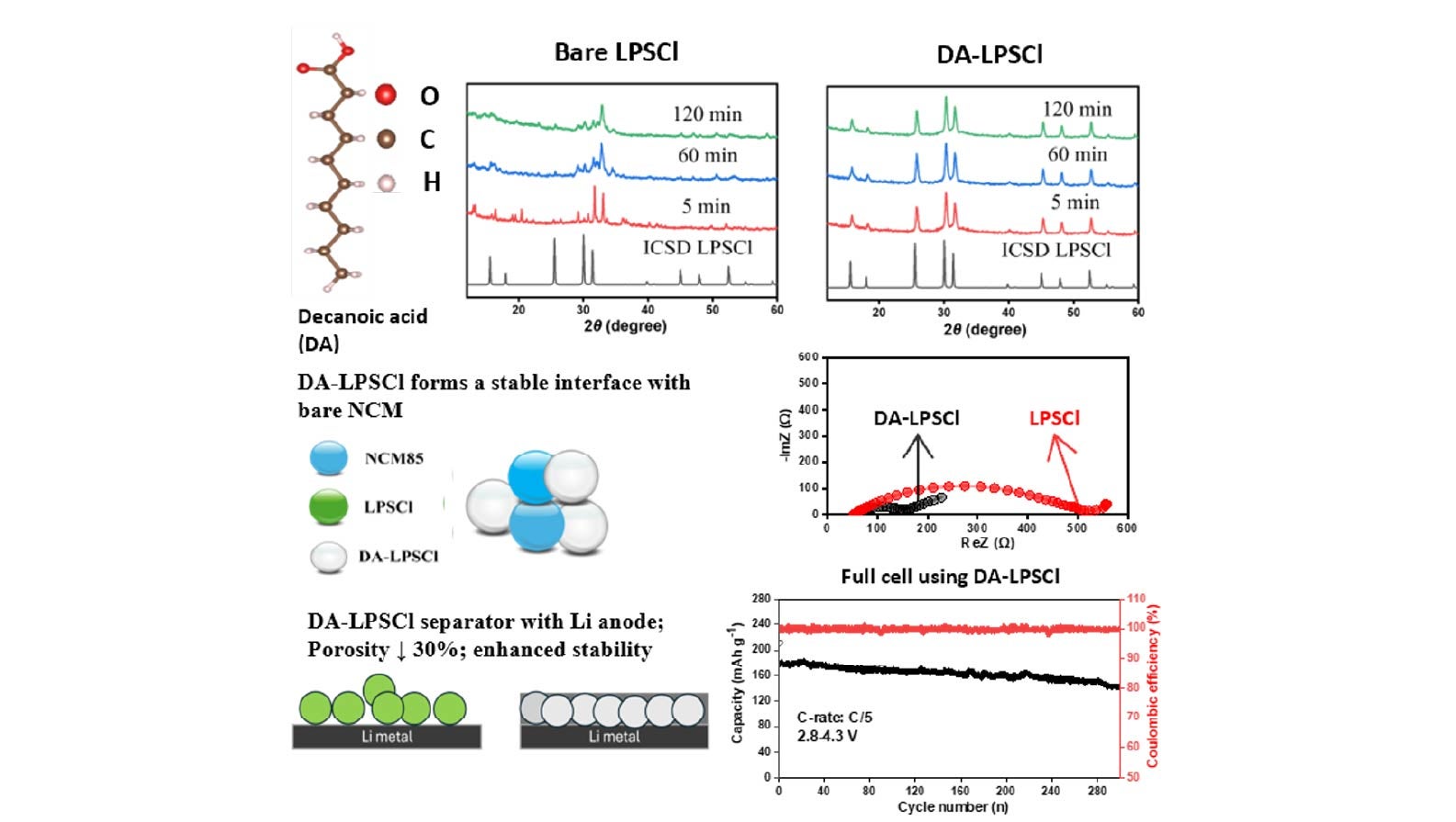
Sulfide solid electrolytes (SEs) are excellent candidates for solid-state batteries (SSBs), but their extreme sensitivity to moisture and lack of oxidative stability with uncoated high-voltage cathodes incur processing complexity and cost. Here, we present a simple and cost-effective decanoate fatty-acid (DA) coating strategy for argyrodite (Li6PS5Cl, LPSCl) that stabilizes it to exposure at 39% relative humidity for up to 2 h, while preserving its structure, ionic conductivity, and increasing its anodic stability. Cells employing 2 wt%-coated LPSCl (DA–LPSCl) as the catholyte, with a bare NCM85 cathode and Li-In anode, deliver a capacity of 175 mAh.g−1, and 96% capacity retention over 150 cycles at 0.2 C, while bare LPSCl retains only 61% capacity. Symmetric Li|DA–LPSCl|Li cells cycle for 1000 h, in contrast to bare LPSCl cells, which short-circuit after ∼230 h. Moreover, full cells using a lithium metal anode with the DA–LPSCl SE showed remarkable performance compared to state-of-the-art SSBs, retaining 81% of their capacity after 300 cycles at 0.2 C. High-loading cells with areal capacities up to 3.2 mAh cm−2 are also demonstrated. This work showcases the potential of a low-cost, processable, and flexible coating to address key limitations of sulfide SEs, advancing the commercial viability of SSBs.
DOI: 10.1002/anie.9983580