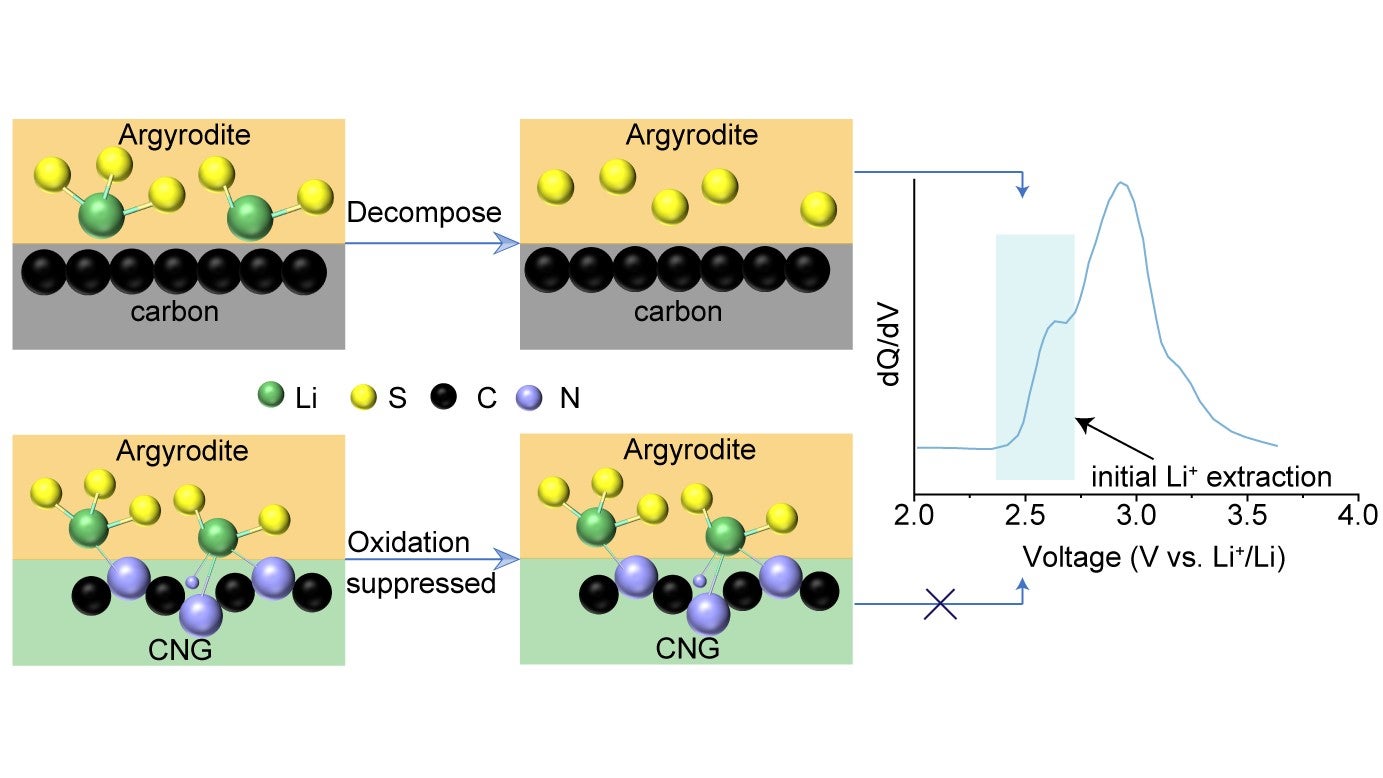
We are excited to share our latest work accepted in Nature Materials: "Suppressing argyrodite oxidation by tuning the host structure for high-areal-capacity all-solid-state lithium–sulfur batteries." The paper was first authored by group member Zhuo Yu.
This research paper describes a breakthrough in all-solid-state lithium–sulfur batteries by addressing the premature oxidation of argyrodite electrolytes. While these electrolytes are highly ion-conductive, they typically decompose at low voltages, which limits battery cycle lifespan. The authors developed a carbon nitride/N-doped graphene (CNG) host that effectively stabilizes the interface through strong chemical binding between electron-rich nitrogen groups and lithium ions. This structural tuning inhibits the initial step of electrolyte breakdown and also regulates electron transport to prevent degradation. As a result, the batteries achieved high areal capacities up to 11 mAh cm-2 and exceptional stability. These findings offer a new strategy for designing durable, high-energy interfaces in next-generation solid-state energy storage.
DOI: 10.1038/s41563-025-02238-2