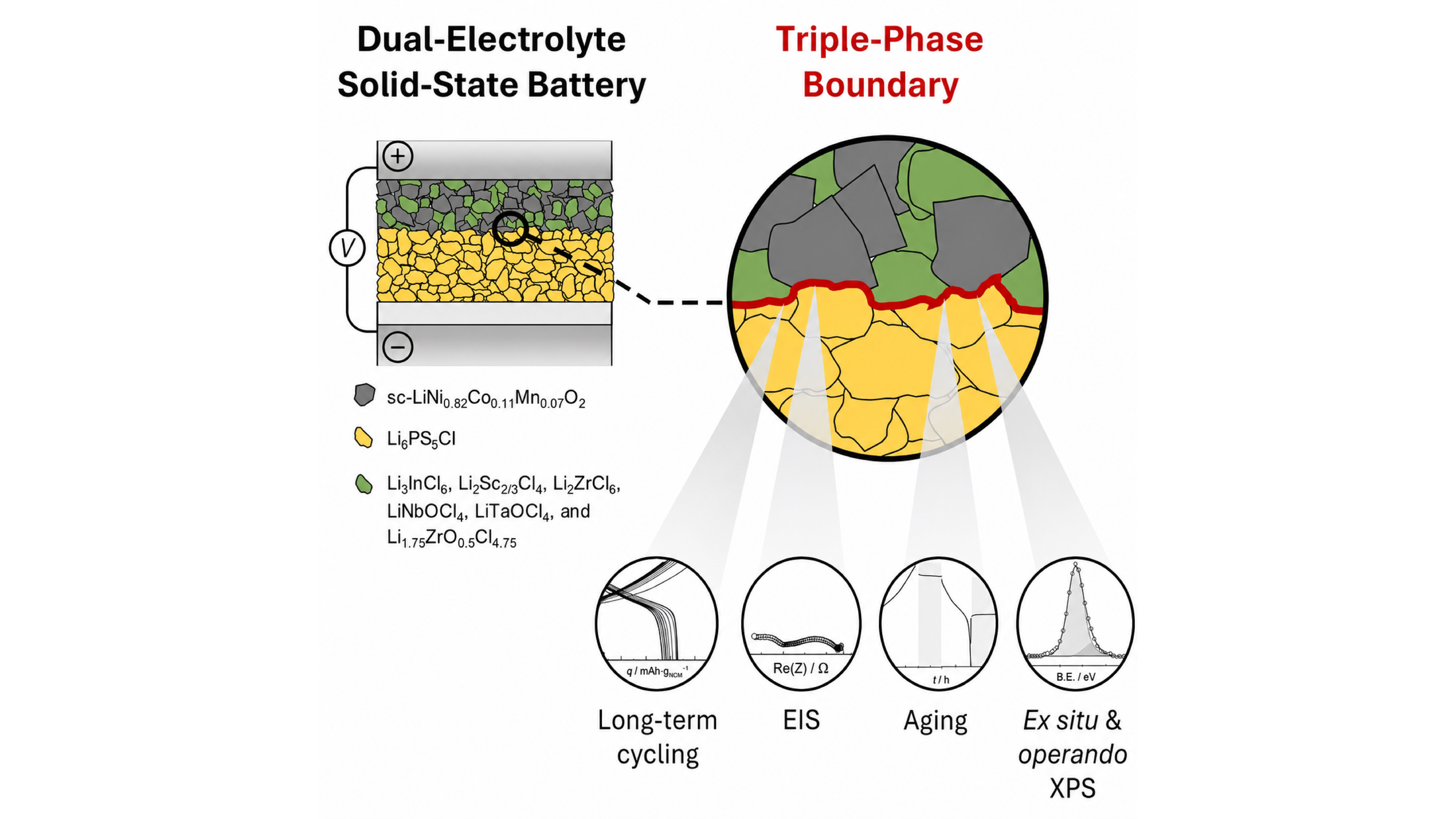
We are excited to share our latest work in Joule in collaboration with JLU, Giessen – “Triple-phase boundary instability as a key degradation factor in sulfide|(oxy)halide dual-electrolyte solid-state batteries.” The paper was co-authored by group member Vipin K. Singh.
To achieve the goal of commercial solid-state batteries (SSBs), the scientific community has increasingly turned to dual-electrolyte designs that combine different solid electrolytes in a single cell, each chosen for its specific advantages. A promising combination involves a sulfide as the separator electrolyte, which offers high ionic conductivity, and an (oxy)halide electrolyte in the positive electrode (cathode), which provides exceptional oxidative stability. Previous reports have shown that the novel interface between the separator electrolyte and the cathode electrolyte gets unstable, which can only be overcome by introducing an interlayer of cathode electrolyte.
This work reveals that when a sulfide and an (oxy)halide electrolyte come into contact near the cathode active material, they form a triple-phase boundary that is fundamentally unstable during cell cycling. This instability is independent of the specific (oxy)halide chemistry and leads to accelerated degradation, sulfur-gas evolution, and rapid performance decay. These findings suggest that the challenges associated with such a triple-phase boundary may be universal to other dual-electrolyte systems and could limit the practical application of dual-electrolyte SSBs. Ultimately, resolving triple-phase boundary degradation will be essential to translating dual-electrolyte SSB concepts from the laboratory-scale to real-world applications.
DOI: 10.1016/j.joule.2026.102444