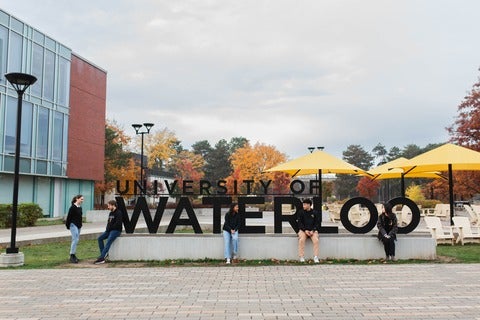
What is the University of Waterloo made of?
As 2023 draws to a close, we cannot forget what a challenging year it was for us as an institution and a community.

As more high potential startups grow out of university research, it’s critical to understand how government, industry and academia can align to accelerate commercialization.
Like so many great decisions in his life, it was the advice of his “Auntie Charity” that led scholar Victor Mawutor Agbo to choose the University of Waterloo as the next phase of his academic journey.
He had just wrapped up his undergraduate degree in Tourism Management in Ghana and was looking at schools in Europe to continue his studies. “That’s when my auntie who lives in Canada said, 'This university is right next to us, and it's one of the best universities in Canada.’ So that's how I heard about Waterloo," says Agbo.
The University of Waterloo has been designated Research University of the Year in the comprehensive category by Research Infosource Inc. for the 16th consecutive year. Waterloo’s consistent ranking stands as a testament to the University being at the forefront of fostering the next generation of researchers and entrepreneurs.
December 6 marks the National Day of Remembrance and Action on Violence Against Women in Canada. Thirty-four years ago, 14 female engineering students were murdered at École Polytechnique de Montréal (now Polytechnique Montréal) in an act of gender-based violence, a manifestation of historical unequal power that creates barriers to limit the advancement of women and gender-diverse people.
By spreading quickly, outcompeting native species for resources, invasive species are becoming a serious threat to biodiversity. As part of the University of Waterloo’s Sustainable Land Care Standard, Waterloo is working towards managing invasive species and increasing native and ecologically appropriate plants across campus.
Over the next week, I’m joining a University of Waterloo delegation on a trip to South Africa and Ghana. Meeting with post-secondary and government leaders, we hope to learn ways to create meaningful partnerships.
As the second-fastest growing region in the world, Africa has a bright future on the horizon. Working with partners across the continent, we are excited to explore ways we can co-create research and teaching opportunitiesthat benefit local communities across Africa and have a global impact.
When the registration period opens for Kinesiology Lab Days, dates sell nearly as quickly as Taylor Swift concert tickets.
Within just a couple of minutes this year, all the available spots were full for Ontario high schools to sign up students to attend the Department of Kinesiology and Health Sciences’ (KHS) live labs for an interactive experience in university-level education.
An interdisciplinary research team from the University of Waterloo aims to tackle CO2 emissions in the value chain by transforming CO2 into valuable chemicals needed by industry.
Supported by BMO, the research focuses on the use of green hydrogen to capture CO2 from power plants as well as the iron, steel, and cement industries, and convert it into useful gases via reverse water gas shift reaction.
The School of Public Health Sciences (SPHS) has partnered with United College’s GreenHouse and the Centre for Career Development (CDD) to offer Health Sciences students an experiential learning opportunity in HLTH 480, a new required course that will address complex health problems like climate anxiety, kidney disease prevention and management, addiction recovery and more.