Future students

Monday, July 22, 2024

Giving back to lighten students’ financial burden

by Charlotte Danby, Faculty of Engineering

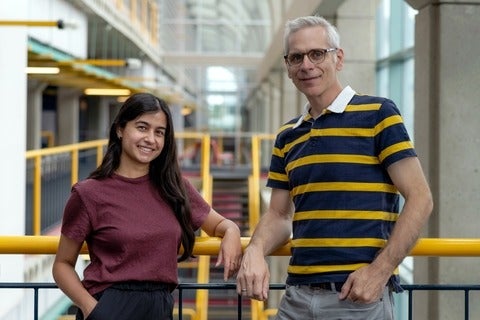
Rehnuma Tasneem (BASc ‘24) did not always want to become an engineer. Growing up she pictured herself as a nurse or a doctor, pursuing a career that held prominence in her Bangladeshi family and community — no one she knew was an engineer. 

Tasneem moved to Canada with her parents when she was in high school. Her interest in the sciences grew with a particular enjoyment for subjects like physics and math. Shifting her focus to these fields, Tasneem researched other areas of impactful work outside of health care and discovered engineering.  

Friday, July 19, 2024

Waterloo partners with the Accelerator Centre to further innovation and entrepreneurship

by Angelica Marie Sanchez, University Relations

A University of Waterloo partnership with the Accelerator Centre (AC) will further advance our commitment to creating social change through innovation with the launch of the Global Impact Creator Program.  

Friday, July 19, 2024

Solving the crisis: Rising urban temperatures

by Jordan Flemming, University Relations

The "Solving the crisis:" series explores the pressing challenges of our time, including climate change, access to health care, housing affordability and more. Each article highlights how Waterloo, a hub of research, innovation and creative thinking, is uniquely positioned to address these issues. Through this series, we highlight the dedication of researchers to tackling global crises and shaping a better future for all.

Friday, July 12, 2024

Q and A with the experts: Break the cycle of burnout

by Naomi Grosman, Velocity

Burnout is a state of emotional, physical and mental exhaustion — and it’s pervasive.

In the U.S., 72 per cent of the workforce reports stress and anxiety affecting their daily lives, according to peer reviewed research published in the Annual Review of Organizational Psychology and Organizational Behavior.

Wednesday, July 10, 2024

Uncovering the truth behind the Alderney death count

by University Relations

Waterloo researchers are known globally for tackling complex problems and Dr. Robert Jan van Pelt, of Waterloo’s School of Architecture in Cambridge, is one of them. He is a highly regarded expert and truth-seeker on all things related to the Holocaust. 

A quarter of a decade ago, van Pelt acquired fame as an expert witness in a notorious British libel trial that pitted British Holocaust denier David Irving against American historian Deborah Lipstadt. 

Friday, July 5, 2024

Less highlighting may mean more learning

by Mayuri Punithan, Cheriton School of Computer Science

If you scroll through the average student’s digital textbook or reading, you will probably see multi-coloured streaks scattered everywhere. However, new research reveals that excessive highlighting may do more harm than good.

Researchers at Waterloo excel at creating new technologies, investigating human-technology interactions, and exploring how to mitigate harm. That’s why it’s no surprise that two computer scientists from Waterloo investigated whether technology controlling the number of words a user can highlight could affect their reading comprehension.

Wednesday, July 3, 2024

New open-source software is greater than the sum of its parts

by Elizabeth Kleisath, Institute for Quantum Computing

Accurate models of real-world scenarios are important for bringing theoretical and experimental research together in meaningful ways. Creating these realistic computer models, however, is a very large undertaking. Significant amounts of data, code, and expertise across a wide range of intricate areas are needed to create useful and comprehensive software. 

Tuesday, July 2, 2024

Overcoming fear for social justice

by University Relations

Waterloo researchers are renowned for challenging perspectives in their pursuit of truth and to produce knowledge that leads to transformative solutions for humanity to thrive in a complex future.   

Although universities are environments where new ideas and discoveries are cultivated, and a space for curiosity to flourish, researchers in many fields also experience hostile responses to their work.  

Tuesday, July 2, 2024

Regulations grounded in research are saving lives by adding restrictions to tobacco

by Jordan Flemming, University Relations

According to Health Canada, about 48,000 people in Canada die from tobacco use each year. Research has shown that tobacco use is a leading cause of preventable diseases and deaths worldwide and efforts to reduce tobacco consumption through regulation and policy measures have significantly contributed to public health improvements.

Strategies supported by science, like the work carried out by Dr. David Hammond and Dr. Geoffrey Fong here at the University of Waterloo, aim to save lives by reducing tobacco-related diseases and promoting public health.

Friday, June 28, 2024

Hope over fear: Standing up to intolerance

by Angelica Marie Sanchez, University Relations

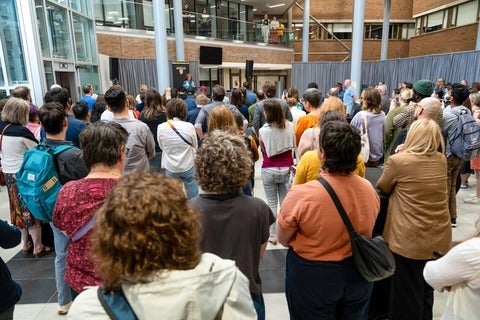
The University of Waterloo marked the one-year anniversary of the Hagey Hall attack, a moment of hate-motivated violence that deeply impacted our community.   

More than 150 campus members gathered inside the Hagey Hall Hub on June 28, in solidarity and support of everyone who had to confront violence and experience trauma that day.  While standing together, the community was standing up against gender-based violence and all forms of hatred and bigotry.