Pocket-sized device detects E. coli in minutes
Waterloo researchers develop inexpensive technology to help prevent deaths, illness caused by contaminated water
A palm-sized device developed by researchers at the University of Waterloo could help save lives and reduce illness by rapidly and inexpensively detecting toxic bacteria in water supplies.
Contamination caused by E. coli, a bacterium commonly found in the gastrointestinal tracts of mammals, causes an estimated 230 deaths and three million acute illnesses globally each year, mostly affecting babies and young children, according to a study from the National Institute of Health.
The research team set out to help reduce those numbers by building on technology it originally developed to detect the COVID-19 virus during the global pandemic.
“We’re confident our technology could have a significant health impact,” said Dr. Carolyn Ren, a professor of mechanical and mechatronics engineering, and the Canada Research Chair in Microfluidic Technologies at Waterloo.
“Testing shows it is very accurate, both in terms of specificity – the ability to differentiate between E. coli and other bacteria – and sensitivity.”
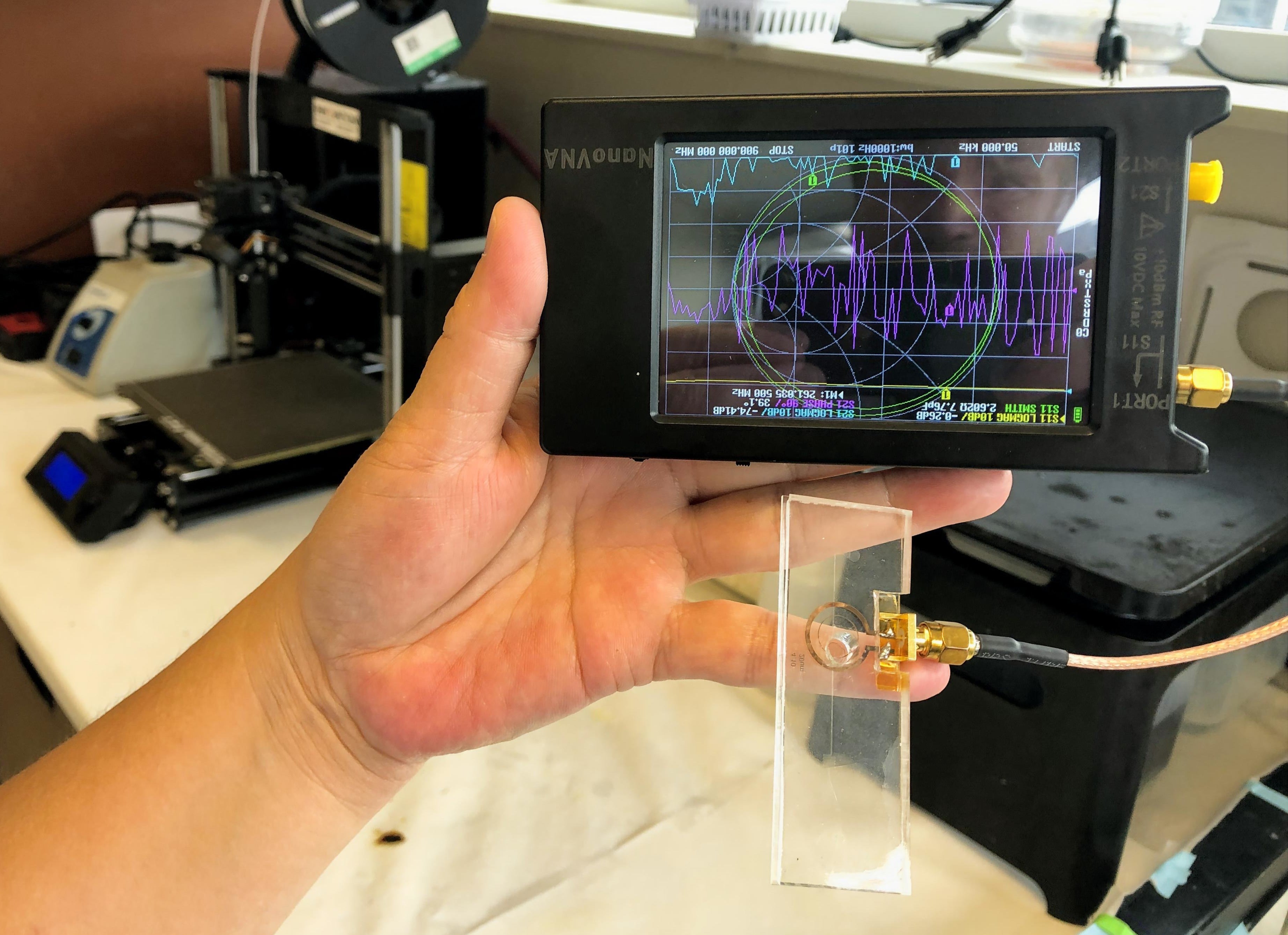
Researchers paired a vector network analyzer (VNA) with a small sensor to create a handheld device that can rapidly detect E. coli bacteria in water.
Costing just $70 to produce, the device includes a gold-plated sensor about the size of a dime paired with a smartphone-size board that contains a small instrument known as a vector network analyzer (VNA).
The sensor is coated with an antibody – a type of protein produced by the immune system – that attracts and binds E. coli to its surface if bacteria are present in a sample of a few drops of water.
When E. coli binds to the antibody, it triggers a shift in the resonance frequency of microwaves emitted by the sensor. That shift is detected and analyzed by the VNA, which determines both the presence and concentration of the bacteria in real time.
The device was tested with only a few drops of water in its reservoir, but Ren said the technology could easily be scaled to meet international E. coli standards that require larger samples.
Current E. coli tests typically involve collecting and transporting water samples to centralized labs, often resulting in delays that can take days and can leave people vulnerable to illness.
Ren said the Waterloo-built device’s rapid results, low cost and portability make it ideal for on-site testing in homes and water treatment plants, and to regularly monitor water bodies for contamination.
Its potential is especially significant in developing countries where people are more vulnerable to E. coli contamination and access to lab-based testing is limited. In a study in sub-Saharan Africa, for example, 71 per cent of household water samples were found to be contaminated.
“Water regulations are strict and it’s difficult to adopt new technology quickly,” said Ren, who is also a member of the Water Institute and the Waterloo Institute for Nanotechnology. “We hope our work will inspire the scientific community and the private sector to help make it widely accessible.”
Collaborators included Dr. Emmanuel Ho, a professor of pharmacy, Dr. Philippe Van Cappellen, a professor of earth and environmental sciences, and Dr. Weijia Cui, a postdoctoral researcher.
A paper on their work, A functionalized microwave biosensor for rapid, reagent-free detection of E. coli in water samples, appeared in Biosensors and Bioelectronics.