Community

Tuesday, November 7, 2017

Eyeing the chance to finally go downhill on concrete toboggan

by Brian Caldwell, Faculty of Engineering

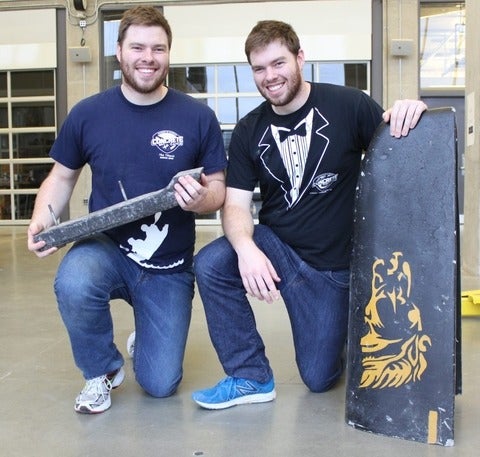
There is at least one advantage – and a bit of drawback – to being former rugby players and identical twin brothers on a concrete toboggan team.

Size, strength and symmetry make Russell and Graham Giles ideal pushers to get a 300-pound contraption with five helmeted passengers off to a fast, straight start at annual races.

And the drawback?

Their usefulness at the top of the hill means the Cambridge brothers have never actually got to ride in a toboggan with a concrete sliding surface as it hit speeds of up to 50 km/h on the way down.

The study, which appears in the Journal of Environmental Quality, describes how the researchers tested private, rural groundwater wells in the Nottawasaga River Watershed for four artificial sweeteners as a way to detect groundwater impacted by human wastewater being released by septic systems in the area.

Artificial sweeteners are ideal human wastewater tracers as they exit the human body essentially unchanged and are not completely removed by most wastewater treatment processes.  Human wastewater contains relatively high concentrations of artificial sweeteners.