Waterloo students’ art shines bright at Lumen Festival
This past September, the City of Waterloo lit up with the annual Lumen Festival, which explores the interplay of light, art and technology.
In an era where climate change is more visible than ever — rising urban temperatures, extreme weather events and increasing instances of poor air quality from wildfire smoke — the demand for accurate and trustworthy information is critical. The University of Waterloo, in collaboration with the Waterloo Climate Institute, hosted an impactful community lecture addressing this pressing issue.
Leveraging co-op opportunities, Waterloo students have been making a huge impact across various industries including business, technology and health.
Many of these breakthroughs occur at the Hospital for Sick Children (SickKids), Canada’s largest single hospital research institute, and one of Waterloo’s top co-op employers.
From designing image detection tools to developing 3D neurovascular prototypes and building surgical robot simulators, producing disruptive technologies is at the core of what our students do in advancing the future of health care in Canada.
Triumph after tragedy, loss and grief are perhaps all the core elements needed for a compelling sports movie script. But scoring a championship-winning shot with just two seconds to spare on the clock sealed the 1974-75 Warriors Men’s Basketball team’s legacy as one of the best to ever play.
After experiencing profound loss, the team went through the entire season undefeated, thanks to the incredible talent and uncontested tenacity of the student-athletes, Don McCrae, the head coach of the team and the incredible support of the Waterloo community.
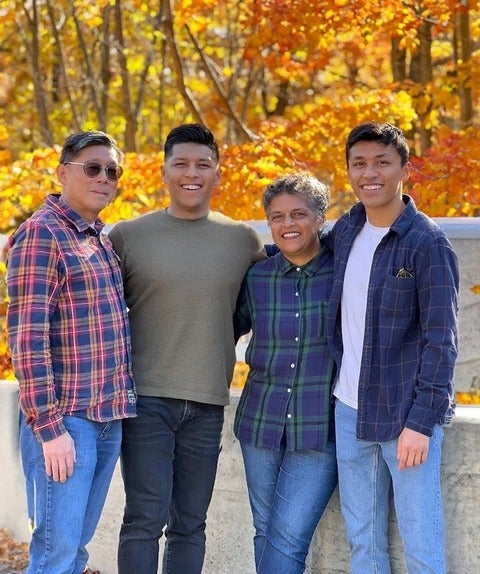
The University of Waterloo has profoundly shaped every aspect of Ruhuni de Alwis’s (BA ’89, BMath ’89) life, from career foundation to personal relationships.
Through Waterloo’s co-op program, de Alwis built a thriving career, met her partner, Barry Matsui (BMath ’89) and forged lifelong friendships. But when de Alwis first arrived on campus in 1984, she was uncertain about her future.
“Kids today seem to have a clearer idea of what to expect, but back then, it was a leap of faith,” she said.
“It’s hard to be creative when you’re afraid,” muralist Stephanie Boutari (BAS ’11, MArch ’14) reflected. Today, Boutari is a successful artist, and her colourful murals appear in commercial and public spaces across Ontario. However, her journey to this point has been a long and winding one as she gained the confidence to pursue her true passion.
The University of Waterloo is dedicated to solving complex global challenges through research excellence and deep industry and community partnerships. Waterloo focuses on transforming societies, economies, technologies, sustainability and health for a thriving future. The "Solving the crisis" series takes an in-depth look at six of some of the most pressing challenges facing humanity today, ranging from climate change to housing affordability.
Developing and delivering quality healthcare requires an interdisciplinary approach, drawing on fields ranging from history to sociology to communication and design. And Waterloo’s strong emphasis on interdisciplinary scholarship is one reason, Dr Peter Warrian and his wife, Dr. Margret Hovenec, established the Lupina Foundation Postdoctoral Research Fellowships with Waterloo’s Faculty of Arts.
The "Solving the crisis:" series explores the pressing challenges of our time, including climate change, access to health care, housing affordability and more. Each article highlights how Waterloo, a hub of research, innovation and creative thinking, is uniquely positioned to address these issues. Through this series, we highlight the dedication of researchers to tackling global crises and shaping a better future for all.
Economic inequality is a persistent and complex issue that has been the focus of scholars, policymakers and activists worldwide for decades.
The "Solving the crisis:" series explores the pressing challenges of our time, including climate change, access to health care, housing affordability and more. Each article highlights how Waterloo, a hub of research, innovation and creative thinking, is uniquely positioned to address these issues. Through this series, we highlight the dedication of researchers to tackling global crises and shaping a better future for all.