Turning seawater into fresh water through solar power
Researchers at the University of Waterloo have designed an energy-efficient device that produces drinking water from seawater using an evaporation process driven largely by the sun.
As technology increasingly transforms business strategy, it is crucial for senior leaders to stay ahead of the curve.
The University of Waterloo’s Tech Horizons Executive Forum, brought to you by WatSPEED and hosted by CIBC, returns this year to equip executives with the insights and tools needed to thrive in a world increasingly driven by technology. This year’s event will take place on November 26 at CIBC Square in Toronto.
Developing and delivering quality healthcare requires an interdisciplinary approach, drawing on fields ranging from history to sociology to communication and design. And Waterloo’s strong emphasis on interdisciplinary scholarship is one reason, Dr Peter Warrian and his wife, Dr. Margret Hovenec, established the Lupina Foundation Postdoctoral Research Fellowships with Waterloo’s Faculty of Arts.
The University of Waterloo has again been ranked the best amongst Canadian universities for producing successful entrepreneurs with undergraduate degrees, according to the 2024 PitchBook university rankings.
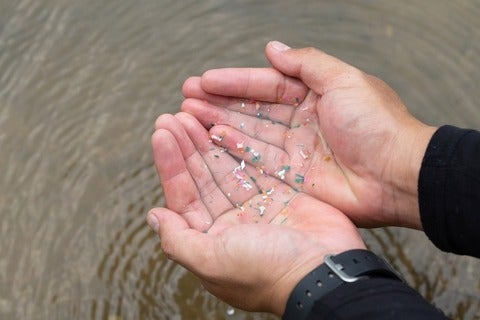
In a global first, University of Waterloo researchers have used 3D imaging technology to understand the fine details of microplastics, paving the way for more effective methods of plastic waste recycling.
Micro and nanoplastics, tiny particles of plastic that come from the breakdown of larger plastic items, have become an exponentially worsening environmental crisis. Due to their difficulties in safely decomposing, plastic pollution poses significant threats to ecosystems, wildlife and human health.
Two University of Waterloo researchers, Drs. Ihab Ilyas and Laura Hug, are being recognized as a Royal Society of Canada (RSC) fellow and a member of the RSC College.
University of Waterloo researchers have developed a new material that can absorb more than eight times its weight in oil, offering a new solution in preventing groundwater contamination from spills or accidents.
“The current technology for oil capture is lagging,” said Tizazu Mekonnen, a professor at Waterloo’s Department of Chemical Engineering. “Preserving our environment is crucial, which is why developing advanced technologies like this polymer is essential for remediating future groundwater contaminants that involve oil.”
The "Solving the crisis:" series explores the pressing challenges of our time, including climate change, biodiversity collapse, housing affordability and more. Each article highlights how Waterloo, a hub of research, innovation and creative thinking, is uniquely positioned to address these issues. Through this series, we highlight the dedication of researchers to tackling global crises and shaping a better future for all.
A research team from the University of Waterloo has developed a new material that shares many of the same traits as bone tissue. Using it in 3D printers provides a new and innovative treatment option for patients undergoing major skeletal repair and reconstructive surgery.
Surgical reconstruction in these cases currently involves metal implants and donated bone. Surgeons request a specific size and type from tissue banks to best match their patient’s anatomy, but it’s rarely a perfect fit. A recipient’s body may also reject donated bone.
A team of undergraduate Computer Science students placed in the top eight at a recent AI Hackathon with “Skyline,” a project that uses demographic data and machine learning to simulate cities and use these patterns to optimize its transit infrastructure.