Technological Futures

Wednesday, November 19, 2025

Financial inflection point: How do we move from analogue to digital-first?

by Meg Vander Woude, Office of Advancement

As Sir Ron Kalifa, head of financial infrastructure and vice chair of private equity at Brookfield, reflected on the beginning of his career, he described a rigid, hierarchical environment and recalled physically writing in ledgers. Those physical ledgers may have exited banks years ago, but Kalifa believes that most large-scale financial institutions are still analogue businesses.  

At a time filled with cryptocurrencies and digital payment systems, how can traditional banks catch up?  

Monday, November 17, 2025

10 Waterloo entrepreneurs to watch

by Darren McAlmont, University Relations

As Global Entrepreneurship Week 2025 begins, we’re spotlighting 10 standout entrepreneurs from the University of Waterloo — students and alumni who are challenging norms, redefining industries and building a better future. These innovators are not only making waves in their respective fields but are also setting the pace for what’s next for society, health, technology, the economy and sustainability. 

Wednesday, November 12, 2025

AI’s energy usage is less than previously thought

by Media Relations

Contrary to popular belief, new research finds that the use of artificial intelligence has a minimal effect on global greenhouse gas emissions and may actually benefit the environment and the economy.

For their study, researchers from the University of Waterloo and the Georgia Institute of Technology combined data on the U.S. economy with estimates of AI use across industries to determine the environmental fallout if AI use continues its current trajectory.

Wednesday, November 12, 2025

Waterloo researchers rank among the most influential in the world

by University Relations

The University of Waterloo has seen an increase in the number of researchers included in this year’s Highly Cited Researchers™ 2025 list recently published by Clarivate. The list highlights the world’s most influential researchers and scientists.

Those selected have authored multiple Highly Cited Papers which rank in the top one per cent by citations in their field. Citations and peer review are the lifeblood of academic research, ensuring both integrity and innovation. The Highly Cited Researchers™ list recognizes only one in 1,000 researchers from around the world.

Monday, November 10, 2025

Swish Solar raises US$1.5M to make solar energy more sustainable

by Media Relations

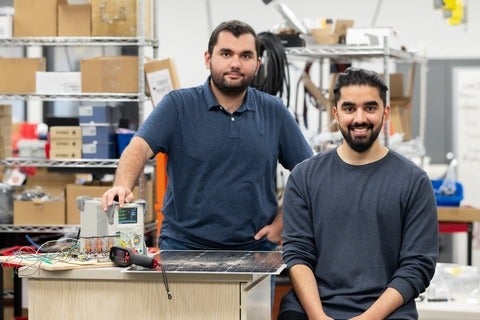
Swish Solar, a cleantech company based at Velocity, the University of Waterloo’s startup incubator, has closed an oversubscribed US$1.5 million pre-seed round. The new financing will accelerate market adoption of its self-cleaning solar technology that helps make renewable energy more efficient and sustainable.

“Solar panels can lose up to 60 per cent of their efficiency due to sand and snow buildup, costing the cleantech energy industry billions in lost revenue each year,” said Miswar Syed (MASc '25), CEO of Swish Solar.

Thursday, November 6, 2025

How AI can track hockey action from faceoff to finish

by Media Relations

Researchers at the University of Waterloo have developed two innovative artificial intelligence (AI) systems that significantly improve how hockey games can be analyzed using video footage without the need for expensive equipment.

Drawing on Waterloo’s strengths in computer vision and systems design, the research advances the evolving field of automated sports analytics. The new tools address long-standing challenges in tracking fast-moving game action, including obstructed views and motion blur common in broadcast feeds.

Wednesday, November 5, 2025

From the clinic to the living room

by Mayuri Punithan, David R. Cheriton School of Computer Science

What if your gym routine consisted of gliding across a forest, skewing fruits like a ninja, or racing on a Formula 1 track?   

That’s the vision behind Hiro, a Waterloo-based startup that is gamifying physiotherapy exercises for children with disabilities — by including people with disabilities at the research’s core.  

Deep within the structure of the Mathematics and Computer building (MC) at the University of Waterloo lies one of the most sophisticated and important digital research computing systems in Canada. The newly refreshed system, named Nibi, recently replaced the Graham supercomputer.