Electric planes approved for Canadian pilot training
Transport Canada has approved the first electric planes for training purposes thanks in large part to years of research and

Contrary to popular belief, new research finds that the use of artificial intelligence has a minimal effect on global greenhouse gas emissions and may actually benefit the environment and the economy.
For their study, researchers from the University of Waterloo and the Georgia Institute of Technology combined data on the U.S. economy with estimates of AI use across industries to determine the environmental fallout if AI use continues its current trajectory.
The University of Waterloo has seen an increase in the number of researchers included in this year’s Highly Cited Researchers™ 2025 list recently published by Clarivate. The list highlights the world’s most influential researchers and scientists.
Those selected have authored multiple Highly Cited Papers which rank in the top one per cent by citations in their field. Citations and peer review are the lifeblood of academic research, ensuring both integrity and innovation. The Highly Cited Researchers™ list recognizes only one in 1,000 researchers from around the world.
Swish Solar, a cleantech company based at Velocity, the University of Waterloo’s startup incubator, has closed an oversubscribed US$1.5 million pre-seed round. The new financing will accelerate market adoption of its self-cleaning solar technology that helps make renewable energy more efficient and sustainable.
“Solar panels can lose up to 60 per cent of their efficiency due to sand and snow buildup, costing the cleantech energy industry billions in lost revenue each year,” said Miswar Syed (MASc '25), CEO of Swish Solar.
The solution to Canada’s housing crisis seems simple: build more affordable homes fast. But like many real-world solutions, that’s easier said than done.
Researchers at the University of Waterloo have developed two innovative artificial intelligence (AI) systems that significantly improve how hockey games can be analyzed using video footage without the need for expensive equipment.
Drawing on Waterloo’s strengths in computer vision and systems design, the research advances the evolving field of automated sports analytics. The new tools address long-standing challenges in tracking fast-moving game action, including obstructed views and motion blur common in broadcast feeds.
What if your gym routine consisted of gliding across a forest, skewing fruits like a ninja, or racing on a Formula 1 track?
That’s the vision behind Hiro, a Waterloo-based startup that is gamifying physiotherapy exercises for children with disabilities — by including people with disabilities at the research’s core.
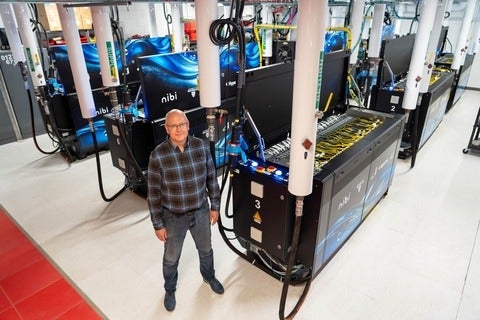
Deep within the structure of the Mathematics and Computer building (MC) at the University of Waterloo lies one of the most sophisticated and important digital research computing systems in Canada. The newly refreshed system, named Nibi, recently replaced the Graham supercomputer.
Four researchers at the University of Waterloo have been awarded $3.95 million in funding to support their research as part of the illustrious Canada Research Chairs (CRC) program.
This year, the CRC program is investing more than $198 million to support new and renewed Chairholders. Through the program, up to $311 million each year is invested to attract and retain some of the world’s most accomplished and promising minds.
An international team led by researchers at the University of Waterloo has developed new material that can be used as flexible “artificial muscles” to replace rigid motors and pumps in robots and allow them to move more naturally and fluidly.
Soft robots differ from hard robots in that they are pliable and flexible, making them safe for interaction with people, but the materials currently used for components enabling their movement aren’t strong enough to be effective.