Entrepreneurship

Thursday, February 1, 2018

Alumni robot is scrubbing down and cleaning up

by Carol Truemner, Faculty of Engineering

Neo is making a clean sweep inside hundreds of buildings throughout the world.

Launched by Kitchener-based Avidbots in early 2017, the robot is gaining a reputation for effectively cleaning and scrubbing large spaces in over 100 locations such as commercial and industrial buildings, shopping malls, airports, education facilities and healthcare centres.

Neo is the creation of Avidbots co-founders Pablo Molina and Faizan Sheikh, both alumni of Waterloo’s mechatronics engineering program.

Friday, December 22, 2017

Waterloop is building a faster pod to reach speeds of 300+ km/hr

by Natalie Quinlan, University Relations

The Waterloop team is on its way to building a faster, lighter and more sophisticated pod. So fast, they estimate passengers could one day travel from Waterloo to Toronto in a mere six minutes.

Having formerly used a levitation system that would allow the pod to travel completely frictionless, the student design team has moved to a different method to enhance speed.

At opportunities organized by Canada’s leading entrepreneurship programs, more than 100 U.S. and Canadian financers lined up to evaluate 43 of the most investment-ready tech startups in the Toronto-Waterloo Corridor.

The investors were introduced to the companies at an invite-only Demo Day event held at the Computer History Museum in Mountain View California on November 7, as well as a similar event held for Canadian investors in Toronto on October 19.


Wednesday, November 1, 2017

AI startup offers environmental protection

by Brian Caldwell, Faculty of Engineering

As a startup in the operational artificial intelligence (AI) sector, EMAGIN Clean Technologies Inc., is finding a receptive audience for a new system that uses AI for environmental protection as a means to help municipal utilities proactively improve their water and wastewater operations.

Friday, September 29, 2017

A Waterloo invention makes Dyson shortlist four years in a row

by Carol Truemner , Faculty of Engineering

A patch that delivers allergy medication to children developed by Waterloo students is one of only two Canadian projects to be shortlisted for this year’s international James Dyson Awards competition. It’s the fourth year in a row a University of Waterloo project has reached the final round.

Wednesday, September 27, 2017

Ourotech developing biomaterials for testing of cancer drugs

by Shane Schick, Faculty of Engineering

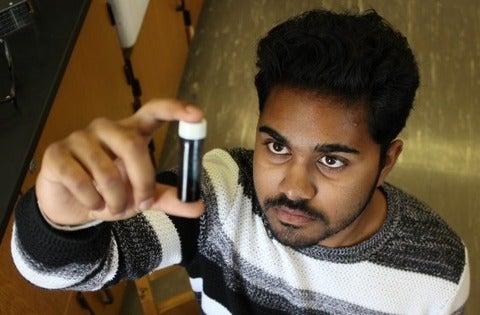
Duleeka Ranatunga proved the strength of his belief in his business idea when he entered – and won – a startup competition known as the Wolves Summit last year.

Held biannually in Warsaw, Poland, the contest is widely celebrated as a gathering of engineers, designers and other innovators. It’s also an opportunity for entrepreneurs to get in front of investors to make five-minute pitches.

A medical artificial intelligence (AI) startup was named one of 2017’s 20 most innovative technology companies by the Canadian Innovation Exchange (CIX) earlier this month.

Elucid Labs, a startup founded by three University of Waterloo researchers, uses AI technology in a small imaging device for the early detection of skin cancer. The technology helps dermatologists make better, faster decisions and reduces the number of unnecessary biopsies.

Representing Waterloo start-up EPOCH, students Jade Choy, Keith Choy, Lisa Tran, and Kaivalya Gandhi ranked among the top six teams in the $1 million Hult Prize Challenge at the United Nations in New York. The Challenge asked participants to find a sustainable, scalable social enterprise that could restore the rights and dignity of 10 million refugees by 2022.

EPOCH proposed an app that facilitates an exchange of talents and skills among refugees and community members through redeemable credits, a form of time banking where time is used as currency.