Research

Tuesday, June 1, 2021

High-risk, high-reward research

by Brian Caldwell, Faculty of Engineering

Four high-risk, high-reward research projects led by Waterloo Engineering professors were awarded a total of $1 million in federal funding this week.

Each of the projects is eligible for up to $250,000 over two years under the New Frontiers in Research Fund 2020 Exploration program, which brings researchers from different disciplines together to pursue breakthrough ideas.


Monday, May 31, 2021

Empowering Indigenous youth in the workplace

by Claire Francis, Faculty of Arts

Over the past three years, Indigenous and non-Indigenous scholars in Waterloo’s Industrial-Organizational Psychology program have been working with partners to explore and develop the qualities that make a workplace environment more equitable for Indigenous employees. Together they are contributing their findings to Indigenous Workways, a program that partners with companies and organizations to clear pathways for Indigenous employees and create safe and supportive space in organizations for Indigenous bodies and worldviews.

Wednesday, May 26, 2021

Helping doctors manage COVID-19

by Brian Caldwell, Faculty of Engineering

Artificial intelligence (AI) technology developed by researchers at Waterloo Engineering is capable of assessing the severity of COVID-19 cases with a promising degree of accuracy.

The new work, part of the COVID-Net open-source initiative launched more than a year ago, involved researchers from Waterloo and spin-off startup company DarwinAI, as well as radiologists at the Stony Brook School of Medicine and the Montefiore Medical Center in New York.

The pandemic has increased older adults’ willingness to receive the flu shot, new research shows. 

The study analyzed survey results of 4,501 Canadians over the age of 50 from ten provinces.

Twenty per cent of 1,001 research participants aged 50 to 64 indicated they had not considered getting a flu shot, but were now more likely to given the impact of COVID-19. Of these respondents, 92 per cent inducated that they had not been vaccinated against influenza the year before.

There’s wide consensus that workers should not go to work when they have COVID symptoms, but what can the Canadian government and employers do to ensure this doesn’t happen? Mikal Skuterud, an economics professor, suggests ways to achieve this objective. 

How best can the policymakers ensure that workers don’t go to work when they have COVID symptoms?

Friday, May 14, 2021

New tech passes the test

by Brian Caldwell, Faculty of Engineering

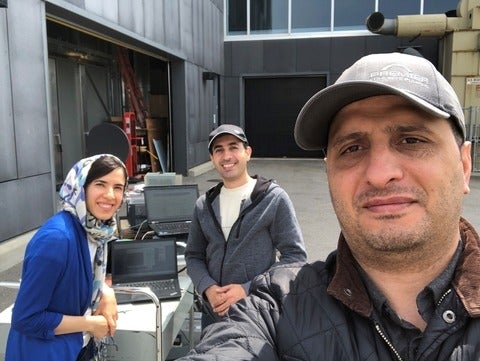
An intelligent antenna developed by researchers at Waterloo Engineering has been successfully tested, a major milestone in a multi-year, multi-million-dollar project.

The phased array antenna system for next-generation communications can be electronically steered to maintain links to overhead satellites for Internet connectivity.

BlackBerry Limited (NYSE: BB; TSX: BB) and the University of Waterloo today announced a five-year, multi-million dollar partnership agreement focused on driving research-powered innovation in Canada.

Combining the University’s world-renowned research and BlackBerry’s ability to deliver transformational products and services, the two organizations will work together in a unique program designed to fast-track the development of research and technology into market-ready products.

Researchers from Canada and the United Kingdom will test a new approach for secure communication using satellite-based quantum technology.

Led by Thomas Jennewein, a faculty member in the Department of Physics and Astronomy and the Institute for Quantum Computing, researchers at the University of Waterloo are developing the Quantum Encryption and Science Satellite (QEYSSat), with a quantum key distribution payload that will allow the transmission of unbreakable keys for securing information.