
Research

Thursday, October 3, 2019

Anticipating performance can hinder memory

by Media Relations

The study’s findings also suggest that the presence of an audience may be an important factor that contributes to this pre-performance memory deficit.

“Performance anticipation could weaken memory because people tend to focus on the details of their upcoming presentation instead of paying attention to information that occurs before their performance,” says lead author Noah Forrin, a postdoctoral fellow in Psychology at Waterloo. “People who experience performance anxiety may be particularly likely to experience this phenomenon.”

Tuesday, October 1, 2019

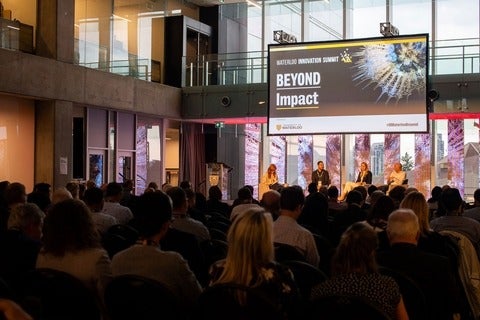
HealthTech leaders share what it takes to bring innovations to market

by Stephanie Longeway, University Relations

Leaders in HealthTech today called for policymakers and health providers to urgently adapt to emerging technologies and respond to the fast innovation cycles of industry, researchers and entrepreneurs.

As technology continues to disrupt the delivery of global and individual health, scientists, entrepreneurs, medical professionals and policy experts told the audience at the Waterloo Innovation Summit that policy innovation needs to keep pace with the development of new technologies and advancements in processes that will enable practitioners to improve life-saving care.

Friday, September 27, 2019

Global tourism vulnerable to climate change

by Media Relations

Climate change will have widespread consequences on the future of tourism, a new study from the University of Waterloo has found. 

Researchers identified the highest levels of climate change vulnerability in regions where tourism growth is expected to be the strongest, and often coincides with countries that invest most heavily in their tourism sector.

Global tourism

Thursday, September 26, 2019

Waterloo Innovation Summit reimagines health with technology

by Media Relations

On Oct. 1, Deputy Premier and Minister of Health Christine Elliott will join a dynamic slate of speakers from the realms of health technology, enterprise and policymaking. The Minister will share her perspective on the government's role in advancing the province's health-care system through innovation.

Wednesday, September 25, 2019

Patterns of youth alcohol use show need for early intervention

by Media Relations


Party

“Early alcohol use is associated with a long list of negative health consequences down the line,” said Mahmood Gohari, a public health postdoctoral researcher at Waterloo. “This study reinforces the idea that prevention policies need to start in those first two years of high school, or even before that, before drinking becomes habitual.”

Wednesday, September 25, 2019

Researchers create 'player trait model' allowing for personalized games

by Media Relations

University of Waterloo researchers have developed a novel tool that will enable user-experience designers to create more effective, personalized games and marketing campaigns.

Unlike other tools that categorize gamers by types, the new “player traits model,” along with a 25-item survey, can be used to more easily and accurately evaluate the kind of games different people will enjoy. The model is based on five traits: social, aesthetic, challenge, goal, and narrative.

Monday, September 23, 2019

Monitoring cancer at the nano-level

by Stephanie Longeway, University Relations

The development of medical imaging and monitoring methods has profoundly impacted the diagnosis and treatment of cancer. These non-invasive techniques allow health care practitioners to look for cancer in the body and determine if treatment is working.

But current techniques have limitations; namely, tumours need to be a specific size to be visible. Being able to detect cancer cells, even before there are enough to form a tumour, is a challenge that researchers around the world are looking to solve.

Monday, September 16, 2019

New imaging technology could ‘revolutionize’ cancer surgery

by Media Relations

Cancer treatment could be dramatically improved by an invention at the University of Waterloo to precisely locate the edges of tumors during surgery to remove them.

The new imaging technology uses the way light from lasers interacts with cancerous and healthy tissues to distinguish between them in real-time and with no physical contact, an advancement with the potential to eliminate the need for secondary surgeries to get missed malignant tissue.