Waterloo researcher uses nano-materials to clean water
Have you ever wondered what harmful chemicals might be lurking in your water? Dr. Juewen Liu wants to make it easier to remove pollutants from mercury to lead; arsenic and more.
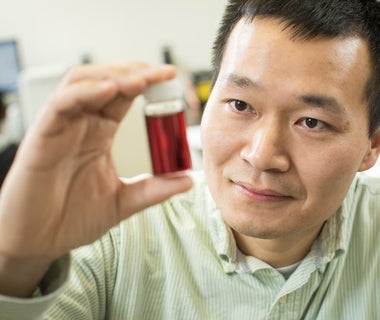
Have you ever wondered what harmful chemicals might be lurking in your water? Dr. Juewen Liu wants to make it easier to remove pollutants from mercury to lead; arsenic and more.
James Craig aims to make our drinking water safer and heat our houses more environmentally. Although his research uses fairly theoretical applied mathematics, the practical is never far from his mind. “Ideally, all of my research ultimately ends up in the hands of practitioners,” says Craig.
An applied math professor’s calculations of an ocean current in Cape Cod may help the highly endangered North Atlantic right whale to survive.

WATERLOO, Ont. (Wednesday, Feb. 27, 2013) - A professor of quantum information science at the University of Waterloo’s Department of Physics and Astronomy and the Institute for Quantum Computing was selected to receive a prestigious E.W.R Steacie Memorial Fellowship from the Natural Sciences and Engineering Research Council of Canada (NSERC).
What would motivate you to perform better at work: a flat-screen TV or a cash reward of equivalent value?

On the subject of financial regulation and corporate fraud, Christine Wiedman believes in letting the facts speak for themselves.

The days of collecting your gold watch and retiring to cottage country are over, says Steven Mock, assistant professor in the Department of Recreation and Leisure Studies.
Retirement is changing, and researchers at the RBC Retirement Research Centre at the University of Waterloo are investigating how people can better prepare for the evolving post-career landscape.
It shouldn’t come as any surprise that many of the world’s largest multinational corporations shop around from country to country for the best deal they can get on taxes.

Bernard Glick and a team of researchers have discovered the mechanism in bacteria that help plants grow, even under stressful conditions like drought and disease.
The implications of this fundamental scientific discovery are huge: crops that otherwise would have been wiped out can be saved; people who might have gone hungry have food.

WATERLOO, Ont. (Thursday, Feb. 14, 2013) - Researchers from the Institute for Quantum Computing at the University of Waterloo will present the latest research into quantum devices at the American Association for the Advancement of Science (AAAS) annual meeting in Boston this week.
Quantum sensors introduce unprecedented exploration and control of the nanoscale world. Uniquely harnessing the laws of quantum mechanics, quantum sensors have the potential to achieve the highest possible sensitivity, efficiency and selectivity allowed by nature.