Research

Tuesday, June 25, 2024

Centring underrepresented populations in pharmacy research

by Milana Madzarac, Faculty of Science

Underrepresented populations have been historically excluded from clinical trials including women, racial and ethnic minority groups, and pregnant, lactating, pediatric and geriatric populations. While the importance of including these groups in clinical trials are slowly being recognized and remedied, there are still questions in how currently prescribed drugs affect these populations, including the safety and efficacy of the medications. 

Mira Maximos

Monday, June 24, 2024

Indigenous students tackle climate change in South Africa

by Emily Brant, Office of Indigenous Relations

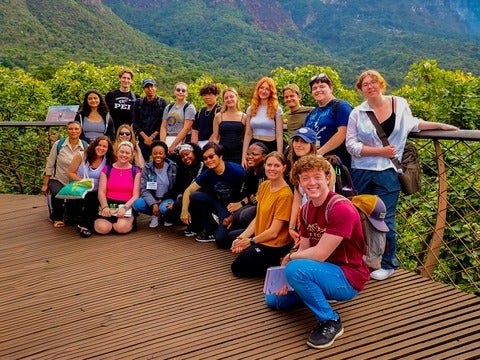
A group of Indigenous students from the University of Waterloo were among a delegation who visited Cape Town, South Africa this spring to gain international perspectives on environmental issues.

Friday, June 21, 2024

No black holes from light

by Melodie Roschman, Faculty of Mathematics

For the last seven decades, astrophysicists have theorized the existence of “kugelblitze,” black holes caused by extremely high concentrations of light.

These special black holes, they speculated, might be linked to astronomical phenomena such as dark matter, and have even been suggested as the power source of hypothetical spaceship engines in the far future.

However, new theoretical physics research by a team of researchers at the University of Waterloo and Universidad Complutense de Madrid demonstrates that kugelblitze are impossible in our current universe.

Thursday, June 20, 2024

Waterloo’s leading voices behind future cities

by Darren McAlmont, University Relations

With the rising cost of housing, aging infrastructure, climate change and disruptive technology at the forefront of urban planning, cities require data-driven tools and expertise to prosper today, and into the future.

Thursday, June 20, 2024

Reshaping health care with AI innovations

by Emma Pavlovich, WatSPEED

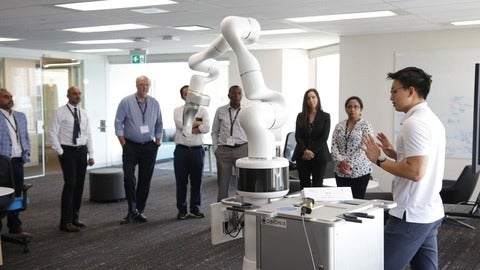
On June 12, WatSPEED convened senior health care leaders and executives to explore the transformational potential of artificial intelligence (AI) in enhancing Canadian health care services.

Wednesday, June 19, 2024

10 inventions you didn’t know came from Waterloo

by Jordan Flemming, University Relations

Waterloo researchers, students and alumni approach challenges differently. They unlock barriers by working together to develop creative approaches across disciplines. The futures they are transforming are not independent islands but an interconnected landscape of opportunities representing a path for Waterloo to foster lasting, impactful global change.

Tuesday, June 18, 2024

Pursuing the dream of education

by Olivia Vanderwal, Faculty of Arts

Ida Mukuka is an internationally renowned advocate for HIV/AIDS awareness and research. She’s worked with the Stephen Lewis Foundation, co-authored numerous articles and addressed the United Nations Human Rights Council in Geneva. And now, she’s pursuing her dream at the University of Waterloo. Mukuka is a master’s student in the Department of History, researching the HIV/AIDS epidemic in Zambia with a focus on the impacts of gendered stigma and violence. For Mukuka, this work is more than just an area of interest – it’s rooted in her own life story.

Researchers at two Ontario universities have developed a pain-free, wearable sensor that can continuously monitor levels of blood sugar, lactates and other critical health indicators for weeks at a time, sending results to a smartphone or other device.

The Wearable Aptalyzer, created by a team featuring researchers from McMaster University and the University of Waterloo, uses an array of tiny hydrogel needles that penetrate just deeply enough to reach the interstitial fluid beneath the skin, but not far enough to reach the blood vessels or nerves.

Monday, June 17, 2024

Waterloo researchers awarded more than $10 million

by University Relations

The University of Waterloo is a leading global research-intensive university and home to transformational research and inspired learning. Waterloo researchers recently received more than $10 million as part of $693.8 million in funding awarded on June 14 to support discovery and applied research.