
By Karen Kawawada
Over the summer, several of our faculty members who you may remember from your time as a student, announced their retirement and concluded their teaching and clinical careers. Read each of their stories of impact on teaching and research: Dr. Trefford Simpson, Dr. Murchison Callendar, Dr. Daphne McCulloch, Dr. Jeffrey Hovis and Dr. Elizabeth Irving.
Dr. Trefford Simpson
Dr. Trefford Simpson’s career in optometry didn’t get off to the most promising start. As a teenager in Johannesburg, South Africa, his primary interest was playing soccer. He applied to optometry school, among other programs, just because it seemed interesting. And, initially, he didn’t get in.
Read more about Dr. Trefford Simpson
Dr. Trefford Simpson’s career in optometry didn’t get off to the most promising start. As a teenager in Johannesburg, South Africa, his primary interest was playing soccer. He applied to optometry school, among other programs, just because it seemed interesting. And, initially, he didn’t get in.
Then, as he was trying to decide on next steps, Simpson got a telegram saying a vacancy had arisen in the optometry program at the Witwatersrand College for Advanced Technical Education.
It was the beginning of a long and productive career in which Simpson would eventually be cited more than 10,000 times, ranked among the top two per cent of most-cited scientists and named a Fellow of the Association for Research in Vision and Ophthalmology (ARVO).
A professor at the University of Waterloo School of Optometry and Vision Science for more than 30 years, Simpson is winding down his full-time career this year. He leaves a varied legacy of scholarship as well as a reputation for superb teaching and mentorship.
As a young man, though, Simpson didn’t love optometry school. In fact, he briefly considered leaving. After graduation, he completed his compulsory military service, partly as an “okay” military optometrist. Then, to forestall going into private practice, he went to the University of Houston in Texas for a master’s degree.
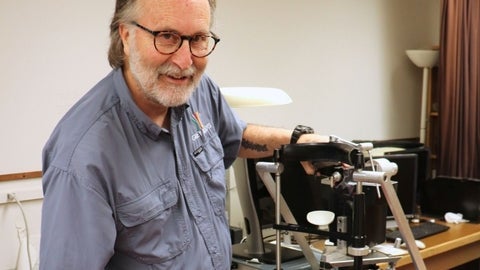
Dr. Trefford Simpson in his lab.
“The University of Houston changed my life,” says Simpson. “The notion that I could actually have a career as a vision scientist was astounding.”
To fulfil the conditions of his student loan, Simpson returned to South Africa after his master’s. However, it was a tumultuous time. Pressure was building internally and externally to do away with apartheid, but the government was digging in its heels. As opponents of apartheid, Simpson and his wife decided they couldn’t stay, so they returned to Houston for Simpson to do a PhD.
Following his PhD, Simpson and his young family – by this time, he had twin sons – went to the University of Toronto for a postdoctoral fellowship. Then, in 1994, he came to the University of Waterloo, initially as a research assistant professor.
One discovery Simpson made outside the lab: he was born the same day as the University of Waterloo, on July 3, 1957. It must have been meant to be.
Over the years, Simpson has followed his interests into varied fields of vision science. As a PhD student, he initially researched the aging of the human retina. However, for various reasons, that project didn’t work out, so he had to pivot. His new topic became how humans judge direction.
“The way you judge direction from one eye isn’t the same as the way you judge direction from the other eye, so the brain deals with that by putting the ego’s centre right between your two eyes,” explains Simpson. “That’s not a new insight. A seminal paper was published in 1792 and I did my thesis defence in 1992. What I did was work on empirically demonstrating these rules and how the eyes work together to coordinate vision.”
During his postdoc, Simpson worked primarily on visual neuroscience – specifically, the effects of multiple sclerosis on the visual system.
When he came to Waterloo, Simpson initially researched how binocular vision – how the two eyes work together – affects contact lens wear. It was in one sense a homecoming – when he was an undergraduate optometry student, Dr. Desmond Fonn taught the class about contact lenses. Fonn later founded the Centre for Contact Lens Research, now the Centre for Ocular Research and Education (CORE), at the University of Waterloo.

Dr. Trefford Simpson, centre, with well-wishers at his retirement celebration
As time went on, Simpson began to focus more on the area he’s arguably best known for: the way we experience and process stimuli – particularly pain – on the ocular surface.
“When I started, this work wasn’t being done in humans,” says Simpson. “We still know very little about these very complicated, exquisitely sensitive processes in people. That’s what’s kept me doing it for 30 years. The interesting stuff isn’t where the light is; it’s where the shadows are.”
Throughout his career, Simpson continued to maintain diverse lines of research, for which he was almost continuously funded by bodies such as the Natural Sciences and Engineering Research Council of Canada and the U.S. National Eye Institute. In much of his work, he collaborated with students, postdocs and faculty from different backgrounds.
His curiosity, as active as ever, is why Simpson isn’t stepping away entirely when he officially retires. Despite plans to spend more time travelling, birding and taking photos, he’ll continue working on research projects and may do some teaching and consulting. He might even start a company, an idea he’s currently exploring.
“I’ve always been serious about pursuing the things I was curious about,” says Simpson. “I’ve loved what I’ve done. I love teaching, I love being a scientist, and in particular, I’ve loved working with professional and graduate school students. I’ve been very lucky to do everything I’ve done.”
Murchison Callender
Dr. Murchison “Murch” Callender’s career journey has been marked with victorious highs and discouraging lows. As one of the first Black faculty members at the University of Waterloo, much less the School of Optometry and Vision Science, he persevered in the face of racial inequity and overcame numerous barriers to become a highly respected expert in contact lenses.
Read more about Dr. Murchison Callender
Dr. Murchison “Murch” Callender’s career journey has been marked with victorious highs and discouraging lows. As one of the first Black faculty members at the University of Waterloo, much less the School of Optometry and Vision Science, he persevered in the face of racial inequity and overcame numerous barriers to become a highly respected expert in contact lenses.
Dr. Murchison “Murch” Callender’s career journey has been marked with victorious highs and discouraging lows. As one of the first Black faculty members at the University of Waterloo, much less the School of Optometry and Vision Science, he persevered in the face of racial inequity and overcame numerous barriers to become a highly respected expert in contact lenses.
Born in Trinidad and Tobago, Callender knew his strengths were in the biological sciences. After high school, to save money, he worked as a research assistant at an oil company in Trinidad before entering a Bachelor of Science program at George William University (now Concordia) in Montreal. Subsequently, Callender went on to McGill University to research diabetes and the outcomes of insulin deprivation.
Callender recalls two instances that ignited his interest in vision and suggested he should pursue a career in optometry. Insulin deprivation led to blindness in his animal models, which fascinated him. Not long after this realization, a young woman named Chloe came to visit her cousin in Montreal, who happened to be Callender’s roommate. Chloe later became Callender’s wife.
“She was wearing rigid contact lenses, but I noticed her eyes were red and I began questioning why,” he says. “This was the second indication that told me maybe I should do something with the eyes.”
Callender applied to the College of Optometry in Toronto and was accepted. He started his degree there and moved to Waterloo after the College became part of the University. He graduated in 1968 as part of the first class to convocate from the new location.

Dr. Callender in the early 2000s
Of the 24 graduates, only two did not receive interviews to associate with a practitioner. Callender was one of them. He identifies this as one of his first subtle experiences of discrimination within optometry. Eventually, he interviewed with a practitioner in Southern Ontario but was told he would not fit in with the community – another subtle experience with discrimination.
“That was a shock to me,” he says. “I thought I would bring a lot to that community – I had the most up-to-date education in optometry and research experience from my time at McGill – but I shrugged it off and knew something else would turn up.”
While he was searching for private practices to join, Callender held a part-time position at the School of Optometry and Vision Science – but he was working full time hours and received no benefits from the University. Yet another inhibiting encounter with discrimination.
A year later, a young professor was hired at the School and saw Callender’s potential. The young man played a key role in instigating the School to give Callender a full-time position as a lecturer with benefits.
As a full-fledged faculty member, Callender contributed extensively to the School and the field of optometry. He spearheaded an overhaul of the contact lens program so students would be trained in a more clinical and evidence-based manner.
“Before, contact lens teaching was more of an art than a science,” he says.
He also designed forms for quantificational recording of patient information so researchers could retrospectively find information easily. His designs were adopted by many other schools and practitioners across North America. At the time, they were paper based, but they were modified for the software that was developed by a University of Waterloo graduate: Visual Eyes. VisualEyes is the digital patient information system hundreds of clinics across Canada, including the Waterloo School of Optometry clinics, use today.
Alongside his teaching duties, Callender kept up with contact lens research. He was one of the first clinicians in Canada to investigate and introduce the rudimentary hydroxyethyl methacrylate (HEMA) material used for soft contact lenses to the country. Companies from the United States and Japan came to him for his expertise.
To move up the ranks of faculty positions, Callender completed a master's degree in the biology department. He also started the Contact Lens Journal, now renamed to the Contact Lens Compendium, to provide Canadian practitioners with up-to-date information in the field of contact lenses. Today, it’s available online as a worldwide publication.
In 1988, he became a founding member of the Centre for Contact Lens Research (CCLR), now known as the Centre for Ocular Research & Education (CORE). Over the years, CORE has become an established global leader in the contact lens space and has been involved with some of the most meaningful advancements in the history of contact lenses.
For over 45 years of his career, Callender travelled to Jamaica twice a year with groups of fourth-year optometry students to provide voluntary eye care services to underprivileged people. Long after the School ceased to provide financial support due to budget cuts, Callender and his students continued the mission by fundraising and covering costs out –of- pocket. As a result, over 30,000 patients received eye care.
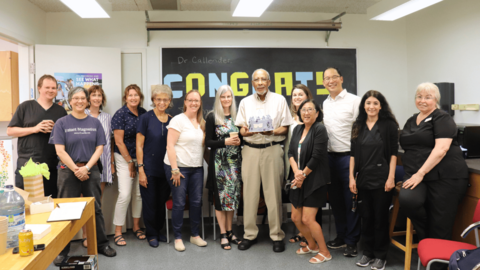
August 2024 - Dr Callender's retirement celebration
Callender retired from his full-time duties in 1996, and up until very recently, remained actively involved with the school as an adjunct professor and part-time clinical supervisor. When asked why he’s stuck around for so long, he has a few main reasons. Firstly, because he finds immense satisfaction in seeing patients and treating those who’ve returned for follow-up care for decades. He also loves sharing knowledge with eager students, and in 2021, after the passing of Dr. Gina Sorbara, former head of the Contact Lens Clinic, Callender wanted to help maintain the quality and standards of care for students and patients alike.
Nowadays, much of his time is spent caring for his wife, Chloe, who has been diagnosed with Alzheimer’s disease. The extent of his involvement with the School is dependent on her needs, so he has decided to not return as a part-time supervisor, but he still plans to remain in touch.
“I am always available for the people at the School,” he says. “And I will continue to be there, as long as I can breathe life into my body.”
Dr. Daphne McCulloch
As Dr. Daphne McCulloch nears her retirement at the end of August, her career will come full circle. Almost 50 years ago to the day, the now-professor started her undergraduate degree at the University of Waterloo in the Faculty of Science.
Read more about Dr. Daphne McCulloch
As Dr. Daphne McCulloch nears her retirement at the end of August, her career will come full circle. Almost 50 years ago to the day, the now-professor started her undergraduate degree at the University of Waterloo in the Faculty of Science.
Having grown up across Southern Ontario in Sarnia, Simcoe and Oshawa, McCulloch first decided she wanted to pursue optometry at the end of high school and came to Waterloo intending to apply to the Doctor of Optometry program. She enjoyed taking care of people and knew she wanted to go into the health sciences.
After graduating as part of the OD Class of 1979, McCulloch was among the first optometrists to enter a residency in primary care (at Pennsylvania College of Optometry, now Salus University). There, she realized her passion for teaching and research and decided to pursue a PhD to facilitate this career decision.
“It’s wonderful to teach students who are so motivated and so bright,” she says.
As her interests evolved, McCulloch found her niche: working with young children and people with special needs. Over the years, she has taught countless students the best ways to interact with these populations in a clinical setting – one of her favourite parts of her job. Additionally, she has completed extensive research, particularly in clinical electrophysiology.
There are a variety of tests that fall under the umbrella of clinical electrophysiology, but they share one principal theme – measuring the electrical signals in the visual system as it responds to different visual stimuli. Gathering information in this way is extremely important when treating young children and those with special needs, since often these individuals may not be able to verbally express what they can or cannot see.
McCulloch’s interest in clinical electrophysiology led her to serve as the past secretary-general of the International Society for Clinical Electrophysiology of Vision (ISCEV). She now serves as the editor-in-chief of the ISCEV official journal, Documenta Ophthalmologica. In 2019, she was awarded the ISCEV Emiko Adachi Award for longtime outstanding service to ISCEV and significant contributions to clinical electrophysiology of vision. As part of the award, she delivered the Emiko Adachi Scientific Lecture. Her talk was titled, “What can my baby see? Clinical electrophysiology of infant vision.”
In the decades since the beginning of her career, McCulloch has witnessed academia shift from being paper based to being strongly reliant on technology. She remembers sifting through research journals by hand and typing up documents on typewriters and word processors. She purchased her first PC during her PhD. If you ask McCulloch what the overall biggest change has been, she’ll wholeheartedly say the availability and access to information.
“Back then, the human genome hadn’t been mapped out, so when it came to genetic diseases, nobody would know what genes were involved,” she says, giving an example. “Now, we have gene identification tools”.
McCulloch’s work has taken her to all corners of the globe. After completing her PhD in Indiana, McCulloch became director of the clinical electrophysiology units in the Ophthalmology Department at the Hospital for Sick Children (SickKids) in Toronto before heading south to the Children’s Hospital in Los Angeles to undertake a similar role. The bulk of McCulloch’s career was spent across the pond as a professor at Glasgow Caledonian University. There, her research included hospital-based clinical trials with newborns at high risk for visual dysfunction – premature infants and infants with prenatal exposure to drugs of misuse.
For the past 11 years, she has been back in Waterloo, where conferences and other work obligations have taken her to places such as South Korea, Japan, and most recently, Hong Kong.
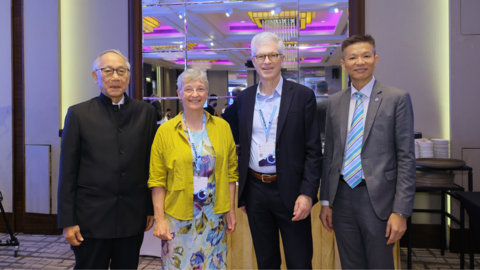
McCulloch with colleagues at the iCover 2024 conference in Hong Kong
After she retires, interacting with little children will be one of the things McCulloch will miss most, since all the babies in her life have grown up. She’ll also miss mentoring her students and seeing the lightbulb go off in their heads when something clicks. As much as she’ll miss her patients and students, McCulloch looks forward to being less busy and sleeping in more. She hopes to renovate parts of her house, particularly the kitchen, and is eager to spend more time travelling. She doesn’t have any fixed plans but is excited to have added flexibility to explore more of what the world has to offer.
This isn’t the complete end of the road for McCulloch’s career, though – she plans to stay with the School of Optometry and Vision Science as an adjunct professor to tie up loose ends and finish a few research projects.
“I’m excited to turn the focus to work I want to do and spend less time doing work I have to do,” she says with a laugh. “I’m retiring, but not gone yet”.
Dr. Jeff Hovis
People such as police officers, pilots and railway dispatchers are responsible for keeping people safe. Dr. Jeff Hovis has helped ensure their vision is up to the job. Hovis, an associate professor with the University of Waterloo School of Optometry and Vision Science, has helped multiple Canadian agencies appropriately set vision standards since the mid-1980s.
Read more about Dr. Jeff Hovis
People such as police officers, pilots and railway dispatchers are responsible for keeping people safe. Dr. Jeff Hovis has helped ensure their vision is up to the job.
Hovis, an associate professor with the University of Waterloo School of Optometry and Vision Science, has helped multiple Canadian agencies appropriately set vision standards since the mid-1980s.
Now, as he moves into retirement, he leaves a legacy of applied scholarship that has made him a sought-after consultant in areas such as aviation, maritime, rail, police and military vision standards.
Hovis grew up in a small town outside Toledo, Ohio, and went to The Ohio State University for his optometry degree and concurrent master’s. During his PhD at Indiana University, Hovis had a chance to delve deeply into colour vision, which fascinated him.
About eight per cent of males and half a per cent of females have colour vision deficits. There are, however, some unusual cases, such as people who have four types of colour-perceiving cones in the eye rather than the usual three. Hovis even encountered a man who claimed his colour blindness was cured when he fell out of a tree – the original problem may have been caused by a bone or blood vessel abnormality.
Hovis started as an assistant professor at the University of Waterloo in 1986, attracted by its friendly and energetic feel. Soon after, his expertise in colour vision and binocular vision – another field of interest – came in handy when he was invited to participate in reviewing vision standards for civil aviation.
At the time, there was no comprehensive summary of vision standards in Canada, so he started by putting one together. He continued periodically updating the summary throughout his career, creating a valuable resource for all concerned.

Jeff Hovis with the colour lantern testing equipment he developed for rail workers.
Vision standards are important in occupations where performance of some tasks is dependent on vision. For example, a locomotive engineer needs to be able to distinguish between different-coloured lights because they govern the train speed. A police officer or firefighter, while permitted to wear corrective lenses, needs a minimum level of uncorrected vision in case they lose their glasses or contact lenses in the line of duty.
In some areas, standards have changed over the years, whether because technologies have changed job requirements or because research has helped fine-tune standards. The advent of refractive laser surgery has also opened career paths for people who would not previously have qualified.
Hovis has been a major part of setting vision standards in Canada and has consulted in other countries, notably the U.S. and Australia. He has developed tests specific to certain jobs, such as a colour lantern test he developed for CN Rail and now used by all major Canadian railways. He has considered factors such as whether wearing tinted sunglasses affects job performance and helped set guidelines in areas such as these.
Another area of interest for Hovis has been ensuring safety eyewear is truly safe without compromising vision. Most notably, he worked with colleague Dr. Ralph Chou, now a Waterloo professor emeritus, on evaluating safety eyewear for the Canadian military, ensuring high performance and optical quality.
With Dr. Graham Strong, also a professor emeritus of the School, Hovis evaluated Canadian bank notes for colour, contrast and accessibility for the visually impaired.
Because of his research interests, Hovis was asked to join the Canadian National Committee of the Commission Internationale d’Eclairage (CNC/CIE), the international standardization organization for vision and lighting. He represented Canada on the international commission (Division 1: Vision and Colour) starting in 2017 and was president of the CNC/CIE from 2020 to 2023.
Hovis has won numerous awards for his work over the years, most recently the 2024 Thomas J. and Margaret D. Tredici Award from the Aerospace Medical Association (AsMA).
“Dr. Hovis’s original research, test designs and academic teaching about aviation-related color vision tasks and testing has established him at the pinnacle of those disciplines,” said AsMA in a news release.
Hovis has enjoyed teaching over the years, particularly lecturing about colour vision. He has also kept one foot firmly in clinical practice, working regularly with patients and students in the binocular vision service of the Waterloo Eye Institute.
Even after his retirement on July 31, he’ll stay active in research. However, he’ll have a chance to enjoy more travel – he and his wife are heading to Greece and Cyprus this summer – as well as bike riding and time with his two adult children.
“I’ll remember the collegial aspect of working here,” says Hovis. “I’ll miss talking with the patients and meeting students from all over Canada.”
His parting message to colleagues and students? Says Hovis: “Keep having fun.”
Dr. Elizabeth Irving
For a big chunk of her career, Dr. Elizabeth Irving was best known as a chick scientist. Not because she was one of the very few women awarded a Canada Research Chair in the early days of the program. Nor because she raised three children while making major scientific contributions. Irving, who recently retired as a much-awarded professor at the School of Optometry and Vision Science, made important discoveries about myopia using baby chicks as models.
Read more about Dr. Elizabeth Irving
For a big chunk of her career, Dr. Elizabeth Irving was best known as a chick scientist. Not because she was one of the very few women awarded a Canada Research Chair in the early days of the program. Nor because she raised three children while making major scientific contributions.
Irving, who recently retired as a much-awarded professor at the School of Optometry and Vision Science, made important discoveries about myopia using baby chicks as models.
Starting in the early 1990s, when she was doing her PhD, Irving contributed significantly to the understanding of how myopia develops. These initial discoveries led to the development of myopia control techniques, now in common use, to slow the progression of myopia in children.
Irving found that by fitting chicks with positive or negative lenses – positive prescriptions correct for hyperopia (farsightedness) and negative ones for myopia (nearsightedness) – the chicks’ eyes grew to adapt to their lenses.
In normal vision, the light is focused on the retina, at the back of the eye, producing clear vision. In a myopic eye, the eyeball grows too long and light focuses in front of the retina, while in a hyperopic eye, the eyeball is too short and light focuses behind the retina.

“I could make chick eyes whatever size or shape I wanted them to be,” says Irving. “This meant we should be able to control eye growth, because eye growth is controlled by the light that’s coming into the eyes.”
Risk factors for myopia, such as too much time indoors and too much time on close-focus tasks, have since been identified. However, the mechanisms still aren’t fully understood, says Irving, who would like to see more money invested into the fundamental science of myopia.
Now that she’s retired, Irving won’t do that fundamental science herself. However, she plans to continue work in a newer area of interest – the visual science of aviation.
When she was growing up in rural Saskatchewan, Irving was surrounded by men with an interest in flying. At the time, it wasn’t her thing. Even after she graduated from the University of Waterloo with her OD in 1983, she imagined an earthbound life as a small-town optometrist, which is why she practiced for over a year in Humboldt, Saskatchewan.
However, in Humboldt, Irving’s husband had trouble finding work in his field of engineering. So the couple returned to Ontario and Irving was offered a part-time job at the School as a clinical supervisor, eventually moving to full time. That was when Dr. George Woo, now a professor emeritus, offered her some advice.
“He said to me, ‘Beth, if you’re going to do this, do it right. Go get a PhD and become a professor,’” remembers Irving. “So I did.”

Elizabeth Irving, in yellow, with well-wishers at her retirement celebration
Irving earned a master’s in 1989 and a PhD in 1994, both at the School. With two prestigious honours in hand, a Royal Society of Canada Alice Wilson Award and a Medical Research Council of Canada postdoctoral fellowship, she spent some time doing eye movement research at the University of Toronto. She returned to the School as an assistant professor in 1996.
For years, in between teaching and service to the School, including a couple of years as clinic director, Irving kept up productive streams of research in myopia, eye movements and binocular vision – how the two eyes work together. She has also done significant work in patient education, measuring infant vision, ocular imaging and the visual effects of concussions. She maintained her title of Canada Research Chair in Vision Science for 10 years, the maximum for her category.
Irving got into aviation in 2012, when some contacts at York University wanted someone with her clinical experience to join them on a project investigating binocular vision in helicopter pilots with the Canadian Forces.
Not long after, Dr. Suzanne Kearns, an aviation expert with the Faculty of Environment, asked her to join a developing aviation research cluster. Irving wound up working with others on a grant application to get a flight simulator for the University.
Irving later secured further funding for research using the simulator. One project focused on training pilots faster and better by evaluating the visual scanning habits of novice pilots. Another investigated vision standards for pilots. Early results of Irving’s research, which found pilots don’t need perfect uncorrected vision to successfully land a plane, could lead to a wider pool of applicants and open up a field that is struggling with staffing shortages.
Until recently, Irving was one of the associate directors of the Waterloo Institute for Sustainable Aeronautics (WISA). Though she may have officially retired, Irving is still working with WISA on how to provide better training to overcome the dangerous visual illusions that can result in plane crashes. She’s also continuing to work with the Canadian Vision Imaging Centre.
Retirement has offered Irving the flexibility to travel more and spend more time in her garden and with her little granddaughter. However, she can’t imagine giving up research entirely, she says.
“I’m not gone – I’ll be around.”