Teacher Resources
Activity Summary:
In this activity students will choose an element to write a short report on. The report has step by step questions that encourage students to think about:
- properties of the elements & the structure of the periodic table
- when and how the element was discovered
- how chemical and physical properties of elements impact the behavior
- how humans have and will interact with elements and compounds
Curriculum Connections:
In this activity students will explore the following ON Grade 10 Science expectations:
- A2.3 - Students will analyze how the development and application of science is economically, culturally and socially contextualized
- A2.5 - Students will analyze contributions to science by people from various historical communities
- C1.1 - Students will assess social and environmental impacts of processes associated with the life cycle of consumer products considering the elements and products they are made from
- C2.3 - Students will use Bohr-Rutherford models to identify details of subatomic particles in an atom
- C2.4 - Students will describe the connection between the location of an element on the periodic table and structure of its elements
- C2.5 - Students will relate properties of elements to the organization of the periodic table
Activity Structure:
This activity includes 3 parts.
- Part 1 focusses on properties of an element. It has students identify different properties of a chosen element and connect that to an element’s location on the periodic table.
- Part 2 focusses on the history of an element. It has students analyze how technology drives scientific discovery and analyze risks of use associated with an element’s compounds.
- Part 3 is a consolidation activity that asks students to combine their research from parts 1 and 2 and communicate that knowledge in pictorial form.
Timeline of Elements Activity
Below is a preview of the worksheet; to receive a printable version of the worksheet please contact us and we’ll email it to you.
Name:
Choose an element between 2-28 on the periodic table.
Follow these steps to get started:
- Navigate to the Timeline of Elements homepage (https://uwaterloo.ca/chemistry/community-outreach/timeline-of-elements).
- Explore the interactive PDF and find your chosen element. Click on your element.
- Read about the considerations that went into the design of your elements tile in the display.
- Navigate to “Read more about the ...” and read the Chem 13 News article related to the time when your element was discovered.
Complete the following questions about your chosen element’s history, discovery and properties. Use the information you’ve learned from the article and your own research to find the answers.
Part 1 Properties of your Element
- What is the Pauling Electronegativity for your element?
- What is the range of Pauling electronegativity?
- What properties does a high electronegativity element have? What properties does a low electronegativity element have?
- Based on your elements electronegativity what properties does it have?
- What are the trends in atomic radius on the periodic table?
- Moving from left to right along a row:
- Why does atomic radius follow the above trend?
- Moving from top to bottom along a column:
- Why does atomic radius follow the above trend?
- Fill in the following blanks from smallest atomic radius to largest atomic radius using your element and four other elements of your choosing.
Showcase the trend from left to right:
______ < ______ < ______ < ______ < ______
Showcase the trend from top to bottom:
______ < ______ < ______ < ______ < ______
- How many electron shells does your element have?
- How many electrons are in the valence shell of your element?
- Does this mean your element is more likely to lose or gain electrons in a reaction?
Bohr-Rutherford Diagrams are a way of illustrating electron configurations of elements.
- In the center of the circle below write the number of protons and neutrons found in the nucleus of your atom.
- Using your answer from above draw one circle around the center circle below for each electron shell your element has.
- Use small dots to represent electrons and begin to fill your shells to reflect your element. The first shell can hold up to 2 electrons, the second shell can hold up to 8 electrons and the third shell can hold up to 18 electrons.

Example: Hydrogen
Part 2 History of your Element
- When was your element discovered?
- Who (or what group of people) discovered the element?
- How was your element discovered?
- What chemical or physical properties of your element affected how your element was discovered?
- What technology, tools or techniques needed to be invented or discovered for your element to be discovered?
- What was humanity's understanding of atoms and or elements when your element was discovered? (ex Aristotle’s four elements, Dalton solid sphere etc)?
- Create a visual representation of your chosen element based on humanity’s understanding of atoms and elements at the time closest to when your element was discovered
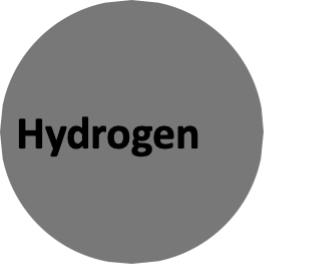
Example: Hydrogen. Discovered: 1766. Closest to: Dalton
- We now use many different elements everyday. List five ways your chosen element can be used. Specify the compound if applicable. (Ex Hydrogen is a component of water, the compound is H2O)
- Some elements and compounds can be quite hazardous to human and environmental health. Find a compound that could be hazardous containing your element.
- Why is the compound above potentially hazardous? What can be done to prevent this compound from causing harm when used?
Part 3 Communicate your Findings
- Taking inspiration from the Timeline of Elements website and using the research from the first 2 parts of your report design a Timeline of elements tile for your chosen element. Be sure to include important information such as the structure of your element, the properties of your element and the history associated with your element.