
Methodology
The Student Communications Survey tracks the evolution of student communication preferences and satisfaction over time, using anchor questions from previous versions and additional questions based on emerging communication trends and practices.
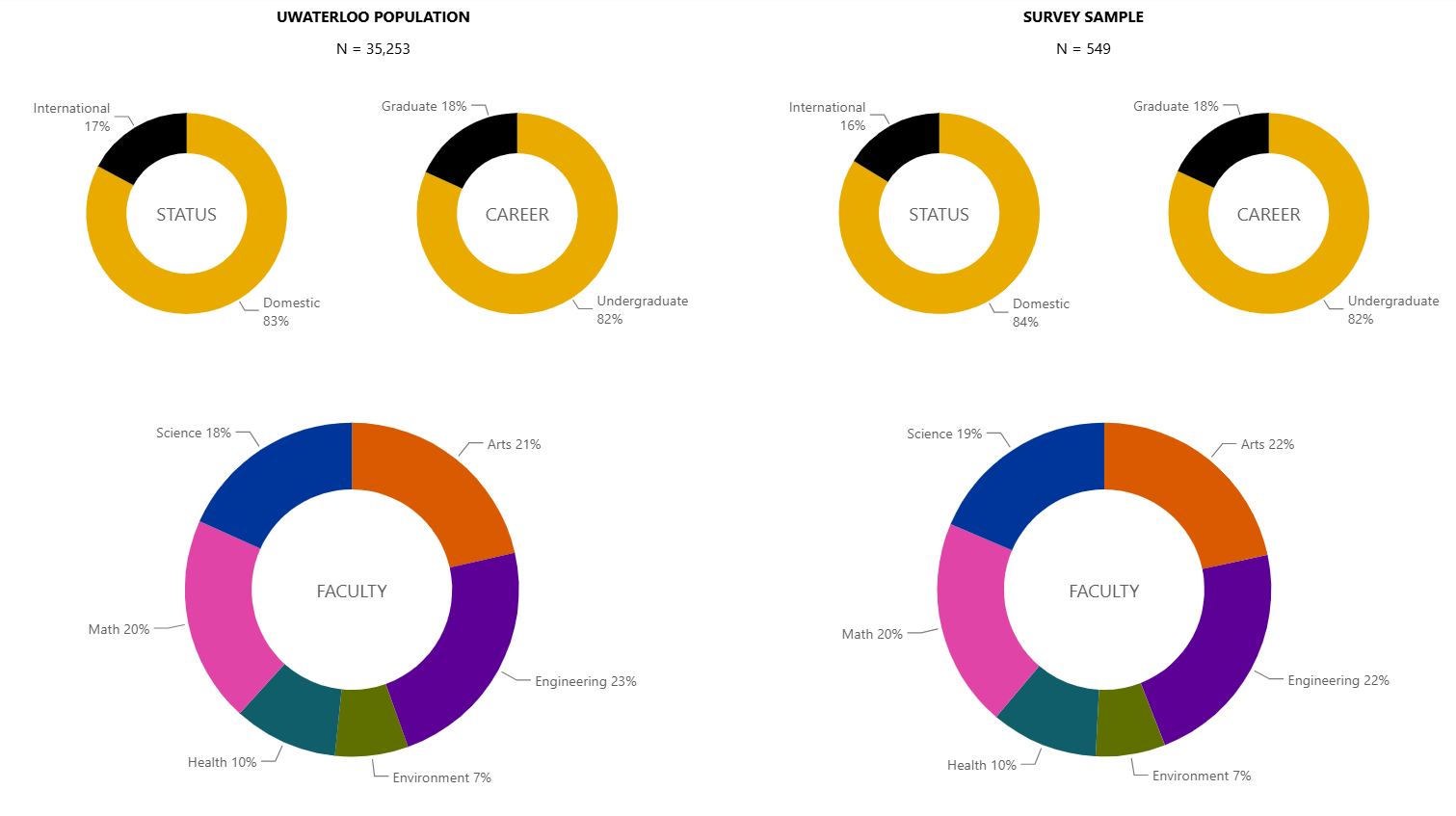
The survey was administered to a stratified random sample of the student population at UWaterloo, including graduate and undergraduate students, international and domestic students, and each of the six faculties. Students were invited to participate in the online survey using a personalized link sent via email invitation and reminders.
The final survey sample included 549 respondents, a representative sample of the student population.
Satisfaction
The 2025 survey results tell us that 73% of students were satisfied with communications from the University.
This sentiment has been trending positively and improving over time when compared to 72% in 2023 and 67% in 2021.
2021
2023
2025
Care and concern
Students were asked if communications from the University demonstrate care and concern for them.
79% of students said “yes” in 2025, representing a steady increase from previous survey years (72% in 2021, 76% in 2023).
Maintaining empathetic, student‑centred language remains important, and regardless of the channel or content, University communications contribute to how supported our students feel.
2021
2023
2025
Clear
Constructive
Approachable
Language and Tone
The language and tone survey results continue to demonstrate stability and consistency over time.
That consistency is highlighted by results that are nearly identical to 2021 and 2023: students agree that communications from the University are clear (short and understandable) 66%, constructive (solution and action-oriented) 57%, and approachable (plain language and conversational) 76%. Although the findings are consistent, there is an opportunity to refine the language and scope of the content to make our messaging more clear and constructive.
The information that matters most
New this year, students were given a list of 12 common topics and were asked how important it is for the University to communicate about each of them.
Across both undergraduate and graduate student audiences, the same topics were consistently rated as most important: documents, courses, and finances (94%), emergency notifications (90%), career development (82%), and faculty/program information and events (79%).
These areas represent core communication expectations and are where students expect clear, timely, and accurate communication. Under‑delivering communications in these areas carries a higher risk to our students’ experience.
We also asked students to tell us about the volume of communication they receive about the same list of topics. The results show that not enough communication is received about: documents, courses, and finances (36%), career development (36%), living and eating (30%), and academic success (29%).
Most important communication topics
"Not enough" communication is received for these topics
Frequency and volume
When asked to share their perceptions of frequency and volume of email, the majority of students say they receive “the right amount” of information, for most topics, with few areas showing signals of information overload.
The data suggests that students are not broadly experiencing too much email, and the issue is instead relevance, not volume. While 72% of students indicate they are receiving “the right amount” of communications, differences emerge when we look at specific audiences.
How much email do you receive?
Not enough
The right amount
Too much
Social media
We asked students which social media channels they use and which ones they would like the University to use.
The top three platforms our students use are Instagram (88%), YouTube (73%), and LinkedIn (60%). These are also the same platforms where they would like the University to have and maintain a presence and is consistent across each audience.
YouTube