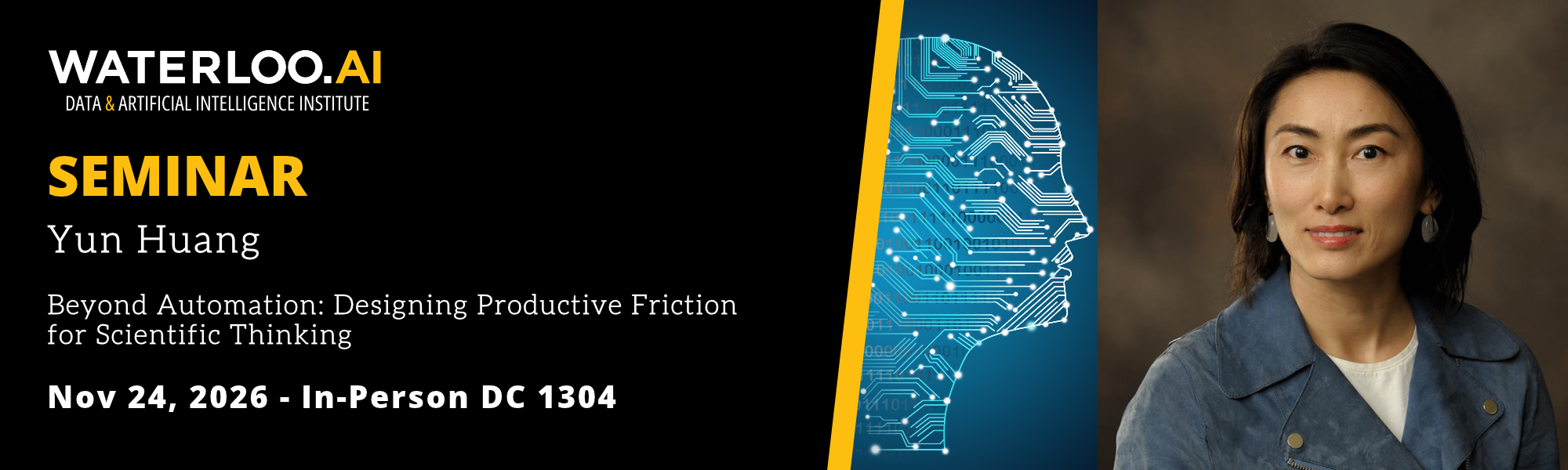
Date: Tuesday, November 24th, 2026
Time: 10:00AM - 11:30AM
Location: DC 1304
Title: Beyond Automation: Designing Productive Friction for Scientific Thinking
Abstract: As AI increasingly automates scientific work, how should we design AI to support scientific thinking? Large language models are driving a new wave of “AI scientist” systems that automate literature reviews, generate hypotheses, conduct experiments, write papers, and even review research. But scientific discovery involves more than producing accurate and reproducible results. Much of the important work is less visible. Researchers need to decide which questions are worth asking, examine their own assumptions, and remain open to contrary evidence.In this talk, I share a three-year journey of designing, deploying, and evaluating LLM-based systems for research ideation. Drawing on our research prototypes and empirical studies, I introduce productive friction for AI-augmented research: intentionally creating moments of pause, choice, and disagreement that encourage deeper thinking. I discuss four complementary forms of productive friction: temporal, structural, interactional, and relational, and use examples to show how they can help researchers engage more critically and creatively in research ideation. Using an iceberg metaphor, I illustrate how the visible outputs of research depend on intellectual work that often goes unnoticed. I close by inviting the community to consider what we should preserve as AI takes on more scientific tasks, and how we might evaluate its impact on scientific thinking over time.
Bio: Dr. Yun Huang is an Associate Professor in the School of Information Sciences at the University of Illinois at Urbana-Champaign. She is dedicated to innovating AI-based solutions that foster a synergistic relationship between humans and machines, enhancing educational opportunities to all and expanding access to community services. She is deeply committed to translating research into real-world benefits and making a positive societal impact. Her work has garnered support from respected government agencies such as the National Science Foundation (NSF), the Institute of Museum and Library Services (IMLS), and the National Institute on Disability, Independent Living, and Rehabilitation Research (NIDILRR), as well as from leading industry organizations such as OpenAI, Google, IBM Research, and HeyGen. She was selected for the 2024-25 Emerging Research Leaders Academy by the Interdisciplinary Health Sciences Institute (IHSI) at the University of Illinois. Huang earned her Ph.D. in information and computer science from the University of California, Irvine. She received her bachelor's degree from the Department of Computer Science and Technology at Tsinghua University in Beijing, China.