News

Filter by:

Limit to news where the title matches:
Limit to items where the date of the news item:
Date range
Limit to news items where the audience is one or more of:

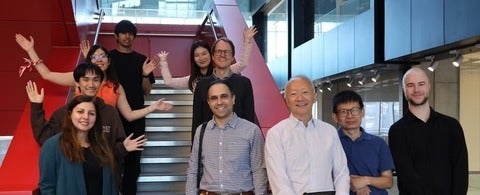
The Tang Family Foundation donated $500,000 to Waterloo.AI to support graduate research in embodied AI, AI systems that perceive and act in the physical world through sensors and actuators (like robots), as opposed to purely text-based AI.

The inaugural cohort of eight graduate students from the faculties of Engineering and Math each received $15,000 scholarships to support their research. Their work spans robotics, exoskeletons, control systems, and the ethical questions around AI operating near people.

Waterloo.AI Director Dr. Stephen Smith explained the value of directing philanthropic funding toward students specifically: it gives them more time to focus on foundational research, which is where real long-term impact lies.

Roger Tang, founder of the Tang Family Foundation, sees embodied AI as the next major step in industrial development and views philanthropy as well-suited to backing high-risk foundational research that commercial markets later scale. He has had a growing relationship with Waterloo since establishing a Chair in New Energy Materials and Sustainability in 2023.

A second round of scholarships is expected to open in the fall.

As artificial intelligence (AI) learns to write code, it still struggles to test firmware without access to physical hardware. For University of Waterloo founders Seungmin Hong (BASc ’26) and Ahnaf Shahriar (BASc in progress), that challenge represented an opportunity.

As artificial intelligence (AI) drives a global surge in data centres in Canada and around the world, a less visible but increasingly urgent challenge is growing alongside it. Researchers are beginning to investigate ways to manage the risks posed by the lithium-ion batteries that keep those facilities running.

From helping municipalities advance toward net-zero emissions to improving homelessness policy, understanding the societal impacts of artificial intelligence and building more resilient communities, University of Waterloo researchers have secured more than $8 million in new funding through Social Sciences and Humanities Research Council of Canada (SSHRC) competitions.

In spring 2026, Professor Dan Brown appeared before the Senate of Canada’s Standing Committee on Transport and Communications to discuss intellectual property and safety concerns raised by the rise of generative AI. He highlighted concerns about the use of copyrighted works to train generative AI systems and the potential impact of these technologies on creative professionals, particularly writers and creators from minoritized communities.

From advancing artificial intelligence and quantum technologies to strengthening climate resilience and health-care innovation, more than 100 University of Waterloo researchers are receiving more than $7.1 million through the Natural Sciences and Engineering Research Council of Canada’s (NSERC) Discovery Grants program.

Through a shared commitment to artificial intelligence research and co-operative education, the University of Waterloo and the Norwegian University of Science and Technology (NTNU) are working together to turn global collaboration into real-world impact.

Co-operative and Experiential Education (CEE) and the Waterloo Data & Artificial Intelligence Institute (Waterloo.AI) recently welcomed a delegation of eight NTNU researchers to campus for a four-day visit. The program brought together faculty and students to explore shared research interests, strengthen ties between both institutions, and spark new opportunities for collaboration in the field of AI.

About the Visit

This visit was part of the International Work-Integrated Learning in Artificial Intelligence (IWIL AI) project, a four-year initiative between NTNU and the University of Waterloo that connects student learning with real-world application and research. Supported by the Norwegian Directorate for Higher Education and Skills (HK-dir), the program promotes international research mobility and hands-on learning to strengthen education for a sustainable future.

A Growing Partnership

Since its launch, IWIL AI has supported twenty-four Waterloo co-op students completing AI-centred research work terms in Norway, along with five NTNU master's students undertaking research visits in Waterloo. The recent delegation of NTNU researchers builds on this project by offering new opportunities to connect the research ecosystems of both institutions.

Program Highlights

Throughout the visit, the NTNU delegation visited a wide range of Waterloo labs and innovation spaces, including:

  • A campus tour and an overview of the Waterloo Data & Artificial Intelligence Institute, led by faculty members
  • Meetings with student-led AI groups
  • A tour of RoboHub
  • A visit to the Bio-robotics, Artificial Intelligence and Neuroscience (BRAIN Lab)
  • Sessions on Waterloo's approach to industry collaboration, including visits to the Perimeter Institute and the Velocity Innovation Arena, to explore the intersection of research and entrepreneurship
  • A networking session bringing Waterloo co-op students, researchers, and faculty supervisors together with the NTNU delegation to share research ideas and explore future collaboration

Voices from the Delegation

Several NTNU PhD students reflected on what the visit meant for their own research. “The trip was beneficial for me, as I gained a fresh perspective on research and innovation beyond Europe and Africa. I will definitely reach out to some of the contacts I got and explore possible future collaborations,” said one delegate. Another added, “Learning about the Waterloo co-op program, industry collaborations, campus infrastructure, student clubs, and administrative support: these were very interesting and inspiring practices that gave me a new perspective.”

Looking Ahead

As the program wraps up this year, visits like this reinforce the value of international collaboration in strengthening Waterloo's position as a global leader in AI innovation, helping expand its research networks, and creating new opportunities for students and researchers to collaborate on impactful, real-world projects.

Learn More

Professor Victor Zhong (principal investigator) and Professor Jimmy Lin (co-investigator) of the Cheriton School of Computer Science have been awarded $1,641,776 through the NSERC Alliance Grant program. Combined with more than $1.8 million in cash and in-kind contributions from industry partner BASF Canada, the total project value reaches roughly $3.5 million.

The three-year project, titled “Deep Research Agents for Natural Science R&D,” will co-develop and deploy an end-to-end intelligent research assistant capable of retrieving, reasoning over, and acting on diverse experimental data sources. Developed with BASF Canada, it aims to transform chemical informatics from static information retrieval into dynamic, action-oriented knowledge systems that accelerate scientific discovery.

The project will also help train the next generation of researchers, supporting two postdoctoral researchers, six PhD students and two master’s students over its three years.

More about this research

Innovation in the chemical sciences requires integrating diverse data sources — from reaction protocols and compound properties to safety data sheets and spectral data — that are often stored across separate, incompatible systems. As a result, researchers can spend a significant share of their time retrieving, cleaning and integrating data manually rather than focusing on discovery.

Overcoming these barriers requires AI systems that can reason across diverse information sources and interact seamlessly with laboratory data. Current methods fall short: retrieval-augmented generation systems struggle with complex hybrid scientific queries, while text-to-SQL systems require rigid schemas poorly suited to unstructured lab notes. This project aims to develop a multimodal, general-purpose agent equipped with computer vision and logical reasoning to support experimental planning — a step toward autonomous scientific execution.

Professor Zhong contributes expertise in frontier agentic behaviours and reasoning, while Professor Lin brings expertise in scalable retrieval infrastructure to enable efficient processing of the large, complex datasets involved in industrial R&D.

Read more

p>

A new algorithm could drive breakthroughs in understanding cancer, Alzheimer's disease, and other potentially fatal conditions. Researchers from the University of Waterloo developed the machine learning algorithm, called RNovA, to detect changes in the proteins in human cells.

Click here to read article

For much of the last century, the relationship between employers and employees was defined by structure, hierarchy and predictability. Work was something you went to, jobs had clear boundaries, and human resources (HR) was largely an administrative function.

Click here to read article