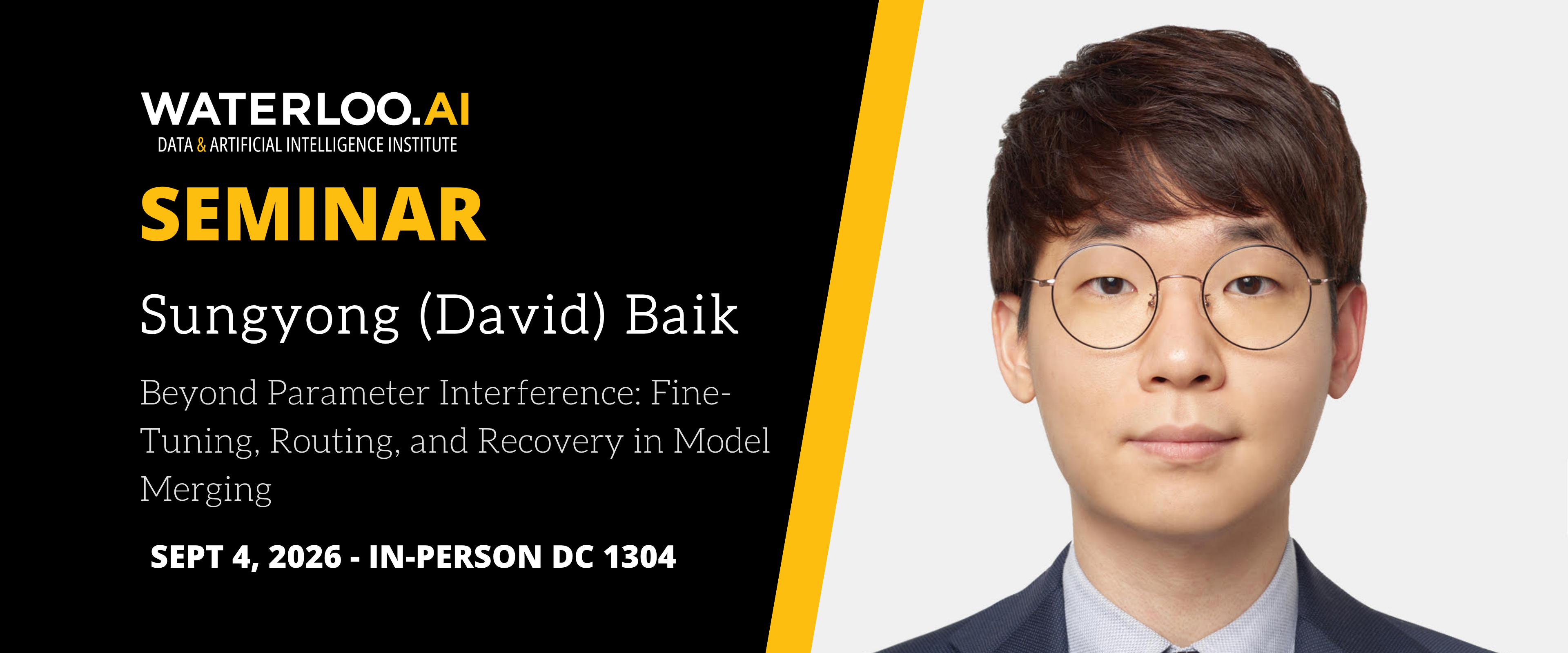
Date: Friday, September 4, 2026
Time: 10:30am - 11:30am
Location: DC 1304
Title: Beyond Parameter Interference: Fine-Tuning, Routing, and Recovery in Model Merging
Abstract: The pretraining–finetuning paradigm, along with large foundation models, has produced an explosion of task-specific experts, motivating efforts to merge them into a single multi-task model. However, parameter interference keeps merged models from matching the individual experts. This talk reframes interference as an offset added to each expert's parameters and surveys three works that attack it at three points in the merging pipeline. Our first work, SAFT, uses sharpness-aware fine-tuning to find flat minima, yielding experts that are intrinsically robust to interference. Then, our second word, SiM sidesteps interference with training-free task classification based on SVD-subspace projection residuals, routing each input to the right compressed task vector. Finally, our third work, ReTeX, directly predicts and removes the offset, recovering each expert from a single merged checkpoint. Notably, SAFT's perturbation and ReTeX's recovery offset are the same quantity with opposite sign, and SiM and ReTeX share the same projection-residual task identifier—together reaching near-expert performance (95–99%) without router training, task IDs, or storing all experts.
Bio: Dr. Sungyong Baik is an Assistant Professor in the Department of Data Science and the Department of Artificial Intelligence at Hanyang University, with joint appointments in Computer Science and Mechanical Convergence Engineering. He received his Ph.D. in Electrical Engineering and Computer Science from Seoul National University and his B.A.Sc. in Engineering Science from the University of Toronto. He also conducted research at Meta Reality Labs. His research focuses on developing data-efficient, adaptive, robust, and trustworthy AI systems toward artificial general intelligence, with interests spanning meta-learning, few-shot learning, model merging, anomaly and out-of-distribution detection, machine unlearning, multimodal AI, and physical AI.