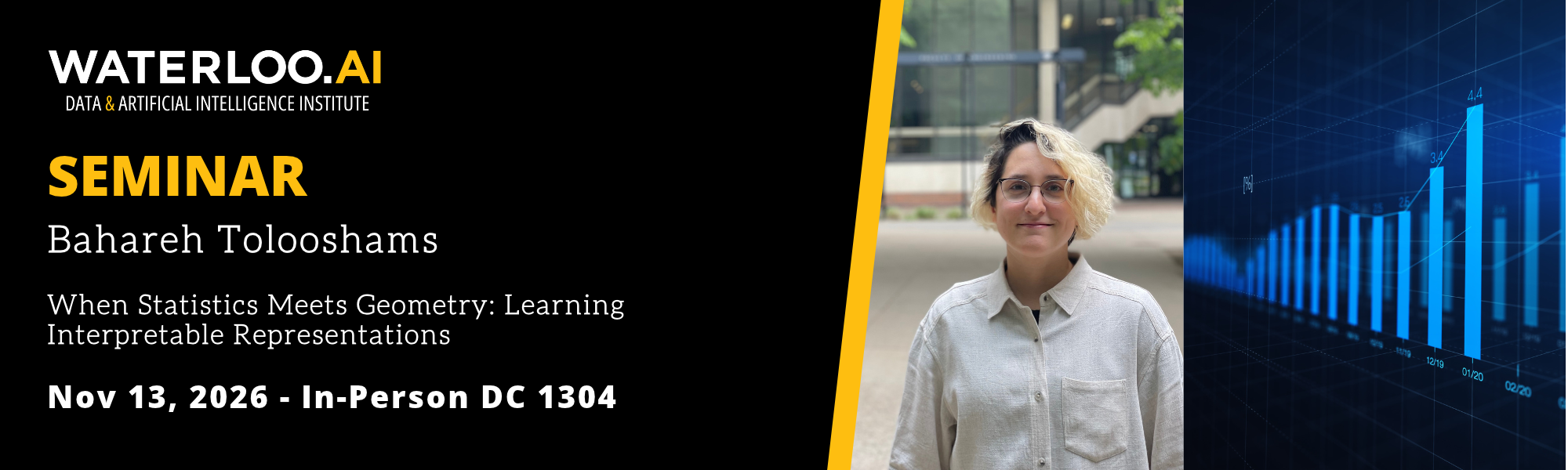
Date: Friday, November 13th, 2026
Time: 11:00AM - 12:30PM
Location: DC 1304
Title: When Statistics Meets Geometry: Learning Interpretable Representations
Abstract: AI systems are shaped by inductive biases that influence the representations they learn. Understanding these representations poses a central challenge: how can we distinguish meaningful structure in a model from assumptions imposed by the methods used to interpret it? This distinction becomes particularly important when models are used for scientific understanding. In this talk, Dr. Tolooshams presents a perspective in which learning is viewed as inference, connecting representation learning, generative modelling, computational neuroscience, and inverse problems. She revisits the linear representation hypothesis used in the mechanistic interpretability literature and discusses methods for recovering hierarchical and functional representations. She shows how feature geometry and activation statistics jointly characterize interactions between extracted concepts, and how inference architectures shape the structure we recover. These questions also motivate her work in computational neuroscience, and a broader question: how does the brain form representations that preserve the structure needed for inference and perception? She concludes with directions toward theoretically grounded interpretability methods and representations that support perceptual inference and predictive world models.
Bio: Bahareh Tolooshams is an Assistant Professor at the University of Alberta, a fellow of Alberta Machine Intelligence Institute (Amii), an affiliate of the Neuroscience and Mental Health Institute (NMHI), and a Canada CIFAR AI Chair. Dr. Tolooshams received her PhD in 2023 from Harvard University, where she was also an affiliate to the Center for Brain Science. Before joining the University of Alberta, Dr. Tolooshams was a postdoctoral researcher and held the Swartz Foundation Fellowship in Theoretical Neuroscience for two years at Caltech. Dr. Tolooshams’ research broadly focuses on representation learning, generative models, interpretability, and NeuroAI. She studies how AI systems learn internal representations of the world and how these representations can be structured, disentangled, and interpretable. A central theme of her research is mechanistic interpretability: developing methods to understand how concepts are represented inside modern neural networks and the principles that shape these representations.