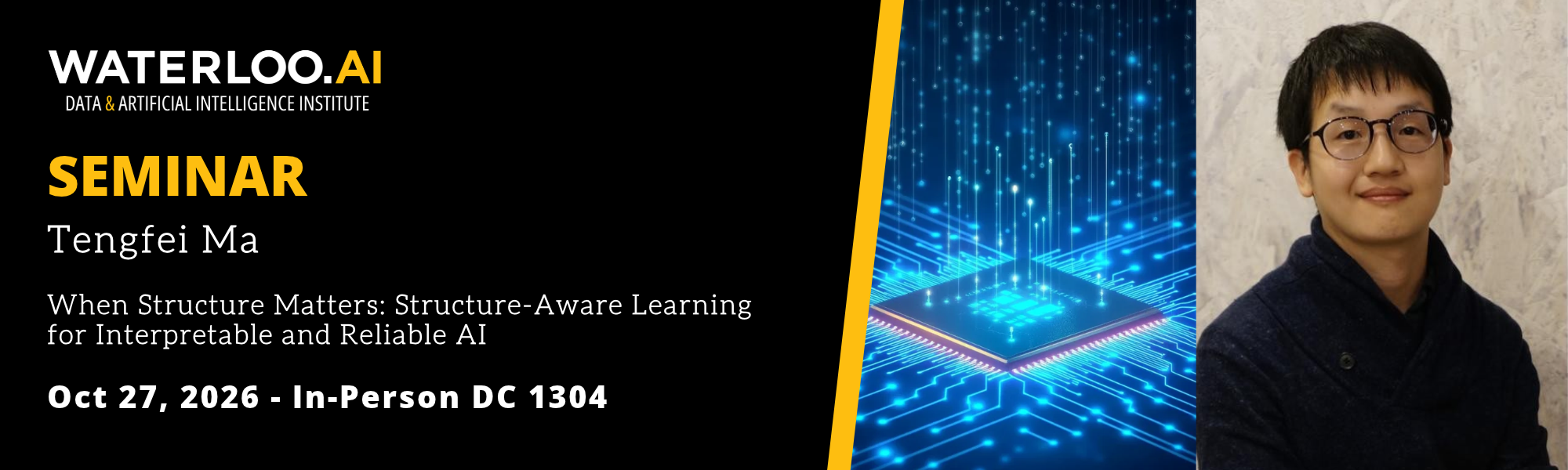
Date: Tuesday, October 27, 2026
Time: 10:00AM - 11:30AM
Location: DC 1304
Title: When Structure Matters: Structure-Aware Learning for Interpretable and Reliable AI
Abstract: Modern AI models are increasingly applied to complex data such as time series, graphs, and electronic health records, where important information lies not only in individual observations but also in their underlying structure. However, simply exposing models to structure is not enough; our findings show that large language models make surprisingly limited use of graph structure in their inputs. In this talk, Tengfei will present his recent work on structure-aware learning, spanning temporal patterns in time series, relationships among concepts and medical codes, and causal dependencies among variables. These studies point to a common conclusion that structure is useful only when model representations and computations are designed to exploit it. Finally, he will conclude by discussing how designing algorithms that truly understand structures can contribute to more interpretable and reliable AI systems.
Bio: Tengfei Ma is an Assistant Professor in the Department of Biomedical Informatics at Stony Brook University. His research spans machine learning, natural language processing, and computational healthcare, with a particular focus on graph learning and on leveraging structural information to develop more reliable and interpretable models for biomedical applications. Before joining Stony Brook University, he was a Staff Research Scientist at the IBM T. J. Watson Research Center. He received his Ph.D. from the University of Tokyo and also spent a year as a researcher at IBM Research-Tokyo. He earned his master’s degree from Peking University and his bachelor’s degree from Tsinghua University. He has published more than 90 papers in leading AI and machine learning venues, including the early influential contributions to graph neural networks, such as FastGCN and EvolveGCN. He also received the Best Research Paper Award at ISWC 2021.