News

Filter by:

Limit to news where the title matches:
Limit to items where the date of the news item:
Date range
Limit to news items where the audience is one or more of:

AI coding agents use a distinctive style of English. The terms exist in software engineering and other technical areas, but how frequently Claude uses them, the way it combines them and the compressed style it uses are distinctive. Professor Yuntian Deng, from the Cheriton School of Computer Science at the University of Waterloo created a translator to help readers better understand Claude’s information-dense outputs. Professor Deng answers some questions about Claudish and his new translator, which has received over a million views on X.   

Read the full story

Safety protections built into some of the world's most widely used artificial intelligence (AI) models can be stripped away with alarming ease, according to a new international study. 

The research team, led by the University of Waterloo and FAR.AI, a non-profit AI security research group, rigorously tested 21 of the most popular open-weight large language models (LLMs) and found they could all be tampered with despite their built-in safeguards. 

The holes in even the best protections currently available raise concerns open-weight models could be used to wage mass disinformation campaigns, create sophisticated email scams or produce step-by-step instructions to make hazardous chemicals. 

Read the full story

A University of Waterloo student who dreamed of becoming an astronaut just raised $5 million to revolutionize home appraisals with AI. Discover how an unexpected co-op twist and a chance family conversation launched him into the startup world.

Click here to read article

University of Waterloo researchers are using AI and machine learning to predict how fires behave in modern homes, where energy-efficient construction and new furniture materials create deadly conditions unknown to traditional fire safety codes. The system could transform how emergency responders tackle evacuations, building codes are designed, and toxic smoke hazards are managed.

Read the full story

University of Waterloo researchers have launched ULYSSES Climate Intelligence, an AI-enabled platform that helps companies protect their supply chains by providing early warning alerts and comprehensive risk data for extreme climate events. The venture combines decades of climate science expertise with practical business tools to help organizations move from reactive crisis management to strategic climate adaptation and resilience.

Read the full story

The University of Waterloo and Cohere, a Canadian AI company, are partnering to launch a new AI Transformation and Change Management certificate program designed to equip students with practical skills for helping organizations adopt AI securely and responsibly. Starting in January 2027, the program will offer 20 co-op positions giving students hands-on experience working directly with private, public sector and non-profit organizations on real AI transformation challenges.

Read the full story

The Tang Family Foundation donated $500,000 to Waterloo.AI to support graduate research in embodied AI, AI systems that perceive and act in the physical world through sensors and actuators (like robots), as opposed to purely text-based AI.

The inaugural cohort of eight graduate students from the faculties of Engineering and Math each received $15,000 scholarships to support their research. Their work spans robotics, exoskeletons, control systems, and the ethical questions around AI operating near people.

Waterloo.AI Director Dr. Stephen Smith explained the value of directing philanthropic funding toward students specifically: it gives them more time to focus on foundational research, which is where real long-term impact lies.

Roger Tang, founder of the Tang Family Foundation, sees embodied AI as the next major step in industrial development and views philanthropy as well-suited to backing high-risk foundational research that commercial markets later scale. He has had a growing relationship with Waterloo since establishing a Chair in New Energy Materials and Sustainability in 2023.

A second round of scholarships is expected to open in the fall.

Saturday, August 1, 2026

The case for AI people really trust

Rather than competing on the size of AI models, Canada can lead the global AI revolution by educating engineers and leaders who build trustworthy systems from the ground up. The Waterloo Engineering dean argues that if every graduate gained real-world experience deploying AI safely in organizations, Canada would create one of the world's most trusted and AI-ready workforces.

Read the full story

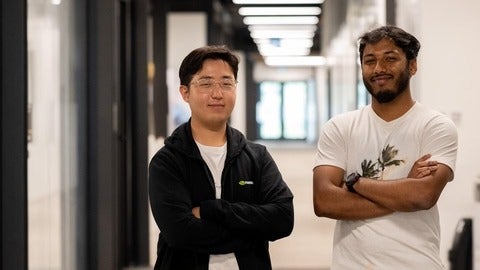
As artificial intelligence (AI) learns to write code, it still struggles to test firmware without access to physical hardware. For University of Waterloo founders Seungmin Hong (BASc ’26) and Ahnaf Shahriar (BASc in progress), that challenge represented an opportunity.

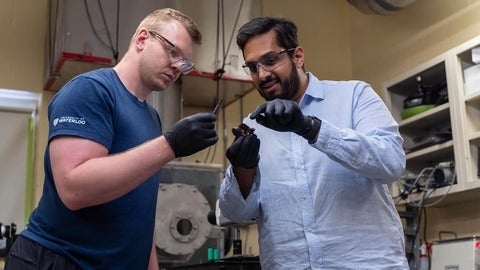
As artificial intelligence (AI) drives a global surge in data centres in Canada and around the world, a less visible but increasingly urgent challenge is growing alongside it. Researchers are beginning to investigate ways to manage the risks posed by the lithium-ion batteries that keep those facilities running.