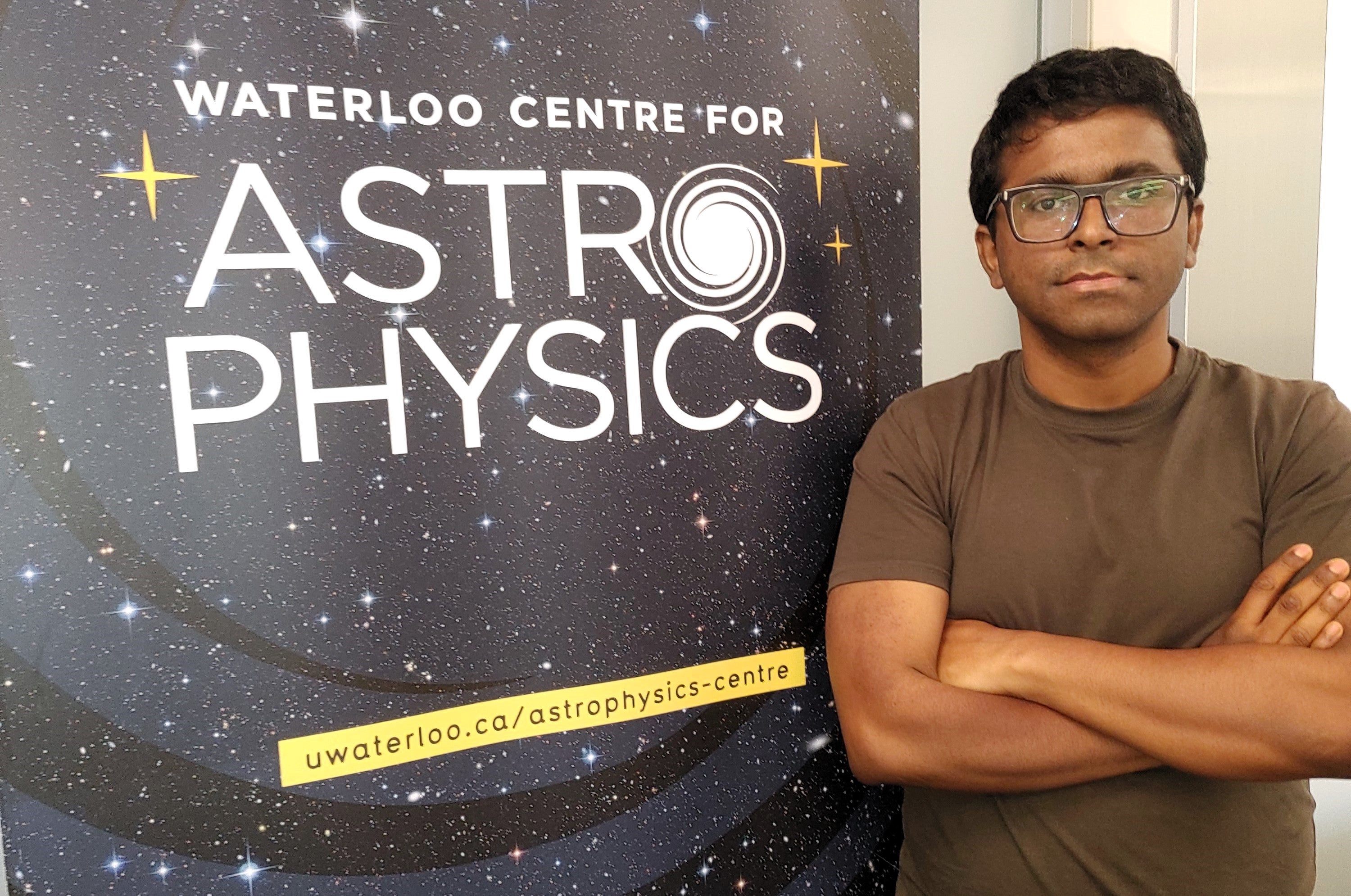
Dr Anwesh Majumder was awarded his Bachelors (2014-2017) and Masters in Physics (2017-2019) with astro specialisation from Presidency University, Kolkata, India. After that, he moved to University of Amsterdam for his PhD (2019-2025). Anwesh followed that up with a short Scientist C position at Space Research Organisation Netherlands (March 2025-May 2025) before moving to Waterloo to take up a joint position with the WCA and Brian McNamara.
Anwesh uses the XRISM X-ray telescope to understand how supermassive black holes affect the environment of galaxy clusters. XRISM provides us with a unique opportunity to study X-ray emission from gas using high-resolution spectroscopy, which allows us to study gas motion of few hundred km/s for the first time. XRISM will enable us to study the turbulent mode of energy injection by the central black hole. Anwesh routinely uses Chandra and XMM-Newton telescope data in hos work as well. He plans to expand his research horizon by working with optical and radio data during his time at the WCA.
Title: The role of turbulence in galaxy clusters: A XRISM perspective
Abstract: Galaxy clusters represent the fossil record of billions of years of accumulated physics driving the formation and evolution of large-scale structure in the Universe. Shocks from mergers, as well as the effects from any central active galactic nuclei (AGN), can heat the intracluster medium (ICM) to temperatures of 10 keV. Over the last twenty years, telescopes like Chandra and XMM-Newton constrained energy injection due to shocks, cavities and sound waves in cluster atmospheres. Their high angular resolution and sensitivity made them particularly suitable for understanding these classes of energy injection mechanisms. However, their low spectral energy resolution (100 eV) made them unsuitable to study the role of gas motions and turbulence. As a result, how much turbulence contributes to the total energy budget remained unknown until the launch of the XRISM telescope. In this talk, I will briefly present recent XRISM results on gas motions in Centaurus cluster, Hydra A, Cygnus A and discuss implications on the role of turbulence in galaxy cluster.